
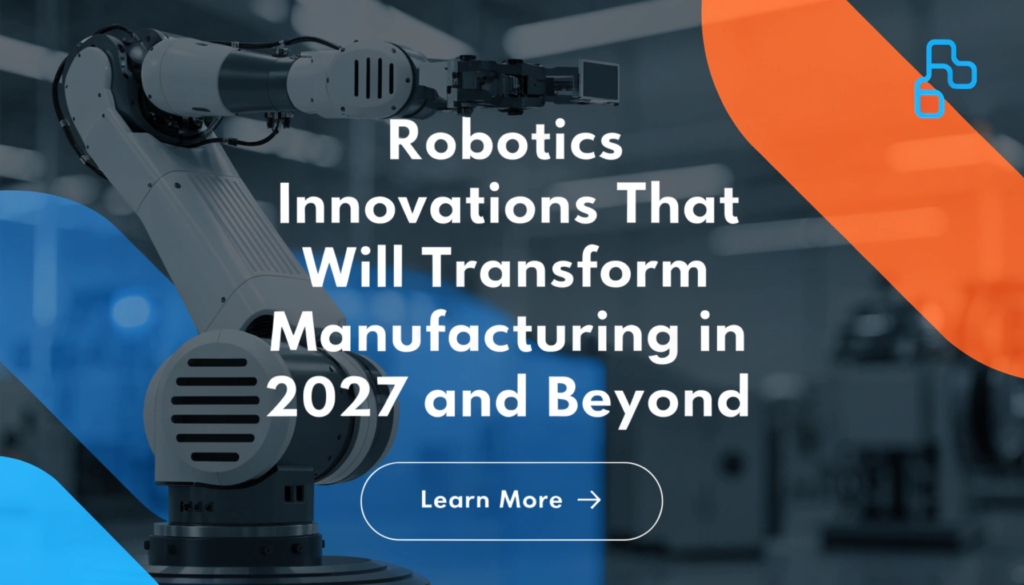
The factory floor is entering a new era. Robotics is no longer limited to repetitive welding, assembly, packaging, or material-handling tasks. Advances in artificial intelligence, machine vision, sensors, software, and autonomous systems are making robots more adaptable, intelligent, and capable of working alongside people.
The global momentum behind robotics demonstrates how quickly the technology is expanding. According to the International Federation of Robotics (IFR), more than 542,000 industrial robots were installed worldwide in 2024, with annual installations exceeding 500,000 units for the fourth consecutive year. The global operational stock reached approximately 4.66 million robots. (International Federation of Robotics)
As manufacturers prepare for 2027 and beyond, the biggest opportunity is not simply installing more robots. It is building factories where robotics, AI, data, and human expertise work together.
This is why manufacturing robotics 2027 will increasingly focus on flexibility, intelligence, autonomous decision-making, and seamless integration.
Here are seven robotics innovations likely to have the biggest impact on the factory floor over the next three years.
1. AI-Powered Robots Will Become More Intelligent
One of the most important developments shaping manufacturing robotics 2027 is the integration of artificial intelligence directly into robotic systems.
Traditional industrial robots typically follow predefined instructions. They can perform highly precise tasks repeatedly, but changing the task often requires reprogramming and engineering support.
AI is changing this model.
Modern robotic systems are increasingly being combined with machine learning, computer vision, generative AI, and advanced perception technologies. Instead of simply repeating a fixed sequence, robots can increasingly interpret their environment and respond to variations.
For example, an AI-enabled robot could identify different components moving along a conveyor, determine their orientation, select the correct component, and perform an appropriate operation.
This creates opportunities for manufacturers operating high-mix, low-volume production environments where traditional automation can be difficult to justify.
The IFR has identified physical, analytical, and generative AI as major robotics trends, highlighting the industry’s movement toward more intelligent and adaptable automation. (International Federation of Robotics)
Over the next three years, manufacturers should expect AI to become increasingly embedded into robot controllers, vision systems, programming interfaces, and production software.
The result will be factories where robots are not simply machines executing instructions but intelligent systems capable of responding to changing production conditions.
2. Collaborative Robots Will Move Into More Complex Applications
Collaborative robots, commonly known as cobots, are another major part of the future of manufacturing robotics 2027.
Unlike traditional industrial robots that often operate inside dedicated safety cells, cobots are designed to work more closely with human operators under appropriate safety conditions.
Their appeal is particularly strong for small and medium-sized manufacturers because they can often be deployed for specific tasks without requiring a complete production-line redesign.
Cobots are already being used for applications such as machine tending, assembly, inspection, packaging, screwdriving, and material handling.
However, the next generation will become more capable.
Better sensors, improved force control, AI-powered perception, and easier programming will allow cobots to perform tasks requiring greater precision and adaptability.
For example, a worker could handle a complex part while a cobot performs repetitive fastening or inspection activities. Instead of replacing the worker completely, the robotic system becomes a productivity partner.
This human-machine collaboration is likely to become one of the most practical industrial automation trends for manufacturers that want to improve productivity without completely rebuilding existing operations.
3. Autonomous Mobile Robots Will Connect the Entire Factory
Robotic automation is moving beyond fixed workstations.
Autonomous mobile robots, or AMRs, can navigate production environments and transport materials, components, tools, and finished products between different areas of a facility.
Unlike traditional automated guided vehicles that generally follow predetermined routes, modern AMRs can use sensors, cameras, mapping technologies, and software to navigate dynamic environments.
Imagine a production facility where an AMR automatically receives a digital request for components. It travels to the warehouse, collects the required materials, navigates around workers and equipment, and delivers the components directly to the production line.
That can reduce unnecessary walking, improve material flow, and give employees more time to focus on higher-value activities.
The bigger opportunity comes when AMRs communicate with manufacturing execution systems, warehouse systems, robots, and production schedules.
This creates a connected material-flow ecosystem rather than isolated automation projects.
As factories become increasingly digital, mobile robotics could therefore become a critical part of industrial automation trends, particularly in facilities dealing with complex layouts and frequent production changes.
4. Machine Vision Will Make Robots Better at Quality Control
Quality inspection is one of the areas where robotics and AI are expected to make significant progress.
Traditional inspection often depends on human operators identifying defects manually or on highly specialized automated inspection systems.
AI-powered machine vision provides another option.
Modern vision systems can capture images and use AI models to identify patterns, irregularities, surface defects, incorrect assembly, missing components, and other quality problems.
When machine vision is integrated directly with robotic systems, inspection can become an active part of the production process.
For example, a robotic system could pick up a component, rotate it, inspect multiple surfaces using cameras, identify a defect, and automatically separate the defective item from acceptable products.
This creates a closed-loop quality process.
The system does not simply detect a problem. It can potentially provide data that helps manufacturers identify where and why the problem occurred.
For industries producing electronics, automotive components, medical devices, aerospace parts, and precision machinery, this could become especially valuable.
As manufacturing robotics 2027 develops, machine vision will increasingly be viewed as a core capability rather than an optional accessory.
5. Digital Twins Will Help Manufacturers Test Robots Before Deployment
One of the biggest challenges associated with automation is the cost and risk of implementing new systems.
Manufacturers cannot afford significant production downtime simply to discover that a robotic cell does not perform as expected.
Digital twins offer a way to reduce this risk.
A digital twin creates a virtual representation of a physical machine, production line, or facility. Engineers can use simulations to evaluate robot movements, production flows, cycle times, equipment interactions, and potential bottlenecks before making changes to the physical factory.
For robotics, this can significantly improve planning.
Manufacturers can simulate the position of a robot, test different layouts, evaluate potential collisions, and optimize movement sequences before installing equipment.
This becomes even more powerful when real-world production data is continuously connected to the digital model.
Engineers can compare expected performance with actual performance and identify opportunities for improvement.
Digital twins therefore fit naturally into the broader industrial automation trends surrounding connected factories, predictive analytics, and smart manufacturing.
By 2027, manufacturers increasingly may use simulation as a standard stage of automation planning rather than something reserved for large transformation projects.
6. Humanoid and Multi-Purpose Robots Will Enter Selected Factory Applications
Humanoid robots are attracting enormous attention, but manufacturers should separate long-term potential from immediate practical applications.
Humanoid robots are being developed to operate in environments designed for humans. Their human-like form could potentially allow them to use existing workstations, tools, storage areas, and equipment without requiring major infrastructure changes.
The technology is developing rapidly, but widespread factory adoption is not guaranteed within the next three years.
Current limitations include cost, reliability, dexterity, safety, battery life, and the ability to consistently perform complex industrial tasks.
Recent reporting has highlighted that humanoid robots remain far from replacing conventional industrial robots for many factory applications. (Reuters)
That does not mean manufacturers should ignore them.
Instead, companies should monitor targeted applications such as material handling, basic inspection, machine tending, and other repetitive tasks.
The more realistic scenario for manufacturing robotics 2027 is that humanoids begin appearing in selected pilot projects while conventional robotic arms, cobots, and AMRs continue to dominate established industrial applications.
The technology could become particularly interesting if AI advances allow robots to learn new physical tasks faster and operate with less programming.
7. Robots Will Become Part of a Connected Automation Ecosystem
Perhaps the most important innovation is not a specific type of robot.
It is the integration of robots into the wider digital factory.
Historically, manufacturers often purchased automation equipment as individual systems. A robotic arm might operate independently from the manufacturing execution system, warehouse software, quality platform, or enterprise planning tools.
The future is different.
Factories are increasingly moving toward interconnected automation environments where machines exchange data and coordinate activities.
A production order could trigger material movement by an AMR, activate a robotic workstation, update inventory levels, initiate automated quality inspection, and send production information to management dashboards.
This creates a factory where automation is coordinated rather than isolated.
Cloud platforms, edge computing, industrial IoT, AI, robotics software, and manufacturing systems will increasingly work together.
For manufacturers, this means the question will shift from:
“Which robot should we buy?”
to:
“How should robotics fit into our entire manufacturing ecosystem?”
That shift will be central to manufacturing robotics 2027.
What These Robotics Innovations Mean for Manufacturers
The next three years will not simply be about buying more robotic equipment. They will be about making automation more intelligent, flexible, connected, and accessible.
The IFR reports that the number of industrial robots installed globally in 2024 was more than double the level of a decade earlier, demonstrating the long-term expansion of factory automation. (International Federation of Robotics)
However, technology alone will not determine which manufacturers succeed.
Companies will need to consider workforce training, cybersecurity, data infrastructure, integration capabilities, safety, maintenance, and return on investment.
This is particularly important for smaller manufacturers. Automation does not necessarily require a complete factory transformation on day one. Companies can begin with targeted use cases where robots solve clear operational problems.
For example, a manufacturer could automate repetitive material handling first, then introduce machine vision, followed by predictive maintenance and integrated production analytics.
This step-by-step approach can create measurable improvements while building internal expertise.
Workforce development will also become increasingly important. As robots handle more repetitive physical tasks, employees will need stronger capabilities in robotics programming, maintenance, data analysis, AI systems, and automation management.
The future factory will therefore not necessarily be a factory without people.
It will be a factory where people focus increasingly on decision-making, engineering, problem-solving, system supervision, and continuous improvement while robots perform repetitive, dangerous, or highly precise activities.
Preparing for the Factory Floor of 2027
Manufacturers that want to stay competitive should start preparing now.
The first step is identifying processes where robotics can deliver measurable business value. Look beyond labor savings and consider quality improvements, production consistency, downtime reduction, workplace safety, throughput, and flexibility.
The second step is evaluating whether existing infrastructure can support connected automation. Robotics becomes significantly more powerful when machines, production systems, sensors, and data platforms can communicate effectively.
The third step is preparing employees for the transition. Training operators and maintenance teams can help companies capture more value from automation investments while reducing implementation challenges.
Finally, manufacturers should monitor emerging technologies without automatically adopting every new solution.
Not every factory needs humanoid robots. Not every process requires AI. And not every automation challenge requires a large-scale investment.
The strongest strategy is to combine proven robotics with emerging technologies where they create a clear operational advantage.
Conclusion
The factory floor of 2027 will look significantly different from today’s production environment.
AI-powered robots will become more adaptable. Cobots will work alongside employees in increasingly sophisticated applications. Autonomous mobile robots will transform material movement. Machine vision will strengthen quality control. Digital twins will make automation planning more precise. Humanoid robots will begin testing selected industrial applications, while connected automation platforms will bring everything together.
Together, these technologies will define the next stage of manufacturing robotics 2027.
The manufacturers that benefit most will not necessarily be those that deploy the largest number of robots. They will be the companies that understand where robotics creates genuine business value and build the people, processes, data infrastructure, and technology ecosystem needed to support it.
As these industrial automation trends accelerate, now is the time for manufacturing leaders to evaluate their automation roadmap, identify emerging opportunities, and prepare for a more intelligent factory.
Want to connect with the manufacturing technology ecosystem and showcase your solutions?
Register as a Vendor
Register as a Vendor – Smart Manufacturing & Automation Convention 2027