
Healthcare facilities depend on complex infrastructure and critical equipment to deliver safe, uninterrupted patient care. From HVAC systems and medical gas systems to elevators, generators, imaging equipment, pumps, and electrical infrastructure, every component has an important role. When one of these systems fails unexpectedly, the consequences can extend far beyond repair costs. Equipment downtime can disrupt clinical operations, increase maintenance expenses, affect patient comfort, and potentially create safety risks.
This is where predictive maintenance healthcare strategies are becoming increasingly important. Instead of waiting for equipment to fail or replacing components according to a fixed schedule, predictive maintenance uses real-time data, sensors, analytics, and technology to identify potential problems before they become serious failures.
For modern healthcare organizations, predictive maintenance is not simply a maintenance strategy. It is becoming an important part of efficient hospital facility management, helping facility teams improve reliability, manage costs, optimize resources, and create safer and more resilient healthcare environments.
What Is Predictive Maintenance in Healthcare?
Predictive maintenance is a technology-driven approach that monitors the condition and performance of equipment to determine when maintenance is actually required. In healthcare facilities, it can be applied to both clinical and building infrastructure.
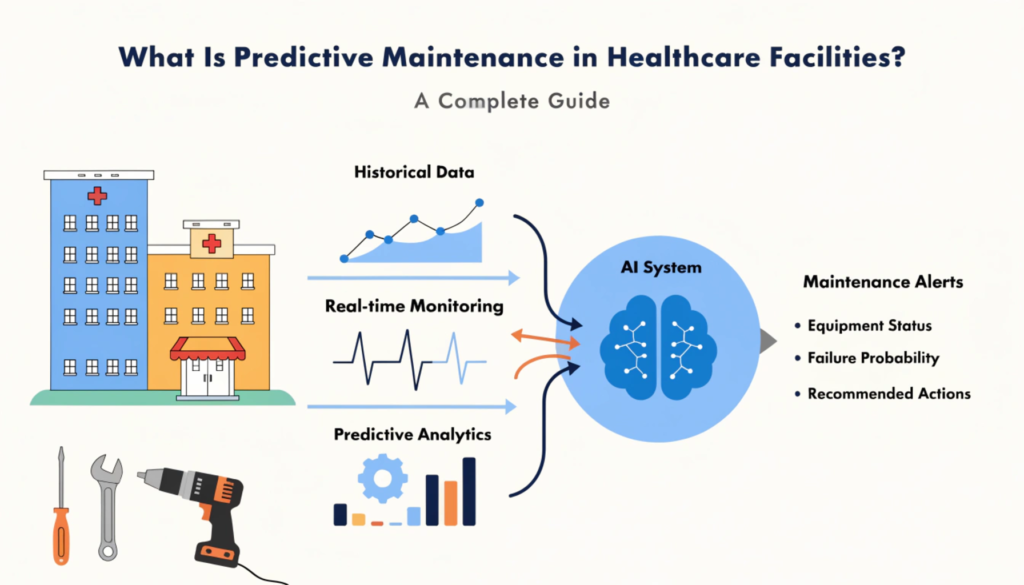
Traditional preventive maintenance generally follows a fixed schedule. For example, a facility team may inspect an HVAC unit every three months regardless of its actual condition. Predictive maintenance takes a different approach. Sensors and monitoring systems continuously collect information such as temperature, vibration, pressure, energy consumption, humidity, and equipment performance.
Analytics platforms can then evaluate this information to identify unusual patterns. If the system detects an indication that a motor, pump, compressor, or other component may be deteriorating, maintenance teams can investigate and address the problem before a major breakdown occurs.
The objective is simple: maintain equipment based on its actual condition rather than relying only on schedules or reacting after failure.
Why Does Predictive Maintenance Matter in Healthcare Facilities?
Equipment reliability is particularly important in healthcare because hospitals operate around the clock. Unlike many commercial buildings, hospitals cannot simply shut down a system for several hours without considering its effect on patients and clinical services.
A failure involving a cooling system, backup generator, air-handling unit, medical gas infrastructure, or electrical system can have significant operational consequences. Even relatively minor failures can create uncomfortable or unsafe conditions for patients and staff.
Predictive maintenance helps facility managers move from reactive maintenance toward a more proactive model. Instead of discovering a problem after equipment stops working, teams can identify warning signs and schedule corrective action at a suitable time.
This approach can also reduce emergency maintenance, improve equipment availability, and support better long-term planning.
How Does Predictive Maintenance Healthcare Technology Work?
A predictive maintenance program typically combines several technologies rather than relying on a single system.
Sensors are installed on equipment and infrastructure to collect operational data. Depending on the asset, sensors may measure vibration, temperature, pressure, electrical current, humidity, airflow, or other performance indicators.
That information can be transferred to a centralized monitoring platform. Building management systems, computerized maintenance management systems, Internet of Things devices, and other digital platforms can help collect and organize the information.
Analytics tools then examine the data and identify patterns. In more advanced systems, artificial intelligence and machine learning can help recognize abnormal behavior and estimate the likelihood of equipment failure.
For example, imagine an air-handling unit operating normally for several months. Its vibration levels gradually begin increasing while energy consumption also rises. A predictive analytics system could identify this combination as a possible indication of mechanical deterioration.
The facility team can then inspect the unit and potentially replace a worn component during planned maintenance rather than waiting for the system to fail unexpectedly.
Predictive Maintenance vs. Preventive and Reactive Maintenance
Understanding the difference between maintenance strategies is important when developing a healthcare facility maintenance program.
Reactive maintenance occurs after equipment fails. Although it may appear inexpensive because maintenance is performed only when needed, unexpected breakdowns can result in emergency repair costs, operational disruption, and equipment downtime.
Preventive maintenance involves scheduled inspections, servicing, and component replacement. It is more proactive than reactive maintenance but does not always account for the actual condition of equipment.
Predictive maintenance uses equipment data to determine when intervention may be necessary. This allows maintenance teams to focus attention on assets showing signs of deterioration.
In practice, healthcare organizations may use all three approaches. Predictive maintenance does not necessarily replace preventive maintenance completely. Instead, it can make the overall maintenance strategy more intelligent and condition-based.
Key Applications of Predictive Maintenance in Hospitals
Predictive maintenance can be applied across a wide range of healthcare infrastructure.
HVAC and Air-Handling Systems
HVAC systems are essential for temperature, humidity, ventilation, and indoor air quality. Hospitals often have specialized environmental requirements for operating rooms, intensive care areas, laboratories, isolation rooms, and other spaces.
Predictive monitoring can identify issues such as abnormal vibration, declining airflow, excessive energy consumption, or unusual temperature patterns. Early detection can help facility teams address problems before they cause major HVAC failures.
Backup Generators and Electrical Systems
Reliable electricity is critical for hospitals. Backup generators, electrical distribution systems, uninterruptible power supplies, and other infrastructure must be available when required.
Predictive monitoring can track parameters such as battery condition, engine performance, temperature, fuel systems, and electrical behavior. Detecting deterioration early can help reduce the risk of unexpected failures during power interruptions.
Pumps and Water Systems
Hospitals rely on pumps for water supply, heating, cooling, and other infrastructure functions. Mechanical problems can gradually develop through bearing wear, imbalance, or other issues.
Vibration and performance monitoring can provide early indications of potential problems and allow maintenance teams to intervene before the pump fails.
Elevators and Critical Building Equipment
Elevators are important for moving patients, staff, visitors, equipment, and supplies throughout hospitals. Predictive monitoring can help identify unusual operating patterns, mechanical deterioration, and other warning signs.
The same principle can be applied to compressors, boilers, chillers, fans, motors, and other critical facility assets.
Benefits of Predictive Maintenance Healthcare Programs
One of the biggest advantages of predictive maintenance is improved equipment reliability. By identifying potential failures early, facility teams can reduce unexpected downtime and improve asset availability.
Another major benefit is cost control. Emergency repairs can be expensive because they may require urgent labor, replacement parts, and service contracts. Planned maintenance provides greater control over scheduling and resources.
Predictive maintenance can also extend asset life. When developing problems are identified early, teams may be able to correct smaller issues before they result in extensive component damage.
Energy efficiency is another important benefit. Equipment operating under abnormal conditions can consume more energy than expected. Monitoring energy patterns can help identify inefficient assets and support corrective action.
For hospital facility management, these benefits can contribute to a more organized and data-driven maintenance operation.
The Role of IoT in Predictive Maintenance
The Internet of Things has become an important component of modern predictive maintenance systems.
IoT sensors can continuously collect information from equipment and building systems. Instead of relying only on manual inspections, facility managers can gain access to real-time or near-real-time operational information.
For example, connected sensors can monitor HVAC temperature and pressure, motor vibration, equipment energy consumption, or environmental conditions. This information can be integrated into dashboards that allow facility teams to monitor multiple assets from a centralized location.
The growing use of connected devices means healthcare facilities can develop more comprehensive digital maintenance environments where equipment performance is continuously monitored.
Artificial Intelligence and Machine Learning
Artificial intelligence and machine learning can take predictive maintenance to a more advanced level.
Traditional monitoring may trigger an alert when a measurement exceeds a predefined threshold. AI-based systems can potentially analyze multiple variables simultaneously and identify patterns that are difficult to recognize through manual observation.
For example, a system could examine vibration, temperature, operating hours, energy consumption, and historical maintenance records together. Over time, machine learning models can learn from historical equipment behavior and help identify conditions associated with potential failures.
However, technology should support not replace professional judgment. Facility engineers and maintenance specialists still need to validate alerts, inspect equipment, and determine the appropriate maintenance response.
How to Implement Predictive Maintenance in a Healthcare Facility
Successful implementation requires more than installing sensors. Healthcare organizations should begin by identifying their most critical assets.
Not every piece of equipment needs the same level of monitoring. Facility managers can prioritize assets based on factors such as criticality, failure history, replacement cost, operational impact, and safety considerations.
The next step is establishing a reliable data infrastructure. Sensors, building management systems, maintenance software, and other platforms should ideally work together so that facility teams can access useful information without managing disconnected systems.
Organizations should also establish clear response procedures. An alert is only valuable when the maintenance team knows what action to take. Workflows should define who receives alerts, how issues are verified, how work orders are created, and how completed maintenance is documented.
Staff training is equally important. Engineers and technicians need to understand how to interpret monitoring data and distinguish genuine problems from false alarms.
Challenges of Predictive Maintenance
Despite its advantages, predictive maintenance also presents challenges.
Initial investment is one of the biggest considerations. Sensors, software, connectivity, analytics platforms, and integration services may require significant investment, particularly in older facilities.
Data quality can also affect results. Inaccurate sensors, missing information, or inconsistent maintenance records can reduce the effectiveness of predictive models.
Cybersecurity is another important consideration. Connected healthcare infrastructure creates additional digital connections that must be properly protected. Organizations need strong cybersecurity policies, access controls, monitoring, and system governance.
There is also the challenge of integrating new technology with legacy infrastructure. Many hospitals operate equipment installed at different times using different communication standards. Creating a unified monitoring environment can therefore require careful planning.
Measuring the Success of Predictive Maintenance
Healthcare organizations should establish measurable performance indicators before implementing a predictive maintenance program.
Useful metrics may include equipment downtime, emergency maintenance frequency, maintenance costs, mean time between failures, mean time to repair, energy consumption, and asset availability.
Organizations can compare these indicators before and after implementation to determine whether the program is delivering measurable value.
The goal should not simply be to collect more data. The goal is to use data to make better maintenance decisions and improve facility performance.
The Future of Predictive Maintenance in Healthcare
The future of predictive maintenance healthcare is closely connected with the broader digital transformation of healthcare facilities.
As IoT sensors, artificial intelligence, digital twins, cloud platforms, and building automation systems become more sophisticated, facility managers will have greater visibility into infrastructure performance.
Digital twins, for example, can provide virtual representations of physical assets and facilities. When combined with real-time data, these models may help teams understand how equipment and building systems are performing and simulate potential maintenance scenarios.
AI-powered systems may also become better at predicting failures and prioritizing maintenance tasks according to risk and operational impact.
This evolution will encourage healthcare organizations to view facilities as interconnected digital environments rather than collections of individual assets.
Building a Smarter Healthcare Facility
Predictive maintenance is ultimately about more than preventing equipment failures. It is about creating a healthcare environment where facility teams can make informed decisions before problems become emergencies.
By combining sensors, IoT connectivity, analytics, maintenance management systems, and engineering expertise, hospitals can move toward a more proactive and efficient maintenance model.
For healthcare leaders, the priority should be to begin with critical assets, establish reliable data processes, train maintenance teams, and gradually expand the program as measurable benefits become visible.
As healthcare facilities become more technologically advanced, predictive maintenance will increasingly become an important part of hospital facility management. Organizations that invest in proactive asset management today can strengthen operational resilience, improve resource utilization, and build facilities that are better prepared for the demands of tomorrow.
Explore the Future of Smart Healthcare Facilities
The transformation of healthcare facilities is being driven by connected infrastructure, automation, data analytics, intelligent maintenance, and emerging technologies. Industry professionals can explore the latest ideas, strategies, and innovations shaping modern healthcare environments.
Explore convention topics and discover opportunities to learn more about the future of smart healthcare facilities.