
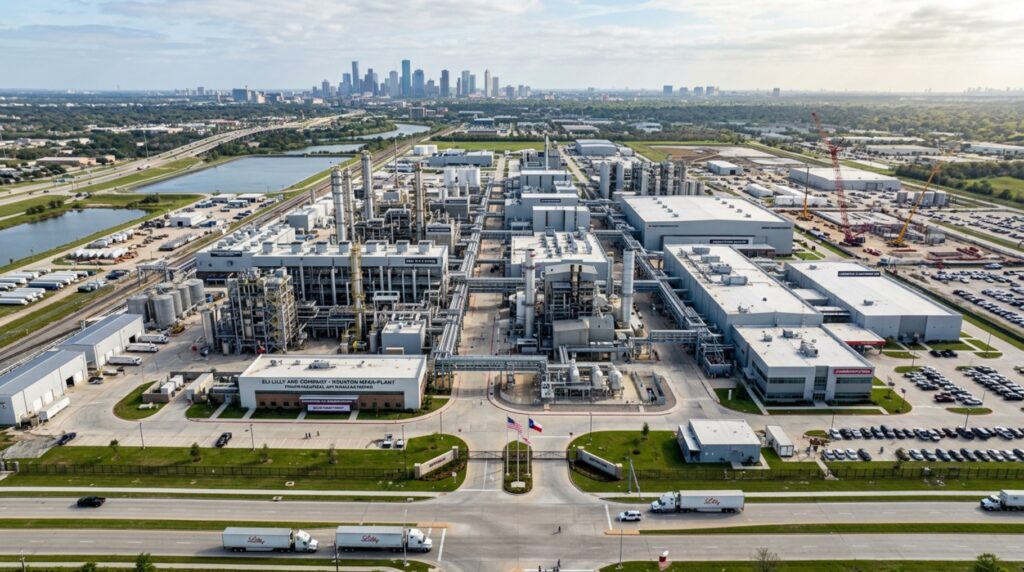
In September 2026, global pharmaceutical powerhouse Eli Lilly and Company officially broke ground on an unprecedented $6.5 billion advanced medicine manufacturing complex in Houston, Texas. Representing one of the largest single biomanufacturing capital investments in American history, this state-of-the-art mega-campus is precision-engineered to produce high-potency active pharmaceutical ingredients (APIs) centering primary production on Foundayo (orforglipron), Lilly’s highly anticipated synthetic oral non-peptide GLP-1 receptor agonist designed for chronic weight management and type 2 diabetes care. Generating over 600 high-wage permanent technical careers, approximately 4,000 skilled construction jobs, and committing $15 million directly to local workforce training programs, the flagship project establishes a monumental milestone for pharmaceutical API manufacturing USA. This major facility expansion highlights a turning point in bio-industrial infrastructure, reinforcing domestic critical supply chains while driving regional economic prosperity.
For executive leaders, plant managers, and supply chain directors across North American healthcare and industrial sectors, Lilly’s Houston groundbreaking carries profound strategic significance. For decades, the Western pharmaceutical ecosystem relied heavily on overseas chemical synthesis networks across China and India for primary active ingredients, leaving critical healthcare supply chains acutely vulnerable to trade tensions, export restrictions, and international maritime shipping delays. Eli Lilly’s $6.5 billion capital commitment directly combats these systemic vulnerabilities, standing as a premier cornerstone of U.S. manufacturing investment 2026. By establishing robust domestic chemical synthesis infrastructure, life sciences companies can achieve greater resilience, faster product delivery, and elevated quality control standards.
Deconstructing Eli Lilly’s $6.5 Billion Houston Investment
The Houston manufacturing site is an integral pillar of Eli Lilly’s broader $50 billion domestic manufacturing reshoring initiative, launched to secure essential medicine production within the United States. While earlier phases focused on expanding injectable peptide manufacturing and sterile fill-finish operations across Indiana, North Carolina, and Wisconsin, the Houston facility is designed specifically for complex small-molecule chemical synthesis and advanced oral therapeutics. This multi-site strategy ensures end-to-end operational coverage across both biological and chemical manufacturing vectors, positioning the company to respond agilely to shifting patient populations and dynamic healthcare demands.
Unlike peptide-based weight loss medications (such as injectable tirzepatide or semaglutide) that require complex recombinant biologic fermentation, multi-step purification, and continuous cold-chain refrigerated distribution networks, Foundayo is a synthetic small-molecule oral pill. Producing this daily tablet on a global scale demands massive chemical reactor capacity, advanced continuous crystallization technologies, automated high-potency solvent handling, and AI-integrated quality control systems capable of synthesizing millions of doses daily. The technical shift toward small-molecule GLP-1 alternatives opens unprecedented opportunities for high-volume commercial scaling and improved therapeutic adherence worldwide.
The Oral GLP-1 Market Paradigm Shift
The emergence of oral GLP-1 receptor agonists represents a tectonic shift in the treatment landscape for metabolic health, obesity, and type 2 diabetes. While injectable GLP-1 and GIP therapies have demonstrated extraordinary clinical efficacy, their widespread global adoption faces physical bottlenecks. Sterile injectable production involves delicate aseptic filling, specialized glass syringe sourcing, auto-injector assembly, and unbroken temperature-controlled distribution from the factory floor to the patient pharmacy.
In contrast, oral formulations like Foundayo offer a scalable alternative that leverages traditional solid-dose manufacturing principles enhanced by modern automated chemistry. By transitioning patient maintenance therapies to oral dosage forms, pharmaceutical companies can bypass cold-chain bottlenecks, reduce secondary packaging requirements, and drastically lower freight overhead. Furthermore, patient compliance significantly improves when daily oral pills replace weekly subcutaneous self-injections, accelerating market penetration across primary care settings globally.
Key Drivers Behind the Reshoring of Active Pharmaceutical Ingredients
Lilly’s decision to commit multi-billion-dollar domestic capital reflects critical commercial, geopolitical, and operational priorities that resonate across the wider manufacturing landscape:
1. National Security and Drug Shortage Prevention
The global medicine shortages experienced over recent years exposed the extreme fragility of offshore API supply chains. Critical lifesaving therapies were repeatedly stalled when single-source foreign chemical foundries faced regulatory shutdowns, localized contamination issues, or power supply disruptions. By establishing domestic pharmaceutical API manufacturing USA capabilities, Eli Lilly insulates essential public health treatments from geopolitical volatility, international trade disputes, and currency fluctuations. Localized manufacturing ensures uninterrupted domestic supply chains even during global trade shocks or geopolitical realignments.
2. The Scalability Advantage of Oral Small-Molecule Formulations
While demand for injectable GLP-1 weight-loss medications has overwhelmed global manufacturing capacity for three consecutive years, patient compliance is often hindered by weekly needle injections and mandatory refrigeration requirements. Developing an oral pill eliminates cold-chain logistics friction, syringe component manufacturing delays, and pen-injector hardware shortages. Scaling synthetic oral GLP-1 production domestically allows Lilly to satisfy surging worldwide demand with a shelf-stable, easily transportable therapeutic format that dramatically simplifies international market distribution.
3. Digital Integration and AI-Driven Continuous Flow Chemistry
Traditional pharmaceutical production relies heavily on batch processing, where chemicals move sequentially between separate vessels with long delays for intermediate quality testing. Lilly’s Houston facility incorporates continuous flow chemistry and process analytical technology (PAT). Near-infrared sensors, automated inline chromatography, and digital twin control software monitor reaction kinetics continuously, enabling real-time batch release and slashing synthesis timelines by more than 60% while elevating product quality consistency.
4. Environmental Sustainability and Operational Efficiency
Modern reshoring mandates advanced environmental management. The Houston facility incorporates state-of-the-art closed-loop solvent recovery systems, zero-liquid-discharge (ZLD) wastewater treatment plants, and energy-efficient processing units powered by regional renewable energy contracts. By drastically reducing chemical waste streams and localized energy usage, the complex serves as a global standard for clean, sustainable high-potency active ingredient synthesis in the life sciences industry.
Workforce and Regional Economic Ecosystem Multipliers
A $6.5 billion industrial development produces profound economic ripples across Texas, the Gulf Coast region, and the national biomanufacturing landscape. Beyond direct capital expenditures, major facility investments stimulate localized service sectors, create specialized trade demand, and accelerate regional innovation ecosystems:
- Institutional Workforce Partnerships: Recognizing that advanced biomanufacturing requires specialized technical acumen, Lilly committed $12.5 million directly to San Jacinto College for dedicated biomanufacturing training infrastructure alongside $2.5 million in STEM scholarships. This partnership establishes a continuous local pipeline of certified chemical operators and validation engineers.
- Synergy with the Texas Medical Center (TMC): Locating the manufacturing campus in greater Houston establishes immediate physical proximity to the world’s largest medical complex. This geographic clustering accelerates clinical trial collaboration, rapid commercialization feedback loops, and direct engagement with top-tier academic medical researchers.
- Catalyzing the Chemical Supply Chain: The facility generates immense ongoing demand for regional Texas chemical processors, high-purity industrial gas suppliers, specialized cleanroom contractors, hazardous waste management specialists, and cold-chain pharmaceutical logistics providers throughout the Gulf Coast corridor.
- Construction and Infrastructure Stimulus: With roughly 4,000 trade construction workers on site during peak development phases, the project injects massive liquidity into regional hospitality, equipment rental, engineering consulting, and commercial real estate markets.
Strategic Takeaways for Industrial and Life Science Executives
As corporate leadership teams chart their long-term capital deployment strategies heading into 2027 and beyond, Eli Lilly’s Houston project offers four vital strategic insights for optimizing industrial operations and supply chain resilience:
- Reshoring Must Pair with Advanced Automation: High domestic labor costs cannot be overcome by simply rebuilding legacy factories on American soil. Global cost competitiveness requires investing in continuous flow automation, robotic material transfer, and AI-driven quality validation.
- Co-Invest Early in Regional Educational Infrastructure: Finding hundreds of specialized technical workers requires active, upfront corporate investment in community colleges and vocational institutions to build bespoke training curricula before plant commissioning.
- Design for Sustainable Chemical Operations: Lilly’s facility design incorporates closed-loop solvent recovery distillation, zero-liquid-discharge (ZLD) wastewater treatment, and renewable electricity sourcing, proving that heavy chemical synthesis can align with rigorous corporate decarbonization goals while maintaining high efficiency standards.
- Build Flexible and Modular Infrastructure: Designing plant architecture around modular processing suites and skid-mounted continuous reactors allows manufacturing facilities to rapidly reconfigure lines for new drug candidates without requiring full facility retrofits or multi-year downtime.
Conclusion: Pioneering American Biomanufacturing Leadership
Eli Lilly’s $6.5 billion groundbreaking in Houston, Texas, marks a transformative turning point in American industrial history and global life sciences strategy. By re-establishing world-class domestic pharmaceutical API manufacturing USA capacity, the company secures critical health supply chains, scales groundbreaking oral therapeutics for metabolic disease, and demonstrates the profound economic power of U.S. manufacturing investment 2026. As industrial leaders look toward the future, the Houston mega-plant offers a clear blueprint for combining advanced digital automation, regional workforce development, and sustainable chemical synthesis to build resilient domestic supply chains.
Explore Advanced Manufacturing Trends at BMA Conventions
Join executive leaders, life sciences pioneers, and industrial manufacturing directors at our upcoming national conference.