
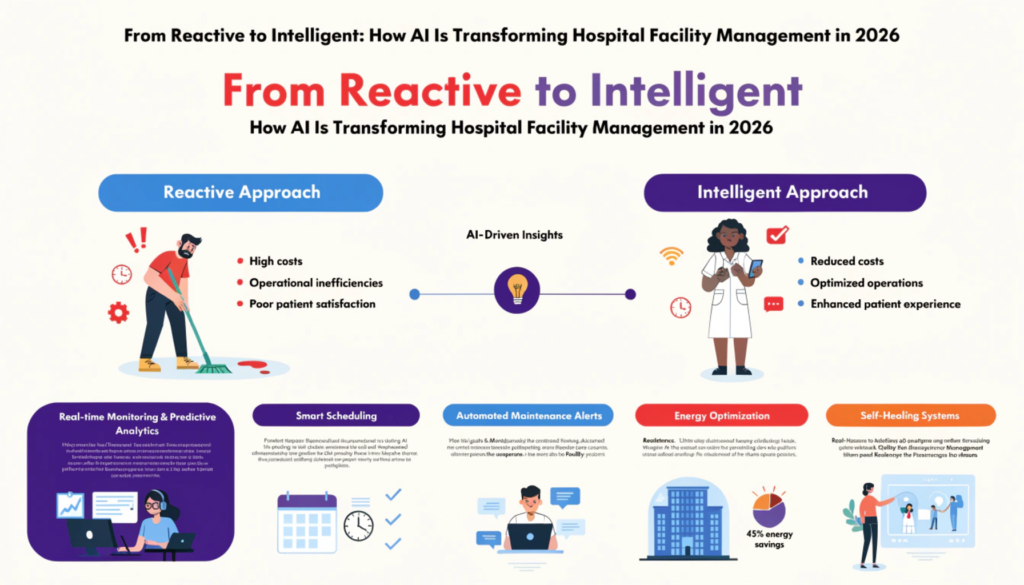
Hospitals operate in an environment where reliability is not optional. A malfunctioning HVAC system can affect infection-control conditions, a power failure can disrupt critical care, and an overlooked maintenance issue can quickly become an operational emergency. For decades, hospitals have relied on traditional facility management approaches built around scheduled inspections, manual monitoring, reactive repairs, and experienced maintenance teams.
In 2026, that model is increasingly being challenged by artificial intelligence. AI-powered systems can analyze equipment data, identify unusual patterns, predict potential failures, optimize energy consumption, and help facility teams make faster decisions. The result is a shift from simply maintaining hospital buildings to managing them as intelligent, connected environments.
This is where AI hospital facility management is becoming increasingly important. Rather than replacing facility professionals, AI is giving them better information and earlier warnings, allowing teams to focus on decisions that require human judgment.
Traditional Facility Management in Hospitals: How It Works
Traditional hospital facility management depends heavily on preventive maintenance schedules and manual processes. Equipment is inspected at predetermined intervals, maintenance is performed according to manufacturer recommendations, and technicians respond when problems are reported or detected.
This approach has clear advantages. It is familiar, relatively straightforward to implement, and supported by decades of operational experience. Skilled facility managers understand the behavior of hospital infrastructure and can often identify problems through observation, sound, temperature, vibration, or equipment history.
However, traditional maintenance has an important limitation: it is usually based on time rather than actual equipment condition.
A chiller may receive maintenance every three months even if its condition is excellent, while another piece of equipment could begin deteriorating shortly after its scheduled inspection. Similarly, a technician may only discover a developing problem after an alarm, breakdown, or complaint occurs.
For hospitals, these limitations can translate into higher maintenance costs, unexpected downtime, inefficient energy use, and additional pressure on already busy engineering teams.
What Changes With AI Hospital Facility Management?
AI changes the maintenance model by allowing facility teams to move from periodic monitoring toward continuous analysis.
Modern hospitals generate enormous quantities of operational data. Building management systems, HVAC controls, sensors, energy meters, medical equipment interfaces, access systems, and other connected technologies continuously produce information.
AI can process this data much faster than a human team could manually review it. Algorithms can compare current operating conditions with historical patterns and identify anomalies that may indicate a developing issue.
For example, an AI system could identify that a cooling system is consuming more electricity than normal while producing the same output. A facility manager may then investigate the equipment before the problem becomes a major failure.
The value is not simply automation. The bigger advantage is early visibility.
Instead of asking, “What failed today?” facility teams can increasingly ask, “What is likely to fail next, and what should we do about it?”
Predictive Maintenance vs. Scheduled Maintenance
One of the clearest differences between AI-enabled and traditional facility management is maintenance strategy.
Scheduled maintenance operates according to predefined intervals. If an air-handling unit requires inspection every six months, the maintenance team follows that schedule regardless of whether the equipment is operating normally.
Predictive maintenance uses equipment condition and performance data to determine when intervention may be necessary.
This distinction matters because hospital infrastructure rarely operates under identical conditions throughout the year. Equipment loads can change according to occupancy, weather, operating schedules, expansions, and clinical requirements.
AI can account for these changing conditions and identify patterns that are difficult to detect through conventional inspections.
In practice, this does not mean hospitals should eliminate preventive maintenance. Instead, the most effective approach in 2026 is often a combination of preventive, predictive, and condition-based maintenance.
The Role of Healthcare Operations AI
Facility management does not operate independently from clinical and administrative functions. Building conditions influence patient comfort, staff productivity, infection control, operating-room performance, pharmaceutical storage, and many other areas.
This is why healthcare operations AI is becoming broader than equipment monitoring.
AI can help connect facility information with operational requirements. For example, occupancy data can be used to optimize heating, cooling, and ventilation. Energy consumption can be analyzed alongside building schedules. Maintenance priorities can be adjusted based on the criticality of particular spaces or assets.
A hospital’s emergency department, operating rooms, intensive care areas, laboratories, and general administrative spaces do not have identical infrastructure requirements. AI-supported systems can help facility teams prioritize resources according to operational importance.
The objective is not simply to make buildings smarter. It is to make hospital operations more coordinated.
What the Data Says About Efficiency
Energy is one of the largest controllable operating costs in many healthcare facilities. Hospitals operate around the clock and often require intensive heating, cooling, ventilation, lighting, and water systems.
Traditional facility management can identify obvious sources of waste, but AI can continuously analyze building performance.
An AI system may detect that a particular zone is being conditioned despite low occupancy, that HVAC equipment is operating outside an efficient range, or that energy consumption has deviated from historical patterns.
This creates an opportunity for facility teams to optimize systems without compromising clinical requirements.
Importantly, energy optimization in healthcare must be approached differently from energy optimization in ordinary commercial buildings. Hospitals cannot simply reduce ventilation or change environmental conditions whenever energy consumption rises. Patient safety, infection prevention, regulatory requirements, and clinical processes must remain the priority.
AI therefore works best as a decision-support layer that identifies opportunities while allowing qualified professionals to determine whether changes are appropriate.
AI Can Help Reduce Unplanned Downtime
Unplanned equipment failure is one of the biggest concerns for hospital facility teams.
A failed generator, cooling system, air-handling unit, elevator, electrical component, or critical infrastructure system can create operational disruption. Depending on the equipment, a failure may affect patient care directly or force departments to activate contingency procedures.
Traditional systems often detect failures through alarms or inspections. AI attempts to identify the conditions that precede those failures.
For example, changes in vibration, temperature, pressure, electrical consumption, or operating cycles may provide early signals of equipment deterioration. AI models can compare those signals against historical behavior and flag abnormal conditions.
The earlier a problem is identified, the more options facility teams have.
Instead of dealing with an emergency repair, a hospital may be able to schedule maintenance during a lower-risk period, order replacement parts in advance, and coordinate downtime with affected departments.
The Human Factor Still Matters
The rise of AI does not mean hospital facility managers are becoming unnecessary.
In fact, the opposite may be true. As technology becomes more sophisticated, experienced professionals remain essential for interpreting recommendations and deciding what actions should be taken.
AI can identify an unusual temperature pattern. A technician understands whether that pattern is actually abnormal.
AI can predict that a component has an increased probability of failure. A facility manager decides whether the component should be replaced immediately, monitored more closely, or evaluated alongside other evidence.
This human-AI relationship is particularly important in healthcare because facility decisions can have consequences beyond cost and efficiency.
The strongest AI hospital facility management strategies therefore focus on augmentation rather than complete replacement of human expertise.
Data Quality Is a Major Challenge
AI is only as useful as the information available to it.
Hospitals often have a mixture of modern and legacy systems. Different buildings may use different controls platforms, sensors, databases, and maintenance software. Some equipment may produce detailed digital data while older assets may provide limited information.
Poor-quality, incomplete, inconsistent, or disconnected data can reduce the accuracy of AI models.
Hospitals considering AI should therefore begin with data infrastructure rather than simply purchasing an AI platform. Building automation systems, computerized maintenance management systems, energy monitoring, asset databases, and sensor networks need to communicate effectively.
Data governance is equally important. Organizations need clear rules for data ownership, access, security, retention, and quality.
Cybersecurity Cannot Be an Afterthought
Connecting more hospital infrastructure to digital systems creates additional cybersecurity considerations.
A modern facility may include network-connected HVAC controls, building automation systems, energy meters, access controls, elevators, security systems, and other operational technologies.
The more connected the environment becomes, the greater the importance of cybersecurity.
Hospitals should evaluate how AI platforms connect to operational technology networks, who can access system information, how software updates are handled, and what happens if an AI service becomes unavailable.
AI adoption should therefore be accompanied by strong cybersecurity governance and appropriate access controls.
The Financial Case for AI
The business case for AI in facility management is not based on technology alone. Hospitals need to determine whether an investment produces measurable operational value.
Potential benefits can include reduced emergency maintenance, better asset utilization, improved energy performance, fewer disruptions, better workforce productivity, and longer equipment life.
However, implementation also carries costs. These can include sensors, software licenses, system integration, training, cybersecurity improvements, data infrastructure, and ongoing support.
For this reason, hospitals should avoid attempting to transform every facility system simultaneously.
A focused pilot can be more effective. A hospital could begin with high-value equipment such as chillers, boilers, air-handling units, pumps, or electrical infrastructure. The organization can then measure performance before expanding the program.
Measuring Success in 2026
Hospitals should establish clear performance indicators before implementing AI.
Useful measures may include mean time between failures, emergency work orders, preventive maintenance compliance, energy consumption, maintenance costs, equipment availability, response time, and downtime.
The objective is to establish a baseline and determine whether AI is producing measurable improvement.
For example, if a hospital introduces predictive monitoring for its cooling infrastructure, it should track equipment failures, maintenance interventions, energy performance, and downtime before and after implementation.
This makes the technology investment easier to evaluate and helps facility leaders communicate results to executives.
AI vs. Traditional Management: Which Is Better?
The comparison is not as simple as choosing one model over the other.
Traditional facility management remains valuable because it provides experienced personnel, established maintenance procedures, inspections, regulatory compliance, and practical knowledge of hospital infrastructure.
AI adds a new capability: continuous analysis at scale.
Traditional systems may tell a team that equipment needs maintenance according to a schedule. AI can potentially tell the team that a specific piece of equipment is behaving differently from its normal pattern.
The most effective hospital strategy in 2026 is therefore likely to be a hybrid model.
People provide expertise, accountability, judgment, and operational context. AI provides data analysis, pattern recognition, forecasting, and automated alerts.
Together, they can create a more proactive facility management operation.
What Hospital Leaders Should Expect Next
The next stage of hospital facility management will likely involve deeper integration between building systems, maintenance platforms, energy management, occupancy information, and operational workflows.
AI will increasingly move beyond isolated dashboards toward systems capable of recommending actions and prioritizing work.
For facility leaders, the important question is no longer simply whether AI should be adopted. The more useful question is where AI can solve a clearly defined operational problem.
Hospitals should begin with measurable challenges, establish reliable data, involve facility professionals, and introduce AI in manageable stages.
The goal should not be to make every hospital system “AI-powered.” The goal should be to make hospital facilities safer, more reliable, more efficient, and easier to manage.
Conclusion
The difference between traditional facility management and AI-enabled management is ultimately a difference in how organizations use information.
Traditional approaches remain essential, but they are often reactive or schedule-driven. AI introduces continuous monitoring, predictive insights, anomaly detection, and data-driven decision support.
For hospitals operating under constant pressure to improve reliability and control costs, AI hospital facility management offers a pathway toward more proactive operations.
At the same time, healthcare operations AI should not be viewed as a replacement for experienced facility teams. Its greatest value comes from helping those teams see problems earlier, prioritize work more effectively, and make decisions using a broader view of operational data.
As hospitals continue investing in smart infrastructure in 2026 and beyond, the organizations that combine advanced technology with strong human expertise will be best positioned to build resilient, efficient, and patient-focused facilities.
View all upcoming BMA events: https://bmaconventions.com/smart-healthcare-facilities-convention/