
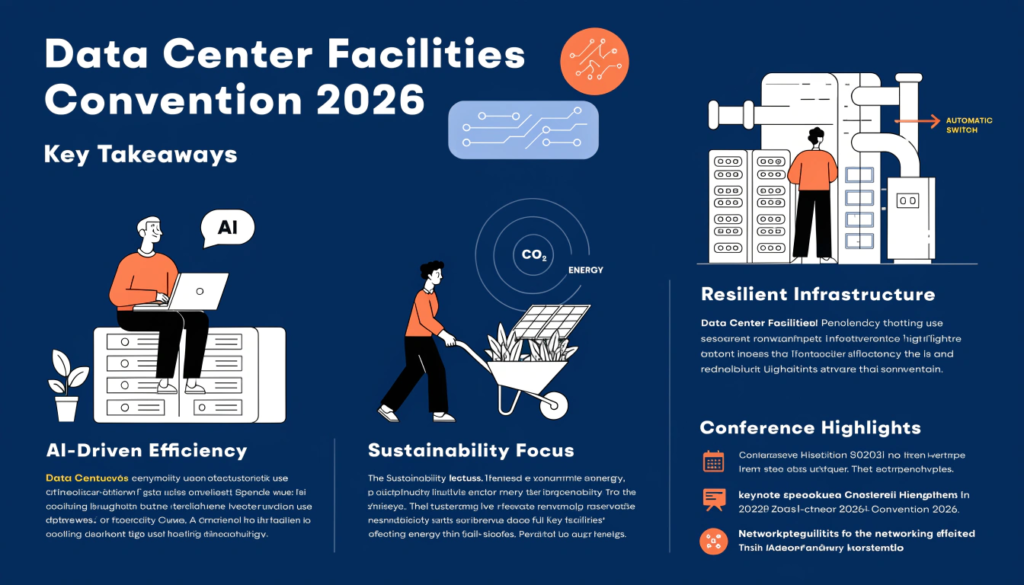
The data center industry is entering a period of rapid transformation. Artificial intelligence, high-density computing, energy constraints, sustainability targets, cybersecurity risks, and the need for faster capacity expansion are changing how facilities are designed and operated. Against this backdrop, the Data Center Facilities Convention 2026 is set to bring together industry leaders, technology providers, facility professionals, and decision-makers to discuss the challenges and opportunities shaping the next generation of data center infrastructure.
Note: The 2026 convention is scheduled for November 17–19, 2026, so the event has not yet taken place. The following Data Center Facilities Convention recap 2026 is therefore framed around the key themes and takeaways expected from the published convention agenda rather than claiming that post-event discussions have already occurred. (BMA Conventions)
Why the Data Center Facilities Convention 2026 Matters
Data centers are no longer simply facilities designed to house servers. They are becoming highly engineered environments where power, cooling, connectivity, automation, security, sustainability, and operational intelligence must work together.
The growing adoption of AI is accelerating this transformation. AI workloads require substantially greater computing power and create new challenges around rack density, thermal management, power distribution, and infrastructure planning. At the same time, operators must address pressure on electricity grids, environmental expectations, limited resources, cybersecurity threats, and the shortage of skilled professionals.
The convention’s agenda reflects these challenges by focusing on ten major areas, including AI-ready infrastructure, liquid cooling, renewable energy, grid reliability, security, DCIM, capacity management, resilience, workforce development, and modular data center design. (BMA Conventions)
These themes provide a useful picture of where the industry is heading and what data center leaders should be considering in their 2026 planning cycles.
1. AI Is Redefining Data Center Infrastructure
One of the biggest data center conference highlights is expected to be the industry’s response to AI-driven workloads.
Traditional data center infrastructure was not necessarily designed for the high-density computing requirements associated with modern GPU clusters. As AI adoption increases, operators need to rethink rack density, power distribution, airflow, and thermal budgets.
The convention agenda specifically highlights the transition from traditional rack densities toward much higher-density deployments and examines how facilities can prepare for AI-scale workloads. (BMA Conventions)
The key takeaway is straightforward: AI readiness needs to be considered at the facility-design stage rather than added as an afterthought. Data center operators that anticipate future computing requirements can make better decisions about electrical systems, cooling architecture, floor space, and scalability.
2. Liquid Cooling Is Becoming a Strategic Priority
Higher computing density creates higher heat loads, making thermal management one of the industry’s most important challenges.
The convention’s cooling discussions are expected to explore direct liquid cooling and immersion cooling, alongside the energy and water considerations associated with high-density facilities. (BMA Conventions)
For operators, the question is no longer simply whether a facility can remove heat. It is whether cooling systems can deliver reliable performance while controlling energy consumption, water usage, operating costs, and environmental impact.
This makes thermal management a strategic business decision as much as an engineering issue. Organizations planning new AI-ready facilities should evaluate cooling architecture early and consider how systems can adapt as rack densities continue to rise.
3. Sustainability Is Moving Beyond Long-Term Ambitions
Sustainability continues to influence data center investment and operations, but the focus is increasingly shifting from broad environmental commitments to measurable strategies.
The convention agenda places significant emphasis on renewable energy, carbon-free operations, energy efficiency, and pathways toward carbon-neutral or carbon-negative data centers. It also highlights the move toward 24/7 carbon-free energy procurement rather than relying solely on annual carbon matching. (BMA Conventions)
This signals an important shift. Sustainability is becoming integrated into decisions around power procurement, facility design, cooling, energy management, and operational performance.
For data center leaders, the lesson is that sustainability should be treated as part of infrastructure strategy. Renewable power agreements, energy-efficient technologies, advanced cooling, and intelligent monitoring can support both environmental objectives and long-term operational efficiency.
4. Power Reliability Will Remain a Major Challenge
AI expansion and increasing digital demand are placing additional pressure on power infrastructure. Data centers need enormous quantities of reliable electricity, while grid constraints, aging infrastructure, and supply uncertainty can make expansion more difficult.
Power and grid reliability is therefore another major theme in the 2026 agenda. The convention is expected to examine grid instability, battery energy storage, diesel generation, microgrids, and on-site generation as possible strategies for improving energy security. (BMA Conventions)
The broader takeaway is that securing power capacity must become part of early-stage data center planning. Operators cannot assume that sufficient grid capacity will always be available when and where new facilities are needed.
Energy storage, microgrids, and diversified generation strategies could become increasingly important tools for improving resilience while supporting sustainability objectives.
5. Cybersecurity and Physical Security Must Work Together
As data centers become more connected, their security requirements are becoming more complex.
Cybersecurity is no longer limited to traditional IT networks. Building management systems, HVAC controls, operational technology, monitoring platforms, and other connected infrastructure can also create potential vulnerabilities.
The convention’s security agenda focuses on the convergence of cybersecurity and physical security, including risks involving building management systems and OT environments. It also considers compliance requirements and the challenge of meeting multiple security frameworks efficiently. (BMA Conventions)
One of the most important lessons for facility leaders is that security should be approached holistically. IT, OT, physical security, facility management, and cybersecurity teams need stronger coordination to identify risks and develop effective incident-response strategies.
6. Smarter Operations Will Depend on Real-Time Data
Another key area in the Data Center Facilities Convention recap 2026 is expected to be the role of data-driven operations.
Data Center Infrastructure Management (DCIM), predictive maintenance, real-time analytics, and AI-driven alerting can provide operators with greater visibility into facility performance.
Instead of responding to failures after they occur, operators can increasingly use data to identify warning signs and address problems before they result in downtime. The convention agenda specifically highlights predictive maintenance, AI-driven alerts, and the integration of real-time analytics into network operations workflows. (BMA Conventions)
The takeaway is that smart infrastructure is valuable only when it translates data into actionable decisions. Technology adoption should therefore be connected to clear operational objectives such as reducing downtime, improving maintenance planning, optimizing energy use, and increasing equipment reliability.
7. Capacity Expansion Requires Smarter Planning
Demand for data center capacity continues to grow, but simply building more facilities is not always the answer.
Land availability, permitting, power procurement, infrastructure limitations, and the risk of stranded capacity can make expansion increasingly complex. The convention agenda specifically addresses these challenges in major data center markets, including Northern Virginia. (BMA Conventions)
Operators need to balance current demand with future requirements. Building too little capacity can create constraints, while building excessive capacity can leave expensive infrastructure underutilized.
Campus-based approaches, phased development, flexible infrastructure, and better forecasting can help organizations manage this balance. Capacity planning is therefore becoming a long-term strategic discipline rather than a simple construction exercise.
8. Resilience Must Account for Climate and Extreme Weather
Business continuity has always been central to data center operations, but resilience planning is evolving as extreme weather and environmental risks become more significant.
Flooding, storms, grid stress, water availability, and other climate-related challenges can affect critical infrastructure. The convention’s resilience discussions are expected to explore facility hardening, disaster recovery, climate risk, and business continuity planning. (BMA Conventions)
This reinforces the importance of designing for real-world conditions rather than relying solely on traditional uptime assumptions.
Resilient data centers need robust backup power, disaster recovery procedures, physical protection, water-risk planning, and tested continuity strategies. Operators should regularly review whether existing infrastructure and emergency plans remain suitable for evolving environmental risks.
9. The Data Center Skills Gap Needs New Solutions
Technology alone cannot operate a modern data center. Skilled professionals are essential for managing increasingly complex electrical, mechanical, digital, security, and energy systems.
The 2026 convention agenda recognizes workforce development as a major industry issue. It highlights apprenticeships, community college partnerships, fast-track training, and retraining professionals who have experience with legacy systems. (BMA Conventions)
The takeaway is that workforce strategy should develop alongside infrastructure strategy.
As facilities adopt AI, advanced cooling, battery storage, renewable energy, automation, and sophisticated monitoring systems, employees need opportunities to develop new technical capabilities. Organizations that invest in training can strengthen operational resilience while reducing dependence on an increasingly limited talent pool.
10. Modular Design Could Accelerate Data Center Development
Speed is becoming a major competitive factor in data center construction. At the same time, projects must maintain reliability, quality, and scalability.
Modular and prefabricated construction could help address these competing demands. The convention agenda explores modular data center designs, containerized capacity, prefabrication, and shorter construction timelines. (BMA Conventions)
The broader lesson is that standardization can create advantages beyond construction speed. Modular approaches can support repeatable designs, predictable quality, scalability, and more efficient deployment.
For organizations facing rapidly changing capacity requirements, modular infrastructure may provide greater flexibility than traditional construction models.
What These Data Center Conference Highlights Mean for Operators
Taken together, the key themes of the convention point toward a data center industry that is becoming more interconnected.
AI affects power and cooling. Cooling decisions affect sustainability. Sustainability affects energy procurement. Energy reliability affects resilience. Digital connectivity affects cybersecurity. Automation affects workforce requirements. Capacity planning influences every one of these areas.
This means data center leaders can no longer evaluate infrastructure decisions in isolation.
The most successful facilities of the future will likely be those designed around an integrated approach that combines high-density computing, reliable power, advanced cooling, renewable energy, intelligent operations, strong security, resilient infrastructure, and skilled teams.
The Data Center Facilities Convention 2026 provides a valuable platform for professionals to explore these interconnected challenges and consider practical approaches to building more efficient, secure, resilient, and future-ready facilities. Its published agenda reflects many of the issues that will influence data center strategy as AI and digital infrastructure demand continue to grow. (BMA Conventions)
Looking Ahead to 2027
The biggest lesson from the 2026 agenda is that the data center sector is moving toward a more intelligent, sustainable, and adaptable operating model. AI-ready infrastructure, liquid cooling, renewable energy, advanced analytics, cybersecurity convergence, resilience, workforce development, and modular construction are not isolated trends. Together, they represent a fundamental change in how data centers will be planned and managed.
For facility managers, engineers, technology providers, energy professionals, and senior decision-makers, staying ahead of these developments will be essential.
Register interest for 2027 and stay connected with future conversations shaping the data center industry.