
Healthcare facilities operate around the clock, making sustainability a more complex challenge than it is for many other types of buildings. Hospitals require continuous lighting, heating, cooling, ventilation, medical equipment, water supply, sterilization systems and critical infrastructure. At the same time, facility managers must maintain patient safety, infection control, comfort and regulatory compliance.
This is where sustainable building certifications such as LEED can provide a structured framework. For healthcare organizations looking to reduce environmental impact while improving operational performance, LEED certification hospital strategies can offer a practical way to connect building design, energy management, water efficiency, indoor environmental quality and long-term facility performance.
For facility managers, LEED is not simply a design-stage certification. It can influence how a hospital is operated, maintained, renovated and improved throughout its lifecycle. Understanding the certification process and its operational implications can therefore help facility leaders make better investment decisions and build more resilient healthcare environments.
What Is LEED Certification for Hospitals?
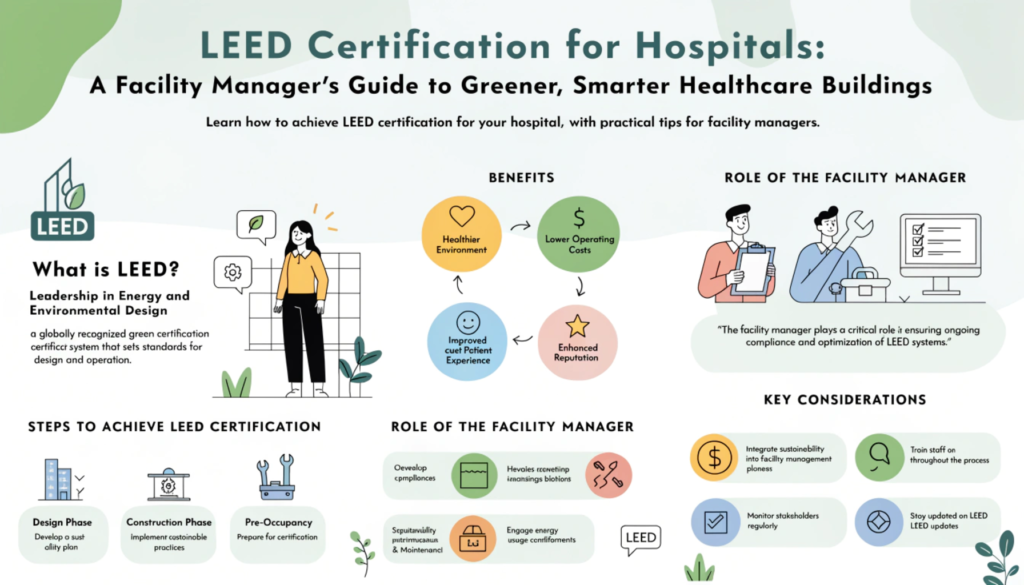
LEED, or Leadership in Energy and Environmental Design, is a green building rating system developed by the U.S. Green Building Council (USGBC). It evaluates buildings against a range of sustainability and performance criteria.
For hospitals, LEED can be applied to new construction, major renovations and certain existing building operations, depending on the project and applicable rating system.
The goal is not simply to make a hospital consume less energy. A successful sustainable healthcare project must balance environmental performance with the unique requirements of healthcare delivery.
A hospital cannot compromise ventilation, temperature control, lighting, infection prevention or critical power simply to reduce consumption. Instead, facility managers need to identify ways to improve efficiency while preserving clinical performance and patient safety.
This makes LEED certification hospital planning particularly relevant to healthcare facility leadership.
Why LEED Matters for Healthcare Facilities
Hospitals are among the most energy-intensive building types. They often operate 24/7 and contain equipment and systems that must remain functional regardless of occupancy levels.
Energy efficiency can therefore have a significant impact on operating costs. Improvements to HVAC systems, lighting, building controls and equipment can reduce unnecessary consumption while maintaining required environmental conditions.
Sustainability can also support broader organizational goals. Healthcare providers are increasingly looking at carbon reduction, resource efficiency, resilience and healthier indoor environments as part of their long-term strategies.
LEED provides a recognizable framework for addressing these objectives.
For facility managers, the value of LEED can extend beyond the certification itself. A well-planned sustainable building can provide better visibility into energy and water performance, encourage preventive maintenance and create opportunities for continuous operational improvement.
Understanding Green Hospital Building Standards
Modern green hospital building standards go beyond adding energy-efficient equipment. They take a more holistic approach to how healthcare buildings are designed and operated.
A green hospital may consider energy consumption, water use, materials, waste, transportation, indoor air quality, thermal comfort and the surrounding site.
The healthcare environment makes these considerations particularly important. For example, indoor air quality is not simply a sustainability issue. It can directly affect comfort and the performance of clinical environments.
Similarly, water efficiency must be approached carefully because hospitals have significant water requirements for sanitation, sterilization, cooling and patient services.
Therefore, green hospital building standards need to be adapted to the operational realities of healthcare rather than treated as a generic commercial-building checklist.
Key LEED Areas Facility Managers Should Understand
LEED evaluates buildings through multiple categories. While the exact requirements depend on the applicable rating system and project type, several areas are particularly important for healthcare facility managers.
Energy and Atmosphere
Energy performance is one of the most important considerations for hospitals.
Facility managers should understand where the building consumes the most energy and which systems provide opportunities for improvement. HVAC systems, lighting, pumps, chillers, boilers and medical-support infrastructure can all contribute significantly to energy demand.
Building automation systems can help facility teams monitor equipment performance and identify abnormal consumption. Scheduling systems can also reduce unnecessary operation in spaces where occupancy varies.
However, energy-saving measures should always be evaluated against clinical requirements. A system that saves energy but compromises required ventilation or temperature conditions is not an appropriate healthcare solution.
Water Efficiency
Hospitals can consume substantial amounts of water every day. Efficient fixtures, cooling systems, irrigation strategies and leak detection can help reduce unnecessary consumption.
Facility managers should also consider water monitoring. Knowing where and when water is being used makes it easier to identify unusual consumption and potential leaks.
Water conservation strategies should be designed with hygiene and infection-control requirements in mind. Healthcare facilities have unique sanitation needs, so efficiency measures should never undermine patient or staff safety.
Indoor Environmental Quality
Indoor environmental quality is especially important in hospitals because patients, clinicians, visitors and support staff may spend significant amounts of time inside the building.
Lighting, thermal comfort, acoustics and indoor air quality can influence the experience of occupants.
Facility managers have an important operational role in maintaining these conditions. HVAC filters, ventilation equipment, sensors and controls require regular monitoring and maintenance.
A building may perform well at the time of certification but deteriorate if systems are poorly maintained. This is why facility management should be integrated into sustainability planning from the beginning.
Materials and Resources
Construction and renovation projects generate substantial amounts of waste. Healthcare facilities can also use large quantities of consumable materials during daily operations.
LEED encourages responsible approaches to materials and resources, including waste management and consideration of material impacts.
For facility managers, this can create opportunities to improve recycling, waste segregation and procurement practices. Renovation projects can also incorporate strategies for reducing construction waste.
The most effective approach is to connect sustainability goals with procurement and operational policies rather than treating them as isolated construction requirements.
Site and Transportation
The location and design of a healthcare campus can influence transportation, stormwater management and the surrounding environment.
Facilities can consider pedestrian access, public transportation connections, bicycle infrastructure, parking strategies and landscaping.
Stormwater management is another important consideration. Sustainable site strategies can help reduce runoff and support better management of rainfall.
For large hospital campuses, these measures can become part of a broader strategy for creating a more resilient and environmentally responsible healthcare environment.
How Facility Managers Can Prepare for LEED Certification
Facility managers should become involved early rather than waiting until the final certification stage.
The first step is to understand the project’s sustainability objectives and identify how operational teams will contribute. Facility staff often have detailed knowledge of how the building actually functions, making their input valuable during design and renovation planning.
Next, managers should establish a baseline for energy, water and operational performance. Without reliable baseline data, it becomes difficult to measure improvement.
Data collection can include utility consumption, equipment performance, HVAC operation, maintenance records and building automation information.
Documentation is also important. Sustainable projects involve multiple teams, including architects, engineers, contractors, sustainability professionals and facility personnel. Clear documentation can help demonstrate that required strategies have been implemented and are being maintained.
Training should also be part of the plan. A sophisticated building automation system cannot deliver its full value if facility staff do not understand how to operate and maintain it.
LEED Certification Is Not the End of the Process
One of the biggest misconceptions about sustainable building certification is that certification represents the end goal.
For facility managers, certification should instead be viewed as a foundation for ongoing performance.
A hospital’s energy use can change because of occupancy, equipment additions, renovations, operating schedules or changes in clinical services. Equipment can also become less efficient over time.
Continuous monitoring is therefore essential.
Facility teams should regularly review building performance and identify opportunities for optimization. Preventive and predictive maintenance can help equipment operate efficiently while reducing the likelihood of unexpected failures.
This approach also supports resilience. Hospitals cannot afford prolonged interruptions to critical systems, and better monitoring can help facility teams identify developing issues before they become major problems.
The Role of Smart Building Technology
Technology is becoming increasingly important in sustainable healthcare facilities.
Building management systems can provide facility managers with real-time information about HVAC, lighting, energy consumption and other building systems. Sensors can provide occupancy and environmental data, while analytics platforms can help identify patterns and anomalies.
Smart controls can also support more efficient operation. For example, systems can adjust lighting or HVAC settings based on occupancy and predefined requirements.
However, technology should support, not replace, facility management expertise. The most effective smart hospital strategy combines reliable data, well-designed systems and trained personnel.
When technology is integrated into a broader sustainability strategy, it can help hospitals make green hospital building standards more measurable and actionable.
Common Challenges in Achieving LEED Certification
Healthcare organizations may face several challenges when pursuing LEED.
The first is the complexity of hospital operations. Hospitals contain specialized areas with different environmental requirements, making standardized approaches difficult.
Another challenge is the cost of upgrades. Energy-efficient equipment, advanced controls and sustainable materials may require significant upfront investment. Facility managers therefore need to evaluate projects based on lifecycle value rather than initial cost alone.
Data management can also be difficult. Hospitals often have multiple buildings, systems and utility meters. Creating a complete picture of facility performance may require improved monitoring and data integration.
Finally, sustainability initiatives can fail if they are treated as the responsibility of a single department. Successful projects require collaboration among facility management, clinical teams, finance, procurement, engineering, construction and leadership.
How to Build a Long-Term Sustainable Hospital Strategy
A strong sustainability strategy should begin with measurable goals.
Facility managers can start by identifying the building’s largest energy and water consumers, assessing the condition of major equipment and reviewing available performance data.
From there, organizations can prioritize projects based on potential savings, operational impact and clinical requirements.
Rather than attempting to transform the entire facility at once, hospitals can develop a phased roadmap. This might include building automation improvements, HVAC optimization, lighting upgrades, water-efficiency measures, renewable energy opportunities and better waste-management practices.
Staff engagement should also be included. Employees who understand the hospital’s sustainability objectives are more likely to support operational changes.
Over time, the strategy can evolve as new technologies become available and building performance data provides additional insights.
The Business Case for Sustainable Healthcare Buildings
Sustainability is often discussed in terms of environmental responsibility, but it can also contribute to financial and operational objectives.
Reduced energy and water consumption can lower operating expenses. Better building controls can improve system visibility. Preventive maintenance can help extend equipment life and reduce unexpected failures.
There can also be reputational value. Patients, employees, investors and communities increasingly pay attention to organizational sustainability commitments.
For healthcare organizations, a sustainable building can therefore support environmental objectives while contributing to operational resilience and long-term value.
The strongest business case comes from viewing sustainability as an integrated facility-management strategy rather than a standalone certification exercise.
What Facility Managers Should Do Next
For facility managers considering LEED certification hospital initiatives, the most important step is to understand the current state of the facility.
Review energy and water data, identify inefficient systems, assess building controls and examine maintenance practices. From there, establish realistic priorities and measurable performance targets.
It is equally important to bring operational teams into the conversation early. Facility managers understand the practical challenges of maintaining healthcare environments and can help ensure sustainability strategies work in real-world conditions.
As hospitals become smarter and more resource-efficient, the role of facility managers will continue to expand. Sustainability, technology, resilience and operational performance are increasingly interconnected.
Conclusion
LEED certification can provide healthcare organizations with a structured pathway toward more efficient, resilient and environmentally responsible buildings. But the real value comes from what happens beyond certification.
For facility managers, successful LEED certification hospital planning means connecting sustainable design with everyday operations, maintenance, data management and long-term performance.
Understanding green hospital building standards, investing in efficient systems, monitoring performance and training facility teams can help hospitals create buildings that support both environmental goals and high-quality healthcare delivery.
The future of healthcare facilities will not be defined solely by clinical technology. The buildings supporting healthcare will also need to become smarter, more efficient and more resilient. Facility managers are at the center of that transformation.
Nominate for Healthcare Facilities Awards
Is your healthcare facility leading the way in sustainable design, smart building operations or innovative facility management? Nominate for Healthcare Facilities Awards and showcase the people and projects shaping the future of healthcare facilities.