
Introduction
Manufacturers are under constant pressure to produce higher-quality products while controlling costs, improving production speed, and meeting increasingly demanding customer expectations. Traditional quality inspection methods can struggle to keep pace with these requirements, particularly when production lines operate continuously and product variations are difficult to identify with the human eye.
Artificial intelligence is changing this equation. By combining computer vision, machine learning, sensor data, and real-time analytics, manufacturers can identify quality problems earlier and respond before small process variations become expensive defects.
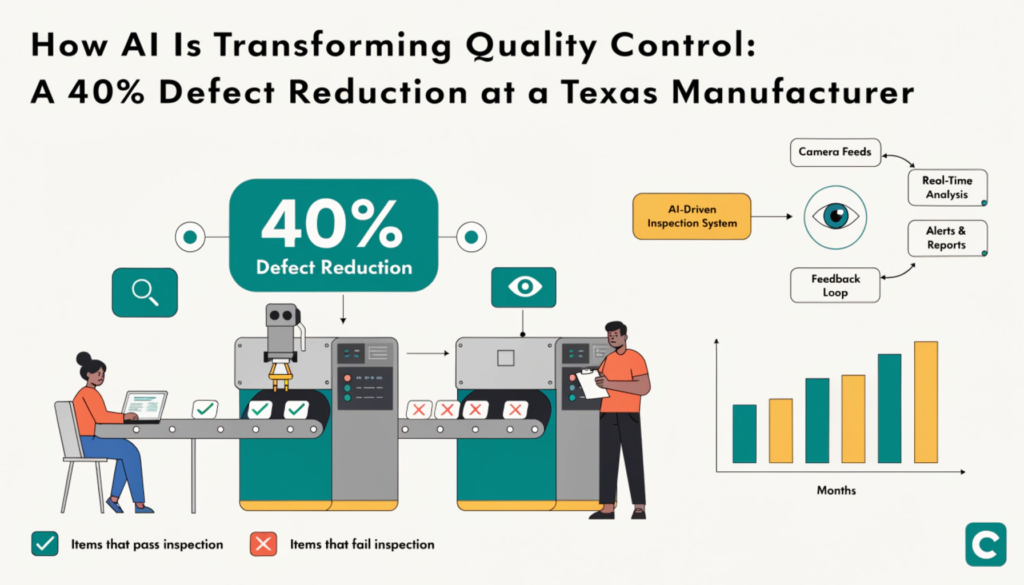
One of the most compelling examples comes from a Texas manufacturing operation that implemented an AI-driven quality control system and achieved a reported 40% reduction in product defects. The experience demonstrates how AI can move quality management from a largely reactive process toward continuous, data-driven improvement.
This AI quality control manufacturing approach is becoming increasingly important for companies looking to build more resilient and competitive production operations.
The Challenge: Quality Control at Production-Line Speed
Before adopting AI, many manufacturing facilities rely on a combination of manual inspections, sampling, measurement equipment, and rule-based systems. These approaches remain valuable, but they can create limitations when production volumes increase.
Human inspectors can identify visible defects and inconsistencies, but fatigue, repetitive tasks, lighting conditions, and production pressure can affect inspection accuracy. Sampling creates another challenge because inspecting only a percentage of products means some defects may pass through undetected.
The Texas manufacturer faced a similar challenge. Its production environment generated large quantities of components, making consistent inspection increasingly difficult. Even when quality teams identified recurring problems, determining exactly when and why those defects occurred could require extensive analysis.
The company needed more than an inspection tool. It needed a system capable of continuously analyzing production data, recognizing patterns, and helping employees intervene earlier.
That requirement created an opportunity for AI.
How AI-Powered Quality Control Works
The foundation of modern AI quality control is the ability to process large volumes of production information much faster than traditional inspection methods.
In an AI-enabled manufacturing environment, cameras can capture detailed images of products as they move along a production line. Machine-learning models can then analyze those images for characteristics associated with defects, such as cracks, scratches, incorrect dimensions, surface abnormalities, assembly errors, or missing components.
AI systems can also combine visual information with data from industrial sensors. Temperature, pressure, vibration, speed, torque, and other operational variables can provide additional clues about why defects are occurring.
Instead of simply identifying a defective product, the system can help manufacturers understand the conditions that contributed to the defect.
This is where AI becomes particularly valuable.
A traditional inspection system may answer the question, “Is this product defective?”
An AI-driven system can potentially help answer:
“What is wrong, how frequently is it happening, and what production conditions are associated with the problem?”
That difference can have a significant impact on manufacturing performance.
The Texas Manufacturer’s AI Transformation
The Texas manufacturer introduced AI-powered inspection into its quality control process to improve the speed and consistency of defect detection.
Rather than completely replacing its existing quality team, the company used AI as an additional layer of intelligence. Automated inspection systems monitored products continuously, while employees remained responsible for reviewing results, investigating significant issues, and making operational decisions.
This human-and-AI model helped the organization increase inspection coverage without requiring a proportional increase in manual inspection resources.
As the system processed more production data, machine-learning algorithms became better at distinguishing acceptable products from products requiring further investigation. Historical quality information also helped identify recurring patterns that were difficult to spot through manual inspection alone.
The result was a reported 40% reduction in defects.
More importantly, the improvement was not simply about catching defective products at the end of the line. Earlier identification enabled production teams to investigate process problems sooner.
That reduced the likelihood of continuing to manufacture products under the same problematic conditions.
Why AI Can Reduce Manufacturing Defects
Several capabilities contribute to the effectiveness of AI quality control manufacturing systems.
Continuous Inspection
AI-powered computer vision can inspect products continuously rather than relying exclusively on periodic manual checks. This increases the amount of production data available to quality teams.
Continuous inspection is particularly useful for high-volume manufacturing environments where even a small defect rate can translate into thousands of problematic units.
Pattern Recognition
Machine learning can identify relationships across large datasets. A defect may not be caused by one obvious factor. Instead, it may result from a combination of machine settings, environmental conditions, material characteristics, and production speed.
AI can analyze these relationships and identify patterns that may otherwise remain hidden.
Real-Time Alerts
Another advantage is speed. When an AI system detects an abnormality, it can generate an alert quickly.
Quality teams can then investigate the issue before the problem affects a much larger production batch.
This changes quality control from a downstream activity into a more proactive manufacturing function.
Consistent Inspection
Human expertise remains essential, but repetitive inspection can be demanding. AI systems can perform repetitive visual checks consistently, helping reduce variations caused by fatigue or workload.
Employees can then focus more heavily on root-cause analysis, process improvement, and complex quality decisions.
A Manufacturing AI Case Study With Broader Lessons
The Texas example can be viewed as a manufacturing AI case study because it illustrates an important principle: successful industrial AI implementation is not primarily about installing sophisticated technology.
It is about solving a measurable business problem.
A manufacturer considering AI should begin by identifying where quality losses are occurring. That might include scrap, rework, customer returns, production stoppages, warranty claims, or inspection bottlenecks.
Once the problem is clearly defined, the organization can determine whether AI is appropriate and what type of data is required.
The Texas experience also highlights the importance of integrating AI with existing manufacturing processes. Quality-control technology delivers greater value when operators, engineers, maintenance teams, and management understand how to interpret its findings and act on them.
AI should therefore be treated as part of a broader operational improvement strategy rather than as a standalone software purchase.
From Defect Detection to Predictive Quality
The most significant opportunity may extend beyond detecting defects.
Manufacturers are increasingly exploring predictive quality control, where AI models analyze process information to identify conditions likely to produce defects before the defective product is created.
Imagine a production line where an AI system recognizes that a particular combination of temperature, machine vibration, and production speed has historically been associated with increased defect rates.
Instead of waiting for finished products to fail inspection, the system can alert the production team when those conditions begin to appear.
This creates a feedback loop:
Production data → AI analysis → early warning → operator intervention → improved quality
Over time, this approach can help manufacturers build a more responsive and adaptive production environment.
The Financial Impact of Better Quality
A 40% reduction in defects can have implications far beyond the quality department.
Every defective product can generate multiple costs, including wasted materials, additional labor, rework, machine time, inspection expenses, shipping costs, and potentially customer-service or warranty costs.
Reducing defects can therefore improve operational efficiency while protecting profit margins.
There can also be indirect benefits. More consistent quality can strengthen customer confidence, reduce delivery disruptions, and help manufacturers meet demanding contractual requirements.
For companies operating in highly competitive markets, these improvements can contribute to a stronger overall manufacturing position.
Challenges Manufacturers Must Consider
Despite its potential, AI implementation is not without challenges.
One major requirement is data quality. Machine-learning systems depend on reliable production information. Poorly labeled images, inconsistent sensor readings, or fragmented historical records can reduce model performance.
Integration can also be complicated. Manufacturing facilities frequently operate with equipment from different generations and vendors. Connecting AI systems with existing machines, manufacturing execution systems, enterprise systems, and quality databases may require careful planning.
Employee adoption is another critical factor.
Workers may initially worry that AI will replace their roles. Successful implementations should instead demonstrate how AI can reduce repetitive tasks and provide employees with better information for decision-making.
Cybersecurity, model monitoring, system maintenance, and ongoing employee training also need to be included in the implementation strategy.
How Manufacturers Can Start With AI Quality Control
Companies do not necessarily need to transform an entire factory at once.
A practical approach is to begin with a high-value, clearly defined quality problem. For example, a manufacturer could select one production line where defect costs are significant and historical data is available.
The organization can then establish a baseline for current performance, introduce an AI pilot, and measure results against clearly defined metrics.
Important measurements can include defect rates, false positives, inspection time, scrap costs, rework hours, throughput, and customer returns.
If the pilot demonstrates measurable value, the organization can gradually expand the technology to additional production lines or facilities.
This approach reduces implementation risk while giving employees an opportunity to learn how AI fits into everyday manufacturing operations.
What the Future Holds for AI-Powered Manufacturing
The Texas manufacturer’s reported 40% defect reduction represents a broader shift taking place across industrial operations.
Quality control is increasingly becoming connected, automated, and predictive. AI can bring together information from cameras, sensors, machines, production systems, and historical quality records to provide manufacturers with a more complete understanding of their operations.
As AI models become more capable, manufacturers may move toward systems that not only detect defects but also recommend corrective actions, automatically adjust selected process parameters, and continuously learn from production outcomes.
The factories that benefit most will not necessarily be those that adopt the most AI technology. They will be the organizations that connect AI investments to measurable operational goals.
Conclusion
The Texas manufacturer’s experience shows why AI quality control manufacturing is gaining attention across the industrial sector. A reported 40% reduction in defects demonstrates how AI-powered inspection, real-time analytics, and machine learning can improve quality while supporting more efficient production.
The larger lesson from this manufacturing AI case study is that successful AI adoption requires more than technology. Manufacturers need reliable data, clearly defined objectives, employee involvement, strong system integration, and continuous performance measurement.
For manufacturing leaders planning their next phase of digital transformation, AI-powered quality control offers a practical starting point. Improving quality is not only about finding defects faster. It is about using data and intelligence to prevent those defects from occurring in the first place.
Sponsor the Smart Manufacturing Convention 2027
Industry leaders, technology providers, and manufacturing professionals can connect around the technologies shaping the next generation of industrial operations.
Sponsor Smart Manufacturing Convention 2027 to position your organization in front of professionals exploring AI, automation, digital transformation, smart factories, and the future of manufacturing.