
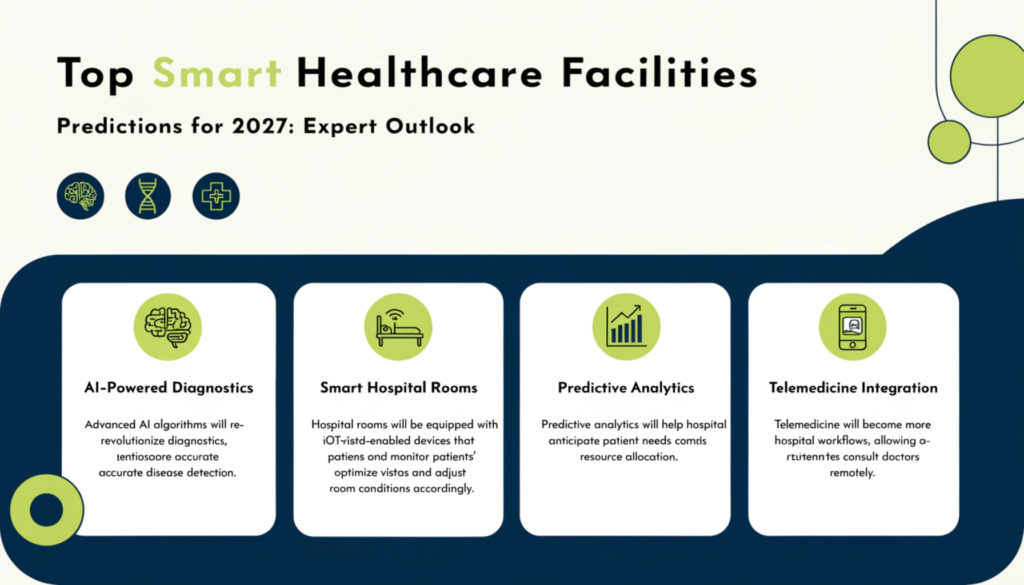
Healthcare facilities are entering a new phase of transformation. Digital technologies that were once viewed as experimental are becoming practical tools for improving patient care, operational efficiency, safety, and facility management. By 2027, hospitals and healthcare systems are expected to move beyond simply adopting individual technologies and instead build connected, intelligent environments where infrastructure, clinical systems, staff, patients, and data work together.
The next generation of healthcare facilities will be shaped by artificial intelligence, connected medical devices, automation, digital twins, predictive analytics, cybersecurity, sustainable infrastructure, and patient-centric design. These developments will influence not only clinical care but also how hospitals are designed, constructed, maintained, and operated.
Understanding these changes early can help healthcare leaders make better investment decisions and prepare their facilities for evolving patient expectations and technology requirements. Here are some of the most important smart healthcare 2027 predictions that healthcare executives, facility managers, architects, engineers, and technology leaders should watch.
1. AI Will Become Embedded Across Hospital Operations
Artificial intelligence is expected to become a standard layer across healthcare operations rather than remaining limited to specific clinical applications. Hospitals will increasingly use AI to analyze large volumes of information, identify patterns, support decision-making, and automate repetitive processes.
AI-enabled systems can help forecast patient demand, optimize staffing, identify maintenance requirements, improve energy management, and support clinical workflows. In facility management, AI can analyze information from building management systems, equipment sensors, and historical maintenance records to identify potential problems before they become expensive failures.
This shift will make healthcare facilities more proactive. Instead of responding to problems after they occur, hospitals will increasingly use predictive intelligence to anticipate operational needs.
For healthcare executives, the challenge will be ensuring that AI investments are integrated into broader infrastructure strategies rather than implemented as disconnected technology projects.
2. Smart Buildings Will Become More Connected
The hospital of 2027 is likely to function more like an interconnected digital ecosystem. Building management systems, HVAC equipment, lighting, security systems, elevators, medical equipment, and energy infrastructure will increasingly communicate through connected platforms.
Internet of Things (IoT) sensors will play an important role in this transformation. Sensors can monitor temperature, humidity, occupancy, air quality, equipment performance, and energy consumption in real time.
For example, a smart HVAC system could automatically adjust conditions based on occupancy levels and environmental requirements. Similarly, connected equipment could alert facility teams when performance indicators suggest that maintenance is needed.
This level of connectivity is one of the key elements of any hospital technology forecast because it changes facility management from manual monitoring to continuous, data-driven management.
3. Predictive Maintenance Will Replace Reactive Approaches
Traditional hospital maintenance often relies on scheduled inspections or reactive repairs. By 2027, predictive maintenance is expected to become significantly more common.
Connected sensors and analytics platforms can identify unusual vibration, temperature changes, energy consumption, or other performance indicators that may signal equipment deterioration. Facility teams can then intervene before equipment failure disrupts hospital operations.
This approach can be particularly valuable for critical infrastructure such as generators, chillers, air-handling units, elevators, medical gas systems, and other essential equipment.
Predictive maintenance can help healthcare organizations reduce unexpected downtime, improve asset life, and prioritize maintenance resources. It can also contribute to better patient safety because failures in critical hospital infrastructure can have serious consequences.
4. Digital Twins Will Support Hospital Planning and Management
Digital twins are expected to become increasingly important in healthcare facility planning. A digital twin creates a digital representation of a physical facility and can combine building information, equipment data, operational information, and real-time sensor inputs.
Healthcare organizations can use digital twins to simulate potential changes before implementing them in the physical environment.
For example, a hospital could model the impact of a renovation on patient movement, HVAC performance, energy consumption, or departmental workflows. Facility managers could also use digital twins to understand asset performance and identify opportunities for optimization.
As hospitals become more complex, digital twins can provide a valuable decision-making environment for capital planning, renovation, maintenance, and long-term facility management.
5. Robotics Will Expand Beyond the Operating Room
Robotics will continue to attract attention in clinical care, but its role in healthcare facilities is expected to become much broader.
Hospitals may increasingly deploy autonomous systems for transportation, logistics, cleaning, inventory movement, and other repetitive tasks. Robots can potentially transport medications, laboratory samples, linens, meals, and supplies across large facilities.
This can reduce the amount of time staff spend on repetitive transportation activities and allow them to focus more heavily on patient-facing responsibilities.
The successful integration of robotics, however, requires thoughtful facility planning. Hospitals may need to consider dedicated pathways, charging infrastructure, elevators, access controls, safety systems, and interaction between robots and people.
6. Energy Efficiency Will Become a Strategic Priority
Sustainability is moving from a corporate responsibility issue to an operational and financial priority for healthcare organizations.
Hospitals are among the most energy-intensive buildings because they operate around the clock and require highly controlled environmental conditions. By 2027, more facilities are expected to invest in smart energy management systems that continuously monitor consumption and optimize building performance.
AI-powered energy analytics, smart lighting, efficient HVAC systems, renewable energy integration, battery storage, and automated controls could become increasingly important.
Healthcare organizations will need to balance sustainability goals with clinical requirements. Energy-saving strategies cannot compromise infection control, patient safety, indoor air quality, or critical environmental conditions.
The future smart facility will therefore focus on achieving both operational resilience and environmental efficiency.
7. Cybersecurity Will Become Part of Facility Design
As healthcare facilities become more connected, cybersecurity risks will expand beyond traditional IT systems.
Connected medical devices, building management systems, access-control systems, smart cameras, IoT sensors, and other operational technologies can create additional points of vulnerability. A cybersecurity incident affecting facility infrastructure could potentially disrupt critical hospital operations.
Consequently, cybersecurity will increasingly need to be considered during facility design, construction, procurement, and technology upgrades.
Healthcare leaders may need stronger segmentation between systems, improved authentication, continuous monitoring, regular software updates, and comprehensive risk assessments.
In 2027, a truly smart hospital will not simply be highly connected—it will also be designed to remain secure and resilient.
8. Patient Experience Will Influence Smart Facility Design
Technology adoption will increasingly be evaluated according to how effectively it improves the patient experience.
Patients and families expect healthcare environments to be convenient, accessible, personalized, and easy to navigate. Smart technologies can support these expectations through digital wayfinding, automated check-in, mobile communication, personalized room controls, real-time appointment updates, and connected patient services.
Smart room technologies could allow patients to control lighting, temperature, entertainment, and communication systems through intuitive interfaces.
Wayfinding technologies may also become increasingly important in large hospitals. Digital maps, mobile navigation, location-based services, and intelligent signage can help patients and visitors move through complex facilities more easily.
The key trend is that technology will increasingly become invisible infrastructure supporting a smoother patient journey.
9. Healthcare Facilities Will Use Data for Real-Time Decision-Making
One of the biggest smart healthcare 2027 predictions is the continued shift from historical reporting to real-time operational intelligence.
Hospitals generate enormous amounts of data every day. The challenge is transforming that information into useful decisions.
Integrated analytics platforms can bring together information from facility systems, clinical operations, equipment, occupancy sensors, energy systems, and other sources. Leaders can use dashboards to monitor performance and identify emerging issues.
For example, facility teams may be able to see which areas have unusual energy consumption, where equipment requires attention, how building occupancy is changing, or whether environmental conditions are approaching predefined thresholds.
Real-time analytics can support faster decision-making and help hospital leaders allocate resources more effectively.
10. Flexible Infrastructure Will Become Essential
Healthcare needs change quickly. New technologies emerge, patient volumes fluctuate, and clinical services evolve. Facilities designed around rigid infrastructure can therefore become difficult and expensive to modify.
By 2027, flexibility is expected to become a major consideration in hospital planning and construction.
Healthcare organizations may increasingly prioritize adaptable spaces, modular infrastructure, scalable technology systems, accessible utility distribution, and flexible clinical environments.
This approach allows facilities to respond more easily to future requirements. A department may need to change its function, new medical equipment may require additional power or connectivity, or a hospital may need to expand digital services.
Designing for flexibility can reduce the cost and disruption associated with future modifications.
How These Trends Will Change Hospital Planning
The most important lesson from this hospital technology forecast is that technology can no longer be considered separately from facility planning.
Architects, engineers, IT teams, clinicians, facility managers, and hospital executives will need to collaborate much earlier in the planning process. A smart hospital requires infrastructure capable of supporting technology throughout its lifecycle.
Power capacity, network connectivity, cybersecurity, equipment rooms, sensor placement, data integration, cooling requirements, and physical accessibility all need to be considered during design.
Healthcare organizations should also avoid investing in technology simply because it is new. Every technology investment should have a clear purpose, measurable outcomes, and a long-term integration strategy.
Preparing for the Smart Healthcare Facility of 2027
Preparing for the future does not necessarily mean replacing every existing system. Healthcare organizations can begin by evaluating their current infrastructure and identifying the areas where digital transformation could deliver the greatest value.
A practical starting point is an assessment of existing building management systems, equipment, connectivity, energy performance, cybersecurity, and facility workflows.
Hospitals can then prioritize investments based on operational impact. For some facilities, predictive maintenance may deliver immediate benefits. Others may gain more value from energy optimization, digital twins, automation, or improved data integration.
Another important consideration is workforce readiness. Smart technologies are only effective when employees understand how to use them. Healthcare organizations will therefore need training, change management, and cross-functional collaboration alongside technology investments.
The Bigger Picture: From Smart Technology to Smart Healthcare
The future of healthcare facilities is not simply about adding more technology. It is about creating environments that can sense, analyze, adapt, and respond.
A smart hospital will increasingly be able to identify equipment problems before failure, adjust building performance according to real-time conditions, support staff through automation, provide patients with more convenient experiences, and use data to improve operational decisions.
The organizations that benefit most from these developments will be those that approach transformation strategically. Instead of adopting isolated technologies, they will build connected ecosystems supported by flexible infrastructure, strong cybersecurity, reliable data, and clearly defined objectives.
The smart healthcare 2027 predictions point toward a healthcare environment where technology becomes deeply integrated into the physical and operational fabric of hospitals. AI, IoT, robotics, predictive analytics, digital twins, smart energy systems, and flexible infrastructure are likely to influence how healthcare facilities are designed and managed for years to come.
For healthcare leaders, the question is no longer whether smart technologies will influence hospital operations. The more important question is whether facilities are prepared to integrate these technologies effectively.
Conclusion
2027 is likely to mark another major step toward intelligent, connected, and patient-centered healthcare facilities. From predictive maintenance and AI-driven analytics to robotics, digital twins, cybersecurity, and sustainable infrastructure, emerging technologies will reshape how hospitals operate.
However, technology alone will not create a smart hospital. Successful transformation will depend on thoughtful planning, integrated infrastructure, workforce readiness, and a clear understanding of patient and operational needs.
Healthcare organizations that begin preparing today can position themselves to respond more effectively to tomorrow’s demands.
Ready to explore the future of healthcare facilities? Register for Healthcare Convention 2027 Houston and connect with industry professionals, innovators, and decision-makers shaping the next generation of healthcare infrastructure.