
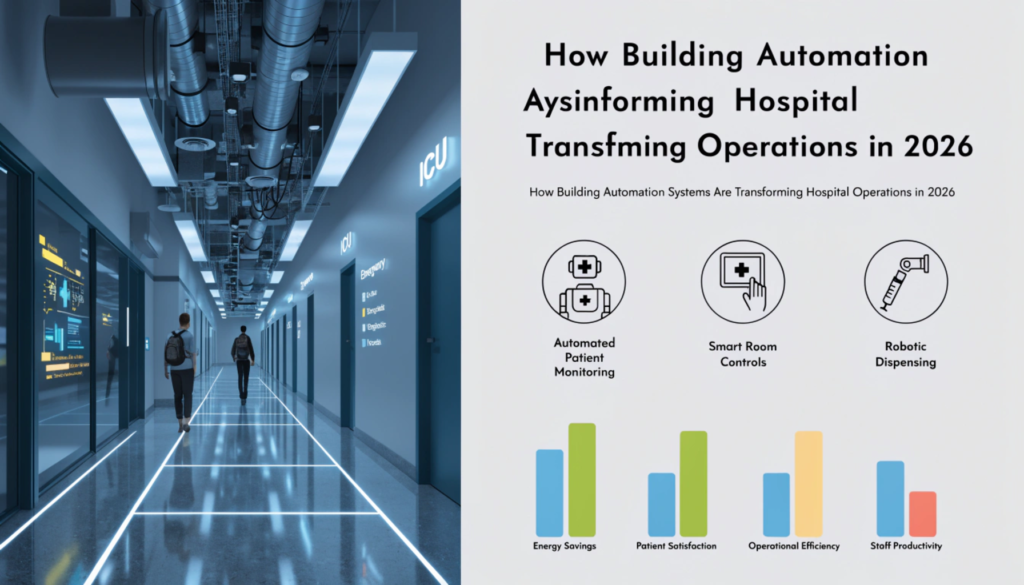
Hospitals are among the most complex buildings to operate. Unlike a typical office or commercial facility, a hospital must maintain safe and reliable conditions around the clock. Heating, ventilation, air conditioning, lighting, power systems, water systems, access controls, and other building services all need to work together while patients receive care.
This is where a building automation system hospital solution becomes increasingly valuable. A Building Automation System (BAS) connects different building systems to a centralized platform, allowing facility teams to monitor, control, and optimize building operations in real time.
As hospitals continue to focus on energy efficiency, patient safety, operational resilience, and cost control, BAS technology is becoming an important part of modern healthcare facility management. The latest hospital BAS 2026 strategies are also moving beyond basic temperature control toward predictive analytics, smart monitoring, automation, and data-driven decision-making.
What Is a Building Automation System?
A building automation system is a centralized technology platform used to monitor and control various building systems. It typically connects equipment such as HVAC systems, air-handling units, chillers, boilers, lighting systems, pumps, sensors, and other facility infrastructure.
Instead of requiring facility staff to check individual systems manually, a BAS brings information into a single interface. Facility managers can see equipment status, temperature levels, alarms, energy consumption, and other operating conditions from one location.
In a hospital environment, this capability is particularly important because building performance can directly affect patient care.
For example, operating rooms may require carefully controlled temperature, humidity, pressure, and air quality. Patient rooms need comfortable environmental conditions. Laboratories, pharmacies, isolation rooms, and other specialized areas can have their own environmental requirements.
A properly designed BAS helps facility teams monitor these conditions continuously and respond when something moves outside an acceptable range.
Why Hospitals Need Building Automation
Healthcare facilities operate 24 hours a day, 365 days a year. There is rarely an opportunity to simply shut down a building for routine maintenance or system adjustments.
At the same time, hospitals consume significant amounts of energy because of continuous HVAC operation, lighting, medical equipment, hot water requirements, ventilation, and other infrastructure demands.
Manual monitoring can make it difficult to identify inefficiencies or equipment problems quickly. A BAS provides continuous visibility into facility performance.
For example, if an air-handling unit begins consuming more energy than usual, the BAS can help facility teams identify the change. Similarly, if a temperature sensor detects an unusual condition in a critical area, an alert can help staff investigate before the issue becomes more serious.
The goal isn’t simply automation. It is better visibility, faster response, and more informed facility management.
How a BAS Improves Hospital Operations
1. Better HVAC Management
HVAC is one of the most important systems in a healthcare facility. Hospitals need to maintain appropriate temperature, humidity, ventilation, and pressure conditions across different areas.
A building automation system hospital platform can provide centralized monitoring of HVAC equipment and environmental conditions.
Facility teams can monitor air-handling units, chillers, boilers, fans, pumps, temperature sensors, and other equipment through a single interface. Automated controls can also adjust system operation according to schedules, occupancy, and predefined operating requirements.
This can help reduce unnecessary equipment operation while maintaining appropriate environmental conditions.
In specialized spaces, BAS monitoring can also provide facility teams with greater visibility into environmental parameters that require close attention.
2. Improved Energy Efficiency
Energy management is becoming a major priority for healthcare organizations. Hospitals cannot simply reduce HVAC operation without considering patient comfort, infection-control requirements, and critical-area specifications.
A BAS helps take a more targeted approach.
Instead of running systems at maximum capacity continuously, automation can help match building-system operation with actual demand. For example, lighting and HVAC settings can be adjusted based on occupancy schedules or operating requirements where appropriate.
Energy data can also help facility managers identify patterns.
If a particular building or piece of equipment consistently uses more energy than expected, managers can investigate the reason and consider corrective measures.
Over time, these improvements can contribute to lower energy consumption and more efficient facility operations.
3. Faster Detection of Equipment Problems
A small equipment issue can become a significant operational problem if it remains unnoticed.
Traditional facility management often relies on routine inspections and staff reports. While these remain important, BAS technology adds continuous monitoring.
A BAS can generate alarms when predefined conditions occur. For example, unusual temperatures, equipment failures, pressure changes, or other abnormal operating conditions can trigger notifications.
This gives facility teams an opportunity to respond earlier.
Early detection can be especially valuable for hospitals because equipment failures may affect critical spaces or disrupt normal operations.
4. Predictive Maintenance and Better Asset Management
The next generation of hospital BAS 2026 strategies is increasingly connected with predictive maintenance.
Instead of waiting for equipment to fail, facility teams can use operational data to identify unusual performance patterns.
For example, changes in equipment runtime, temperature, pressure, vibration data where available, or energy consumption may indicate that a system requires inspection.
A BAS can serve as an important source of this operational data.
When combined with analytics and maintenance management platforms, this information can help facility managers move from reactive maintenance toward more proactive strategies.
The result can be better planning, fewer unexpected disruptions, and more effective use of maintenance resources.
5. Improved Patient and Staff Comfort
Patient experience is influenced by more than clinical services. The physical environment also matters.
Temperature that is too high or too low, poor ventilation, inadequate lighting, or uncomfortable environmental conditions can negatively affect the experience of patients, visitors, and staff.
A BAS allows facility teams to monitor environmental conditions throughout the building.
Rather than responding only after complaints are received, teams can use system data to identify areas where conditions may require attention.
This can support a more consistent and comfortable environment while allowing staff to focus on other operational priorities.
6. Centralized Monitoring
One of the biggest advantages of a BAS is centralized visibility.
Large hospitals may have multiple buildings, floors, departments, and mechanical systems. Monitoring these individually can be time-consuming and inefficient.
A centralized BAS dashboard can bring information from connected systems together.
Facility managers can review equipment status, alarms, environmental conditions, and energy information without physically visiting every location.
This is particularly useful for large healthcare campuses where facility teams need to manage multiple systems simultaneously.
7. Better Response to Alarms
Not every alarm requires the same level of urgency.
A sophisticated BAS can help organize and prioritize alerts so facility teams can focus on important issues first.
For example, an alarm associated with a critical mechanical system may require immediate attention, while a less important operational notification may be reviewed later.
Clear alarm management can reduce the risk of important notifications being overlooked among a large number of routine alerts.
However, BAS alarms should be carefully configured. Too many unnecessary alerts can lead to alarm fatigue, making it harder for staff to recognize genuinely important events.
8. Supporting Hospital Resilience
Healthcare facilities need to remain operational during unexpected events, including equipment failures, extreme weather, power disruptions, and other emergencies.
A BAS cannot replace emergency preparedness systems, backup power, or disaster-response procedures. However, it can provide valuable operational visibility.
Facility teams can monitor critical building systems and identify abnormal conditions more quickly.
When integrated appropriately with other facility technologies, BAS data can also support decision-making during emergencies.
This makes automation an important component of a broader hospital resilience strategy.
Building Automation and Indoor Air Quality
Indoor air quality has become an increasingly important consideration in healthcare facility management.
Hospitals have complex ventilation requirements, and different areas may require different approaches to airflow and pressure control.
A BAS can help facility teams monitor relevant environmental conditions and equipment performance.
Sensors can provide real-time information, while automated controls can help maintain defined operating parameters.
However, BAS technology should complement not replace proper engineering, maintenance, infection-control procedures, and healthcare regulations.
The effectiveness of a BAS ultimately depends on how well it is designed, commissioned, maintained, and integrated with the hospital’s operational requirements.
Connecting BAS With Other Hospital Technologies
Modern BAS platforms are increasingly becoming part of a larger digital ecosystem.
Hospitals may connect building automation with energy management platforms, computerized maintenance management systems, IoT sensors, analytics tools, and facility dashboards.
This creates opportunities to use facility data more effectively.
For example, maintenance teams can combine BAS alerts with work-order systems. Energy managers can analyze building-system performance alongside utility data. Facility leaders can use dashboards to track operational trends.
The result is a shift from isolated building systems toward a more connected approach to facility management.
What to Consider When Implementing a Hospital BAS
Implementing a BAS is not simply a matter of installing software and sensors. Hospitals need a carefully planned approach.
First, organizations should identify the systems and spaces that require monitoring and automation. Critical areas may have different requirements from administrative or non-clinical spaces.
Second, hospitals should consider interoperability. A BAS should ideally work with existing building systems and relevant facility technologies rather than creating another isolated platform.
Cybersecurity is another important consideration. As more building systems become connected, healthcare organizations need appropriate security controls, access management, network segmentation, monitoring, and maintenance practices.
Training is equally important. Facility staff need to understand how to interpret dashboards, respond to alarms, investigate system trends, and use automation tools effectively.
Finally, commissioning and ongoing maintenance should not be overlooked. Even a sophisticated BAS can deliver poor results if sensors are inaccurate, controls are improperly configured, or equipment is not maintained.
The Future of Hospital BAS
The future of building automation is moving toward smarter and more data-driven facility management.
Artificial intelligence, machine learning, IoT sensors, advanced analytics, and cloud-based platforms are creating new possibilities for healthcare facilities.
Rather than simply displaying equipment status, future systems can help identify patterns and recommend actions.
For example, analytics may identify that a piece of equipment is gradually becoming less efficient or that a building zone consistently experiences unusual temperature patterns.
These insights can help facility managers make decisions before problems become major disruptions.
The broader objective of hospital BAS 2026 is therefore not automation for its own sake. It is about creating healthcare facilities that are more efficient, resilient, responsive, and easier to manage.
Conclusion
A building automation system can transform the way hospitals manage their physical infrastructure. By connecting HVAC, lighting, environmental monitoring, energy management, alarms, and other building systems, BAS technology gives facility teams greater visibility and control.
For hospitals, the benefits can extend beyond energy savings. Better monitoring can support faster response to equipment issues, more proactive maintenance, improved environmental conditions, centralized facility management, and stronger operational resilience.
As healthcare organizations continue investing in smarter facilities, the building automation system hospital model will become increasingly important. The hospitals that approach BAS as part of a broader digital facility strategy, not simply as an HVAC control system, can be better positioned to manage growing operational complexity.
The next stage of healthcare facility management will depend on connecting people, systems, and data. BAS technology can provide an important foundation for that transformation.
Want to explore the latest ideas shaping smart healthcare facilities and modern hospital operations?
Explore convention topics: Smart Healthcare Facilities Convention