
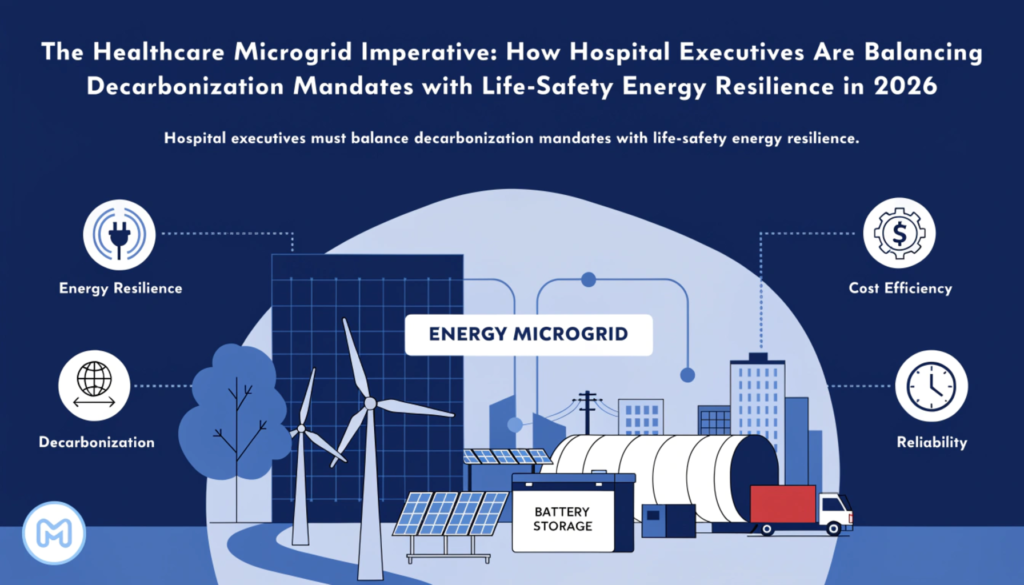
The American healthcare sector stands at the intersection of two powerful, competing imperatives. On one hand, acute care health systems face intense regulatory and community pressure to drastically cut their greenhouse gas emissions. Hospitals operate 24 hours a day, 365 days a year, consuming roughly 2.5 times more energy per square foot than standard commercial office buildings and accounting for nearly 8.5% of total carbon emissions in the United States. On the other hand, worsening climate volatility, catastrophic extreme weather events, and an increasingly fragile commercial power grid make uninterrupted, life-safety electrical reliability more urgent than ever.
For hospital chief executive officers (CEOs), chief operating officers (COOs), and healthcare governing boards, traditional diesel-only backup power is no longer adequate. While conventional standby generators have historically satisfied minimum regulatory codes, they sit idle for vast periods, represent substantial sunk capital costs, emit heavy particulate pollutants, and depend on vulnerable regional fuel supply chains during prolonged crises.
To solve this strategic dilemma, leading healthcare systems are pioneering the adoption of on-site healthcare microgrids. By combining on-site renewable energy generation, battery energy storage systems (BESS), combined heat and power (CHP), and advanced digital power management software, forward-thinking hospital executives are simultaneously achieving aggressive decarbonization goals, insulating their physical campuses from catastrophic utility grid failures, and unlocking transformative long-term financial returns.
The Strategic Case: Redefining Hospital Energy Beyond Cost Containment
Historically, healthcare leadership treated utility procurement as an unavoidable overhead operational expense. Power bills were paid, diesel storage tanks were periodically topped off, and facility engineering was tasked with keeping the lights on at the lowest possible cost. Under modern regulatory frameworks and volatile utility rate structures, this passive mindset exposes healthcare institutions to severe institutional vulnerability.
Volatile peak-demand utility charges, compounding regional grid instability, and emerging federal sustainability disclosure mandates, including new accreditation metrics from The Joint Commission and federal Environment of Care benchmarks, have elevated energy management into a high-priority executive fiduciary duty.
An enterprise healthcare decarbonization strategy 2026 is no longer merely a public relations talking point. It is an operational necessity. Health systems that proactively modernize their electrical infrastructure via smart microgrids achieve three vital strategic outcomes:
1. Unconditional Energy Resilience: The ability to seamlessly disconnect from a compromised public utility grid and operate in autonomous “island mode” for days or weeks without clinical interruption.
2. Predictable Operational Expenditures: Hedging against volatile utility tariff spikes and peak-demand ratchet penalties by discharging on-site stored power during the most expensive peak-demand hours of the day.
3. Regulatory and Community Leadership: Meeting stringent state emissions caps, satisfying ESG investment criteria, and demonstrating tangible health equity by reducing hazardous particulate emissions in surrounding communities.
Architecting the Financial Model: Leveraging Federal Clean Energy Direct Pay
One of the greatest historical obstacles to hospital microgrid adoption was high upfront capital expenditure (CapEx). When healthcare financial officers face razor-thin operating margins and immediate clinical equipment procurement needs, allocating tens of millions of dollars to electrical switchgear and solar arrays is rarely approved.
The financial calculus, however, has undergone a revolutionary shift. Under Section 6417 of the Internal Revenue Code, enacted through the Inflation Reduction Act (IRA), non-profit healthcare institutions and municipal health authorities can now access clean energy tax incentives through “direct pay” (elective pay) mechanisms. Non-profit hospitals can receive direct cash payments from the federal government covering 30% to 50% or more of total capital costs for qualified clean energy assets, including solar photovoltaics, advanced energy storage systems, microgrid controllers, and combined heat and power systems.
To maximize these capital incentives, healthcare chief financial officers (CFOs) are structuring innovative funding strategies:
1. Energy-as-a-Service (EaaS) Partnerships
Under an EaaS agreement, an external energy infrastructure partner designs, builds, finances, operates, and maintains the on-site microgrid asset with zero upfront capital outlay from the hospital. The health system contracts to purchase reliable, clean electricity and thermal energy at predictable, discounted long-term rates, transferring technical and maintenance risk entirely to the specialized vendor.
2. Monetizing Grid Support Services
Modern hospital microgrids do not simply sit in standby reserve; they actively participate in regional wholesale electricity markets. During periods of peak regional grid distress, advanced microgrid controllers can export clean surplus power or shed non-essential administrative loads to provide demand response services to local grid operators, generating substantial ancillary revenue streams that subsidize hospital operating budgets.
3. Integrating Life-Cycle Cost Analysis (LCCA)
When evaluating energy assets, hospital boards must look beyond initial equipment procurement to analyze the total 25-year cost of ownership. The combined savings generated from avoided utility peak charges, reduced diesel fuel consumption, demand response revenues, and direct pay tax credits consistently deliver positive net present values (NPV) that outperform conventional electrical infrastructure replacements.
The Clinical and Operational Convergence: Securing the Acute Care Mission
Energy resilience is fundamentally an issue of patient safety. In an acute healthcare environment, a loss of electrical power lasting even a fraction of a second can disrupt critical life-support equipment, crash real-time clinical monitoring networks, disable electronic health record (EHR) databases, and contaminate millions of dollars worth of temperature-sensitive pharmaceuticals and blood supplies.
Deploying a resilient hospital microgrid energy resilience framework bridges the traditional gap between hospital physical plant operations and clinical continuity:
- Eliminating Electrical Transfer Gaps: While traditional emergency generators require up to 10 seconds to detect utility failure, crank, and ramp up to stable voltage, battery energy storage systems (BESS) provide instantaneous sub-cycle power injection, eliminating momentary voltage sags and safeguarding sensitive surgical robotics and diagnostic imaging suites.
- Thermal Energy Integration: Acute care facilities require enormous volumes of continuous thermal energy for space heating, domestic hot water, laundry sanitation, and high-pressure autoclave sterilization. Incorporating combined heat and power (CHP) or thermal storage within a microgrid ensures that heating and sterilization remain continuous even during prolonged regional natural gas or electric grid blackouts.
- Prioritized Clinical Power Partitioning: Advanced microgrid management software enables dynamic load tiering. During catastrophic utility events where fuel or battery resources must be preserved, the system automatically prioritizes life-safety branches, intensive care units, emergency departments, and surgical suites while systematically shedding non-critical administrative and parking facilities.
Executive Governance: Overcoming Institutional Roadblocks
Successfully transitioning a major medical campus to a microgrid architecture requires strong, coordinated leadership across traditionally siloed departments. Hospital chief executives must establish cross-disciplinary governance structures that align disparate stakeholders:
- Executive Sponsorship and Multi-Disciplinary Steering: Create an Energy Resilience Council chaired by the Chief Operating Officer and composed of the Chief Financial Officer, Chief Medical Officer, VP of Facilities, and Chief Information Officer to ensure technical investments align with clinical priorities and financial horizons.
- Municipal and Utility Partnership: Engage proactively with local electric utilities, regional transmission organizations (RTOs), and municipal emergency management agencies to navigate interconnection agreements, net metering policies, and regional emergency dispatch protocols.
- Workforce Upskilling and Digital Training: Modern microgrids rely on sophisticated predictive algorithms, real-time telemetry, and digital controls. Hospital leadership must invest in ongoing technical training for internal facility engineering teams and partner with specialized contractors to ensure continuous operational readiness.
The Path Forward: Convening at the BMA Smart Healthcare Facilities Convention
As federal decarbonization incentives align with urgent physical resilience demands, hospital executives face a historic window of opportunity to modernize their physical plants. The choices made by healthcare leadership today will determine their institution’s financial resilience, regulatory compliance, and life-safety integrity for the next generation.
At the upcoming BMA Smart Healthcare Facilities Convention, hospital executives, healthcare board trustees, sustainability directors, and leading energy technology innovators will gather near Washington Dulles to address these transformative operational shifts. The convention provides an essential collaborative setting to:
- Evaluate real-world microgrid case studies from leading American health systems.
- Consult directly with federal policy experts on maximizing direct-pay clean energy incentives.
- Benchmark institutional energy resilience roadmaps against top-performing healthcare organizations.
- Establish strategic partnerships with industry-leading microgrid engineering and financing providers.
Healthcare leadership is defined by the courage to build enduring institutions. By investing decisively in clean, autonomous microgrid infrastructure, healthcare executives ensure that when the next great crisis strikes, their hospitals remain beacons of safety, healing, and hope for the communities they serve.
Connect with Healthcare Leaders Shaping Industry Standards
Join hospital CEOs, COOs, and healthcare engineering executives pioneering the clean energy transition in acute care. Secure your registration for our upcoming convention to share actionable insights and evaluate cutting-edge facility solutions.