
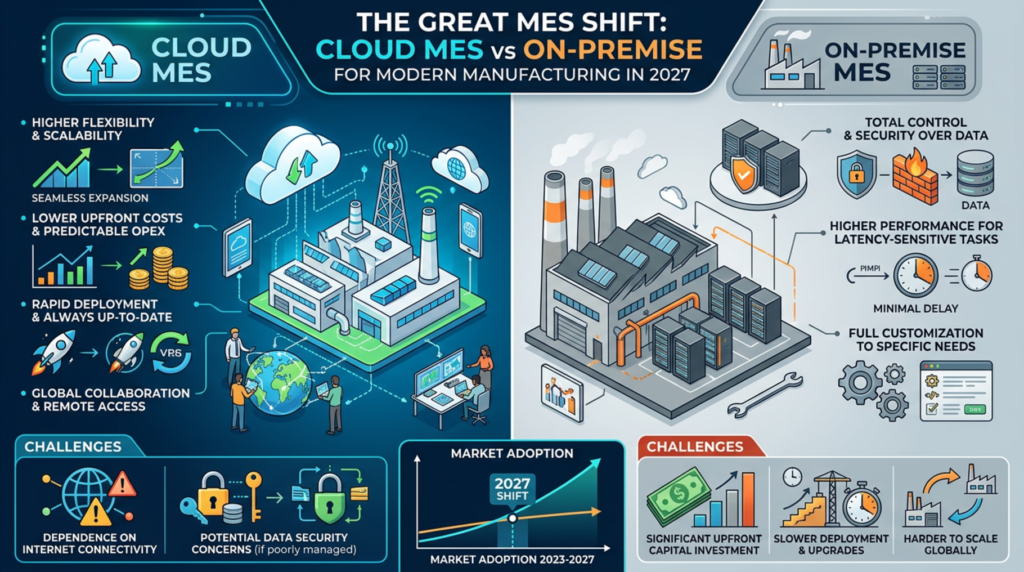
The manufacturing sector in 2027 operates within a hyper-connected, data-driven landscape. Industrial organizations are no longer evaluating digital transformation as an exploratory initiative; it is now the core driver of operational resilience, throughput optimization, and global supply chain integration. Sitting directly at the center of this digital revolution is the Manufacturing Execution System (MES).
As the operational backbone bridging shop-floor programmable logic controllers (PLCs) with enterprise resource planning (ERP) suites, the MES dictates how efficiently raw materials turn into finished goods. However, the architectural paradigm of this technology has evolved dramatically. Modern decision-makers face a pivotal strategic question when architecting their plant operations: when evaluating cloud MES vs on-premise architecture, which model delivers the optimal balance of performance, security, cost efficiency, and future-proof adaptability?
This executive report analyzes how industrial tech stacks are shifting in 2027, examining why multi-site enterprises, automotive OEMs, aerospace suppliers, and discrete manufacturers are pivoting toward cloud-native ecosystems while evaluating where on-premise environments still hold ground.
The Evolution of the Plant Floor: From Monoliths to Cloud Ecosystems
For over three decades, traditional on-premise MES platforms were considered the indisputable standard. Built as monolithic applications hosted on physical servers situated inside the plant facility, these systems delivered rapid execution speeds and complete localized isolation. Operations teams relied on them because they functioned independently of external internet connectivity, providing an air-gapped security posture and deterministic latency for high-speed automated production lines.
However, as industrial operations scaled globally, the limitations of localized infrastructure became glaringly apparent. Legacy systems created isolated data silos across disparate facilities, making enterprise-wide operational visibility nearly impossible without custom, expensive middleware. Upgrades were notorious for requiring weeks of planned downtime, custom code rewrites, and significant risk to production stability.
Entering 2027, the emergence of advanced manufacturing cloud software 2027 solutions has reshaped industry expectations. Cloud-native platforms utilize microservices, containerization, and continuous delivery pipelines to bring consumer-grade software agility to industrial manufacturing. Today, plant managers, industrial IT directors, and chief technology officers are re-evaluating their infrastructure strategies to determine whether legacy on-premise legacy investments still justify their capital and operational burdens.
Architectural Comparison: Cloud MES vs On-Premise in 2027
To understand why industrial adoption curves are tilting rapidly toward modern cloud environments, executives must evaluate both deployment models across critical operational vectors.
| Evaluation Metric | On-Premise MES Architecture | Modern Cloud MES Platform |
|---|---|---|
| Capital Expenditures (CAPEX) | High upfront investment in server hardware, redundant infrastructure, and permanent software licensing. | Low initial CAPEX; shifts investment to predictable, subscription-based operational expenses (OPEX). |
| Implementation Timeline | Extended rollouts ranging from 9 to 18 months per facility due to hardware procurement and local configuration. | Rapid multi-site deployment, often scalable across global plants within weeks via standardized cloud templates. |
| System Maintenance & Updates | Manual updates requiring physical IT intervention, custom scripting, and scheduled plant shutdown windows. | Seamless, automated updates pushed continuously with zero unscheduled disruption to manufacturing execution. |
| Enterprise Scalability | Rigid architecture; expanding capacity requires purchasing additional localized servers and dedicated storage. | Instantaneous, elastic scaling capacity across global production nodes through cloud infrastructure providers. |
| Interoperability & Integration | Requires complex custom interfaces (APIs), middleware, and heavy maintenance for third-party tools. | Open RESTful APIs, native Industrial Internet of Things (IIoT) connectors, and pre-built ERP/PLM integrations. |
| Advanced Analytics & AI | Limited by local processing power; complex machine learning models require dedicated edge-data clusters. | Native access to cloud computing clusters for real-time generative AI, predictive maintenance, and enterprise OEE. |
Evaluating the Core Pillars of Decision-Making
1. Total Cost of Ownership (TCO) and Financial Predictability
When conducting a direct financial comparison of cloud MES vs on-premise systems, traditional cost accounting often miscalculates the true long-term expense of local deployments. On-premise solutions require heavy capital expenditures upfront, including localized server clusters, disaster recovery hardware, uninterruptible power supply (UPS) systems, specialized cooling units, and permanent database licenses.
Beyond hardware lies the hidden operational cost of specialized personnel. On-premise systems demand dedicated on-site IT engineers to manage server health, execute manual database backups, apply security patches, and troubleshoot hardware failures. Over a five-year lifecycle, the maintenance and labor costs of on-premise deployments often exceed the initial hardware and software licensing investment by three to four times.
In contrast, adopting manufacturing cloud software 2027 converts capital investments into predictable, recurring operating expenses. Subscription pricing models encompass server maintenance, cloud storage, platform security, continuous compliance updates, and platform enhancements. This shift enables finance leaders to align software expenditure directly with manufacturing output, lowering the barrier to entry for mid-market manufacturers while optimizing cash flow across enterprise organizations.
2. Operational Agility, Maintenance, and Continuous Innovation
In 2027, market agility is a primary competitive advantage. Manufacturers must adapt to fluctuating customer specifications, rapid product variant cycles, and dynamic supply chain constraints. Legacy on-premise platforms struggle under the weight of these requirements. Upgrading a custom on-premise MES across five manufacturing facilities often turns into a multi-year effort fraught with version control nightmares, where individual facilities end up running disparate software versions.
Cloud MES platforms eliminate version divergence entirely. Built on microservice architectures running on modern cloud infrastructure, these solutions receive non-disruptive micro-updates continuously. New features, quality control modules, and security frameworks are updated seamlessly across every plant in an enterprise network simultaneously.
This continuous release cycle empowers operational teams to adopt new capabilities instantly, such as AI-assisted visual quality inspections, automated material replenishment tracking, or sustainability tracking modules, without re-engineering the base system or interrupting production schedules.
Addressing Industry Misconceptions: Latency and Cybersecurity
Despite the momentum behind cloud technologies, two historical concerns frequently dominate board-level discussions: determinism/latency on the shop floor and cybersecurity risks. Modern engineering in 2027 has largely solved both challenges through refined architectural patterns.
The Latency Solution: The Rise of Edge-Cloud Hybrid Models
A common hesitation regarding cloud deployments is the risk of internet latency or temporary connectivity loss interrupting high-speed execution lines. If a plant’s network connection drops, does the assembly line grind to a halt?
In 2027, the leading deployment standard is not an absolute choice between pure cloud or pure on-premise, but rather a hybrid edge-cloud architecture. High-frequency execution tasks—such as direct machine handshakes, real-time PLC interlocking, sub-second error proofing, and safety monitoring—are handled locally by lightweight edge nodes stationed on the factory floor.
These edge computing devices execute operational tasks independently without requiring constant cloud round-trips. When connectivity is uninterrupted, edge nodes continuously stream structured data up to the enterprise cloud software suite for heavy processing, historical data logging, cross-plant benchmark comparisons, and machine learning model training. If WAN connectivity drops, the edge node buffers operational data locally and continues running line execution without missing a beat, syncing automatically once connectivity returns. +———————————————————————–+
| ENTERPRISE CLOUD |
| • Multi-Plant Analytics • Machine Learning & Predictive Maintenance |
| • Global Supply Chain Sync • Continuous Upgrades & Scalability |
+———————————————————————–+▲│ Continuous Data Streaming &│ Model Orchestration│
▼
+———————————————————————–+
| LOCAL PLANT EDGE |
| • Sub-second PLC Interlocks • Store-and-Forward Offline Buffer |
| • Real-Time Quality Gates • Local Operator Interfaces (HMIs)
+———————————————————————–+
Cybersecurity: On-Premise Air Gaps vs. Zero-Trust Cloud Networks
Historically, plant managers believed that physically housing servers within factory walls created an impenetrable barrier against cyber threats. However, modern industrial security incidents have dismantled the myth of the safe “air-gapped” facility. Legacy on-premise servers often run out-of-date operating systems, have unpatched security flaws, and have unsecured maintenance access points that leave them highly vulnerable to ransomware and lateral network intrusion.
Modern cloud providers invest billions annually into proactive cybersecurity infrastructure. Advanced manufacturing cloud platforms operate under Zero-Trust Network Architectures (ZTNA), utilizing end-to-end data encryption, multi-factor authentication, AI-driven anomaly detection, and automated vulnerability patching. Rather than relying on localized, overworked IT teams to secure physical server rooms, cloud-based operations benefit from enterprise-grade security operations centers (SOCs) monitoring network traffic around the clock.
Why Manufacturers Are Choosing Cloud MES in 2027
As executives weigh their options for system modernization, industry data points decisively toward cloud adoption. Over 70% of new manufacturing execution system deployments in 2027 utilize multi-tenant or private cloud frameworks. Several macroeconomic drivers explain this acceleration:
- Enterprise-Wide Visibility: Global organizations can no longer operate plants as isolated operational islands. Cloud platforms aggregate shop-floor data across global manufacturing sites into unified executive dashboards, allowing leaders to benchmark Overall Equipment Effectiveness (OEE), scrap rates, and labor utilization across continents in real time.
- AI and Machine Learning Integration: Modern artificial intelligence algorithms require massive parallel processing power to process high-definition computer vision, sensor streams, and operational history. Cloud-native platforms harness near-infinite compute capacity to deliver actionable predictive insights straight back to operator interfaces.
- Workforce Mobility and Accessibility: The modern industrial workforce requires remote visibility. Plant managers, quality engineers, and maintenance specialists expect secure access to operational analytics, process alarms, and production reports from any device, anywhere in the world, without battling cumbersome enterprise VPNs.
- Supply Chain Synchronization: Cloud-native architectures allow manufacturing systems to integrate seamlessly with upstream suppliers and downstream logistics partners. Real-time consumption tracking on the factory floor can automatically trigger raw material orders, preventing costly material stockouts and optimizing inventory turns.
Making the Strategic Decision for Your Organization
While cloud architectures dominate modern investments, deciding between a fully cloud-native, on-premise, or hybrid edge-cloud system depends on your specific operational constraints:
- Choose a Cloud-First or Hybrid MES if: You operate multiple manufacturing facilities, require rapid enterprise scaling, seek to integrate advanced AI analytics, want to minimize capital expenditures, and need seamless integration with enterprise cloud systems.
- Maintain On-Premise Infrastructure if: You operate single isolated facilities with extremely strict, legally mandated data-residency requirements, lack access to reliable high-speed network infrastructure, or run highly specialized legacy production systems where cloud API integrations are physically impossible without replacing underlying machinery.
Shape the Future of Industrial Automation
Navigating the landscape of smart manufacturing infrastructure requires direct insights from industry leaders, technology innovators, and peer executives who are actively deploying these solutions on the shop floor.
To explore real-world implementation case studies, experience live demonstrations of next-generation manufacturing platforms, and network with leading technology providers, join us at the premier industry gathering of the year.
Connect with Industry Decision-Makers
Are you an industrial technology provider, cloud architecture specialist, or smart automation vendor driving the future of factory operations? Position your organization at the forefront of digital transformation by showcasing your solutions to senior manufacturing executives, CIOs, and plant operations leaders.
Enquire about sponsorship for the Smart Manufacturing & Automation Convention 2027 today, and join the global movement redefining factory intelligence, operational efficiency, and sustainable industrial production.