
Modern industrial manufacturing operates under unprecedented pressure. Supply chain volatility, compressed product lifecycles, skilled labor shortages, and demanding sustainability mandates mean plant managers can no longer rely on guesswork or trial-and-error optimization on the physical shop floor. When an unplanned equipment shutdown occurs or a production line retooling encounters unexpected bottlenecks, the financial impact can quickly escalate into millions of dollars in lost throughput, idle labor, and unfulfilled customer contracts.
To maintain a competitive edge, forward-looking manufacturers are shifting from physical troubleshooting to virtual intelligence. At the center of this technological evolution is digital twin manufacturing, an approach that bridges the physical and digital worlds to create dynamic, real-time virtual models of machines, production cells, and entire manufacturing facilities.
Rather than waiting for physical equipment to degrade or risking costly line shutdowns during process changes, plant operators use digital twins to test operational adjustments, evaluate line layouts, and run predictive analytics safely in software before touching physical assets.
As industrial organizations prepare their modernization roadmaps for next year, mastering manufacturing simulation 2027 capabilities has become essential. This practical guide provides industrial operations leaders with a step-by-step roadmap for scoping, architecting, deploying, and scaling a high-impact digital twin within a modern manufacturing plant.
What Is a Manufacturing Digital Twin?
At its core, a manufacturing digital twin is far more than a static 3D computer-aided design (CAD) model or a standard computerized dashboard. While traditional CAD models represent how an asset was designed on paper, a digital twin represents how that asset is currently operating in the physical facility.
A true digital twin is continuously synchronized with its physical counterpart through two-way or near-real-time data streams. Non-intrusive industrial IoT (IIoT) sensors, programmable logic controllers (PLCs), Computerized Maintenance Management Systems (CMMS), and Manufacturing Execution Systems (MES) continuously feed live operational variables such as vibration, temperature, speed, motor load, hydraulic pressure, and cycle time into the virtual model.
In return, the digital twin applies physics-based simulations, machine learning models, and algorithmic rules to evaluate asset health, forecast component degradation, and prescribe optimal operating parameters.
In industrial environments, digital twins generally fall into three distinct levels of maturity:
- Component and Asset Twins: Virtual models of specific critical machinery, such as a high-pressure compressor, a robotic weld arm, or an injection molding machine. These twins focus primarily on mechanical health, stress analysis, and condition-based predictive maintenance.
- Process and Line Twins: Models of integrated manufacturing workflows, tracking how materials, tools, and subassemblies interact across an entire production cell. These twins identify throughput bottlenecks, balance cycle times, and optimize line changeovers.
- System and Plant Twins: Comprehensive virtual representations of an entire manufacturing facility. These high-level twins incorporate plant-wide energy consumption, HVAC building management, internal material logistics, and supply chain inventory flows to support executive-level operational planning.
Why Digital Twins Are Essential for 2027 Operations
The drive toward digital twin adoption is propelled by clear operational imperatives. Manufacturers face tightening margins and an urgent need to increase Overall Equipment Effectiveness (OEE).
Traditional manufacturing operations operate in silos. Maintenance teams manage work orders in a CMMS, quality managers inspect finished parts in a Quality Management System (QMS), and production supervisors track output in an MES. When a machine begins to drift out of calibration, these disparate systems often fail to correlate early mechanical warnings with subtle quality deviations until significant scrap has already been produced.
Digital twin manufacturing eliminates these operational blind spots by centralizing machine telemetry and process data into a unified, contextualized model.
Key strategic drivers include:
- Eliminating Unplanned Downtime: By continuously comparing live telemetry against mathematical baselines, digital twins identify anomalous wear patterns weeks before catastrophic physical failure, allowing maintenance teams to intervene during planned changeovers.
- Accelerating Commissioning and Retooling: Virtual commissioning allows engineers to test PLC code, robotic kinematics, and ergonomic safety digitally before physical hardware arrives on the factory floor, cutting line changeover times by up to 60%.
- Optimizing Facility Energy and Resource Utilization: Process twins correlate energy, compressed air, and water usage with machine operating cycles, pinpointing energy-intensive idle states and helping facilities meet net-zero targets.
- Knowledge Retention in an Aging Workforce: As veteran machinists and maintenance technicians retire, digital twins codify institutional knowledge into predictive algorithms, ensuring operational expertise is preserved across shifts.
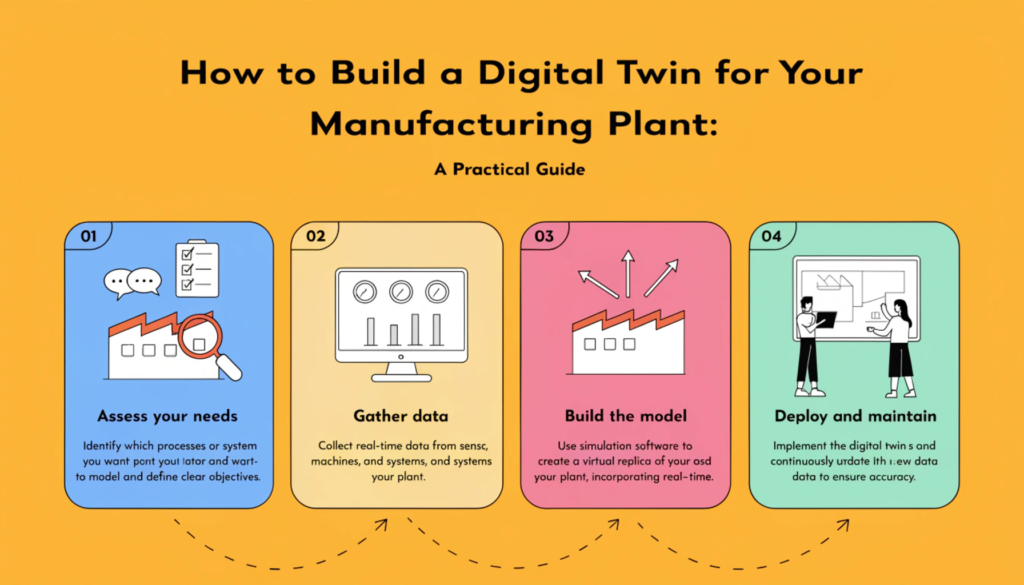
Step 1: Defining the Scope and Selecting the Right Pilot Asset
The most common reason digital transformation initiatives stall is the temptation to digitize the entire plant at once. Attempting to build an all-encompassing factory twin from scratch introduces overwhelming data complexity, prolonged implementation timelines, and delayed ROI.
Successful organizations begin with a tightly scoped, high-value pilot project.
To select the ideal starting point:
- Identify Critical Bottlenecks: Target machines or processes that dictate the throughput of the entire line. If a specific stamping press or heat-treating furnace represents a single point of failure, that asset is your prime candidate.
- Audit Historical Failure Data: Review your CMMS records for assets that account for a disproportionate share of emergency maintenance hours, expensive replacement components, or recurring downtime.
- Evaluate Data Accessibility: Choose equipment that has accessible telemetry or can easily be retrofitted with non-invasive IoT sensors. Brownfield equipment with open industrial communication protocols (such as OPC UA or Modbus) simplifies early connectivity.
- Define Clear Success Metrics: Establish quantitative KPIs before installation, such as reducing unplanned downtime by 30%, decreasing scrap by 15%, or lowering MTTR (Mean Time to Repair) by 25%.
Step 2: Architecting the Industrial Data Pipeline
A digital twin is only as accurate and reliable as the data feeding it. Building a dependable industrial data architecture requires connecting shop-floor physical telemetry with enterprise-level analytics.
Sensorization and Data Capture
For older brownfield assets, non-invasive sensors can be retrofitted without voiding warranties or altering machine wiring. Install high-frequency vibration sensors on bearings, surface temperature probes on gearboxes, and current transformers on electrical feeds. For modern greenfield equipment, extract real-time process parameters directly from onboard PLCs and CNC controllers.
Edge Computing and Industrial Protocols
Streaming high-volume, high-frequency industrial data directly to the cloud can overwhelm plant bandwidth and create latency issues. Deploy industrial edge gateways directly on the plant floor. Edge devices aggregate raw data, filter out background electrical noise, run local anomaly detection algorithms, and convert proprietary machine signals into standardized industrial formats like MQTT and OPC UA.
Cloud Integration and Unified Data Lakes
Edge gateways transmit standardized, time-series telemetry securely to a central industrial cloud repository. Here, time-series sensor data is harmonized with contextual business data from your ERP, MES, and CMMS, creating a unified data model that reflects both physical conditions and operational schedules.
Step 3: Developing the Virtual Model and Physics Simulation
Once data pipelines are active, engineering teams build the virtual counterpart. This stage integrates geometric modeling, physical simulation, and machine learning.
Geometric and Kinematic Modeling
Import existing CAD files of the target equipment into the simulation environment. Define the physical kinematics of moving components such as robotic articulation axes, conveyor belt speeds, and press strokes to ensure the virtual model moves in precise synchronization with physical movements.
Physics-Based and Operational Simulation
Apply physical properties to the model, including mass, friction coefficients, thermal conductivity, and structural stress tolerances. During this phase, manufacturing simulation 2027 tools simulate how mechanical components behave under continuous production stresses, varying ambient factory temperatures, and differing material hardness.
Machine Learning and Predictive Analytics
Train machine learning algorithms on historical maintenance records and live sensor data. Over time, the algorithms learn the subtle vibrational and thermal signatures associated with specific failure modes such as bearing spalling, gear backlash, lubrication starvation, or motor misalignment. When live data deviates from expected parameters, the model forecasts remaining useful life (RUL) with high statistical accuracy.
Step 4: System Integration and Closed-Loop Action
A digital twin provides little business value if its insights remain isolated in an engineering dashboard. The system must trigger operational action across plant workflows.
Connect the digital twin platform directly to your maintenance and production software:
- Automated Work Order Generation: When the twin detects early asset degradation, it automatically generates a prioritized work order in the CMMS, complete with diagnosis, recommended parts, and step-by-step repair guides.
- Dynamic Production Rescheduling: If an asset’s remaining useful life indicates it cannot sustain maximum line speed through a weekend production run, the twin communicates with the MES to rebalance work-in-progress (WIP) toward alternative lines or throttle cycle speeds safely.
- Mobile Technician Enablement: Equip maintenance technicians with tablets or augmented reality (AR) headsets. When inspecting machinery, technicians can overlay real-time internal sensor data and operational histories directly onto the physical asset.
Step 5: Scaling from Pilot Asset to Connected Plant
After validating the digital twin on a pilot asset and demonstrating measurable ROI, leadership can systematically scale the technology across the facility.
- Replicate Across Identical Assets: Expand the model to identical machines or sibling production lines, leveraging pre-trained algorithms and proven sensor configurations.
- Integrate Upstream and Downstream Processes: Connect individual asset twins into a comprehensive process twin that monitors material handoffs, queue times, and inter-machine buffer capacities.
- Incorporate Facility and Infrastructure Systems: Link manufacturing equipment twins with building automation systems (BAS). Monitoring how plant HVAC, compressed air loops, and electrical substations interact with heavy production loads allows facility managers to optimize overall plant energy efficiency and lower utility demand charges.
Addressing Common Challenges and Roadblocks
While the business case for digital twin adoption is compelling, industrial leaders must navigate several practical challenges:
- Legacy Equipment Integration: Brownfield factories often feature machinery spanning several decades. Rather than replacing functional assets, use standardized plug-and-play IoT sensors and edge protocol converters to bring legacy machines into the digital ecosystem.
- Data Quality and Noise: Industrial floors are noisy electrical and mechanical environments. Implementing edge-level filtering ensures that temporary mechanical shocks (such as a dropped die) are not misinterpreted as bearing failures.
- Cybersecurity and OT/IT Convergence: Connecting plant-floor operational technology (OT) to cloud-based IT networks introduces potential security vulnerabilities. Implement strict zero-trust architecture, robust network segmentation, and hardware air gaps where necessary to safeguard industrial control systems.
- Workforce Resistance: Technicians may view automated predictive systems with skepticism. Involve maintenance craftspeople and machine operators early in the design phase, demonstrating that the digital twin acts as an empowering diagnostic assistant rather than an invasive monitoring tool.
The Future Outlook: What to Expect in 2027
As manufacturing technology continues to advance, the capabilities of digital twins will expand dramatically. By 2027, factories will increasingly adopt autonomous closed-loop digital twins capable of self-optimization. Instead of merely alerting human operators, advanced systems will dynamically adjust robotic feed rates, recalibrate tooling offsets, and balance facility power distribution in real time.
Furthermore, supply-chain-wide digital twins will connect tier-one suppliers directly with OEM assembly plants. Shared operational models will provide end-to-end visibility, allowing suppliers to adjust production runs dynamically based on real-time assembly line consumption.
Conclusion
Building a digital twin for your manufacturing plant is no longer an experimental research project it is a proven, scalable operational strategy. By taking a focused, phased approach that starts with high-impact bottlenecks and scales through disciplined data architecture, manufacturers can eliminate unplanned downtime, cut retooling costs, and build a resilient production environment.
The organizations that invest in digital twin capabilities and virtual simulation today will set the standard for manufacturing efficiency, agility, and profitability tomorrow.
Ready to explore the advanced technologies reshaping modern factory floors?
Download the Smart Manufacturing & Automation Convention 2027 Agenda and connect with industry leaders, automation innovators, and smart factory specialists transforming industrial operations.