
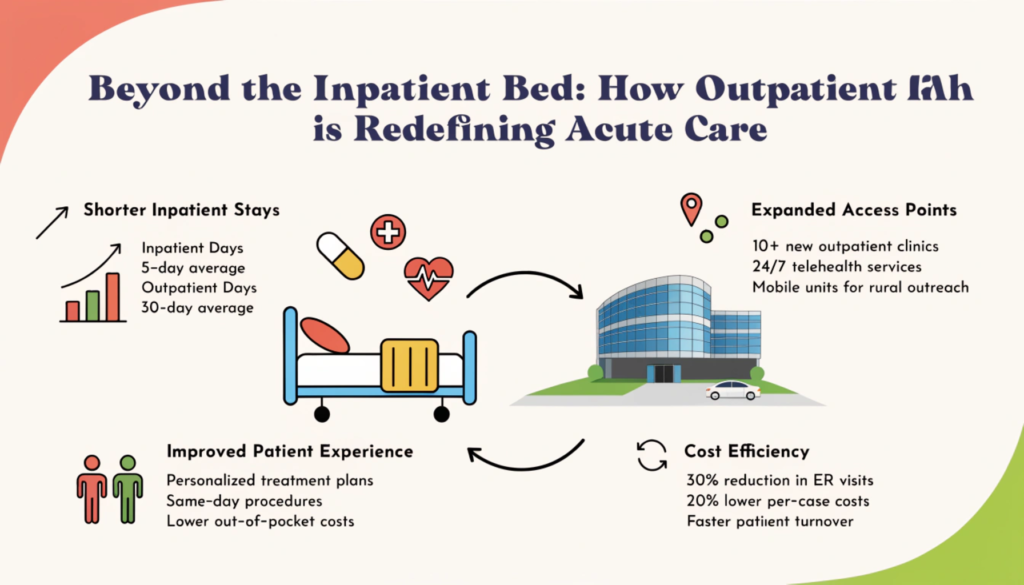
Introduction: The Great Migration Outside the Hospital Walls
For nearly a century, the core engine of healthcare economics was built around a singular physical metric: inpatient beds. Hospitals built vast multi-story bed towers under the financial model that admitted patients requiring multi-day postoperative stays would generate the high-margin revenue needed to subsidize uncompensated emergency care, complex ICU stays, and capital-intensive infrastructure.
That fundamental model is dissolving. Advances in minimally invasive surgical techniques, long-acting regional anesthetics, and digital remote patient monitoring have made multi-day hospital stays unnecessary for routine orthopedics, ophthalmology, cardiology, and general surgery.
Simultaneously, financial pressure from commercial insurers and government payers has accelerated surgical migration away from acute care settings. The rapid expansion of Ambulatory Surgery Centers (ASCs) is not merely an incremental trend; it is fundamentally rewriting hospital economics, shrinking the footprint of traditional acute facilities, and forcing health system executives to reimagine the role of the hospital bed.
The Strategic Pivot: Why Health Systems Are Buying ASCs Instead of Building Bed Towers
Historically, health system leadership viewed standalone surgical centers as competitive threats that poached profitable, low-risk commercial patients. Today, executive strategy has pivoted from resistance to aggressive acquisition and joint-venture integration. Traditional Strategy Modern Ambulatory Strategy
┌────────────────────────────────┐ ┌────────────────────────────────┐
│ • Multi-million Bed Towers │ │ • Modular ASC Footprints │
│ • Centralized Acute Operations │ ────►│ • Distributed Community Outlets│
│ • Protected High Facility Fees │ │ • Joint Ventures with Surgeons │
└────────────────────────────────┘ └────────────────────────────────┘
Capital Allocation Dynamics
Building a modern acute hospital tower can cost anywhere between $1.5 million to $3 million per bed in capital expenditure. In contrast, developing or acquiring an outpatient facility requires a fraction of the capital while yielding significantly faster development timelines and lower operating overhead.
Health systems are altering their capital deployment in several key ways:
- Joint Ventures with ASC Management Companies: Instead of full ownership, health systems partner with specialized ASC management organizations and physician groups. This model aligns physician incentives while maintaining health system brand presence.
- Defensive Market Capture: By placing outpatient surgical sites in suburban and growth corridors, health systems prevent independent physician groups and private equity-backed operators from capturing market share.
- Capital Redistribution: Capital previously earmarked for general inpatient unit expansion is diverted into specialized surgical robotics, digital health infrastructure, and distributed outpatient networks.
The Economic Equation: Lower Fees, Faster Turnarounds, and Payer Mandates
The economic argument driving outpatient surgical growth rests on a stark financial contrast between Hospital Outpatient Departments (HOPDs) and freestanding surgical centers.
| Metric | Hospital Outpatient Dept. (HOPD) | Ambulatory Surgery Center (ASC) | Economic Impact |
|---|---|---|---|
| Average Facility Fee | Higher (Overhead Allocation) | 40%–60% Lower on Average | Substantial healthcare payer savings |
| OR Turnover Time | 35 – 55 Minutes | 10 – 20 Minutes | ~2x Increase in Daily Procedure Capacity |
| Nurse-to-Patient Ratio | Generalized / Variable | Specialized / Standardized | Lower Operating Costs & Burnout |
| Patient Co-Pay Cost | High Deductibles Applied | Significantly Reduced Out-of-Pocket | Higher Patient Satisfaction & Retention |
Payer-Driven Site-of-Care Mandates
Commercial payers and Medicare are actively enforcing “site-of-care” policies. Insurance providers increasingly refuse to reimburse elective procedures such as total knee arthroplasty (TKA), simple spinal fusions, and cataract surgeries when performed in a traditional hospital setting, unless clear medical necessity for higher-acuity care is documented.
This structural shift benefits three key stakeholders:
- Payers: Realize immediate reductions in total episode-of-care costs.
- Patients: Experience reduced out-of-pocket costs, lower risk of hospital-acquired infections (HAIs), and predictable scheduling without emergency department delays.
- Surgeons: Gain greater control over scheduling, block time efficiency, and ownership equity in the facility.
What Remains for Traditional Hospitals: The High-Acuity Dilemma
While the shift toward outpatient environments improves efficiency for elective care, it creates a challenging economic environment for traditional acute care hospitals. As low-risk, high-margin cases migrate to outpatient centers, traditional facilities are left managing a significantly more complex operational profile.
1. Elevated Patient Acuity and Shifting Payer Mix
The patients remaining in traditional inpatient beds are older, sicker, and present with multiple comorbidities. Emergency department admissions, trauma, complex oncology, and high-risk cardiovascular procedures dominate hospital census reports.
- Margin Compression: High-acuity care requires higher intensive care unit (ICU) staffing, advanced monitoring, and longer lengths of stay (LOS), which carry thinner margins or net losses under prospective payment systems.
- Loss of Internal Cross-Subsidization: Historically, profits generated by routine elective orthopedic and vascular surgeries cross-subsidized loss-leading essential services like emergency care, burn units, and behavioral health. Without these elective margins, overall hospital profit margins face continuous pressure.
2. Escalating Staffing Pressures and Fixed Cost Overhead
Operating an acute care hospital requires maintaining 24/7 staffing, specialized trauma capability, and standby capacity regardless of daily census fluctuations. CONVENTIONAL HOSPITAL FINANCIAL REALITY
┌─────────────────────────────────────────────────┐
│ Fixed Infrastructure Overhead (24/7 Operations) │
├─────────────────────────────────────────────────┤
│ Severe Clinical Staffing Shortages & Overtime │
├─────────────────────────────────────────────────┤
│ Higher-Acuity / Lower-Margin Inpatient Base │
└─────────────────────────────────────────────────┘
Clinical staffing shortages have exacerbated this issue. Hospitals must offer higher wages and rely on temporary agency staffing to manage high-acuity inpatient units, escalating operating expenses at the exact moment high-margin surgical revenue is migrating off-campus.
Navigating the Future: Operational Adaptations for Health Systems
To remain financially viable, health system executives are adapting their operational strategies across three core areas:
Flexible Space and Capacity Reallocation
Forward-thinking hospitals are converting underutilized medical-surgical beds into specialized observation units, step-down intensive care suites, or expanded outpatient diagnostic centers. Converting static inpatient units into flexible, modular care spaces allows facilities to adjust capacity based on seasonal shifts and emergency volume.
Industrialization of Healthcare Operations
Healthcare leaders are increasingly adopting operational models from advanced manufacturing and high-throughput logistics. Workflow automation, predictive analytics for bed management, and automated supply chain logistics are becoming critical components of modern acute care management.
By optimizing patient flow, reducing equipment downtime, and automating routine administrative tasks, acute facilities can reduce fixed operational overhead and stabilize operating margins.
Conclusion: A New Equilibrium in Healthcare Delivery
The disappearing inpatient bed does not signify the decline of the traditional hospital, but rather its evolution into a specialized acute care node.
As Ambulatory Surgery Centers (ASCs) handle a growing share of elective procedures, the acute care hospital is returning to its core purpose: delivering complex, high-acuity care that demands intensive multidisciplinary resources. Health systems that successfully build integrated networks combining efficient outpatient facilities with lean, technology-enabled acute care hospitals will be best positioned to navigate these evolving economic realities.
Drive Operational Excellence with BMA Conventions
As health systems and complex industrial ecosystems adapt to shifting economic models, operational efficiency, technology integration, and automated workflow strategies have become vital business imperatives.
Discover how leading organizations are leveraging automation, AI infrastructure, and advanced operational strategies to optimize modern facility design and supply chain resilience.
Register as a Delegate – Smart Healthcare Facilities Convention to connect with industry leaders, operations executives, and technology innovators shaping the future of smart facilities and sustainable operational strategies.