
Introduction
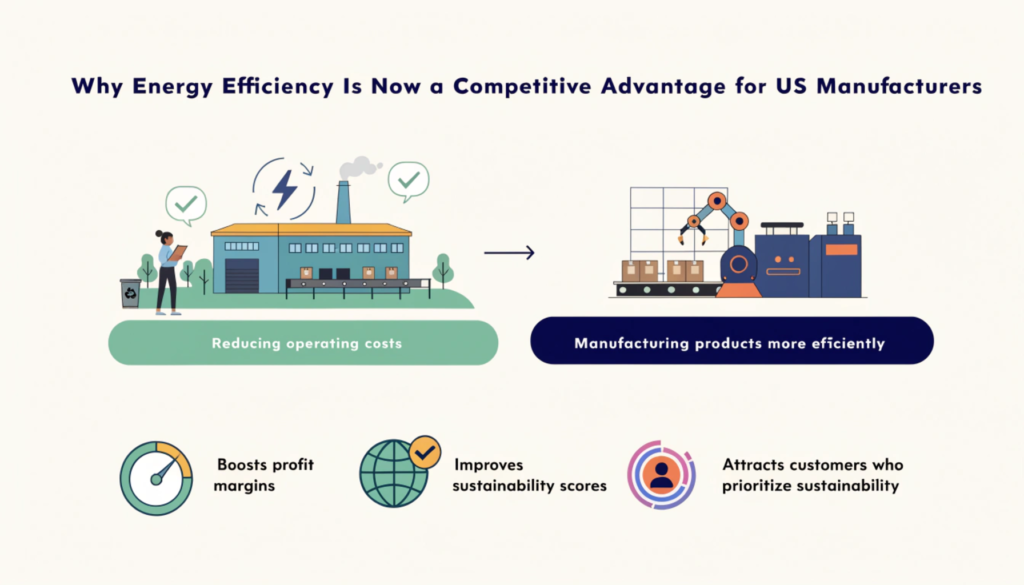
For U.S. manufacturers, energy efficiency is no longer simply an environmental initiative or a way to demonstrate corporate responsibility. It is increasingly becoming a business strategy for controlling costs, improving productivity, and strengthening competitiveness.
Manufacturers operate in an environment where energy prices, supply chain pressures, labor costs, customer expectations and global competition can all influence profitability. In this environment, every unit of energy saved can contribute directly to operational performance.
The growing importance of energy efficiency manufacturing USA is also reflected in government and industry initiatives. In September 2026, the U.S. Department of Energy announced $117 million for 56 projects focused on technologies designed to strengthen American industry through energy- and cost-saving innovations. (The Department of Energy’s Energy.gov)
The message is clear: manufacturers that use energy more intelligently can potentially build leaner, more resilient and more competitive operations.
Why Energy Efficiency Matters More to Manufacturers in 2026
Manufacturing is inherently energy intensive. Factories require electricity and thermal energy to operate machinery, run production lines, heat materials, maintain temperature-controlled environments, power compressed-air systems and support facility operations.
According to the U.S. Department of Energy, the industrial sector represented roughly one-third of U.S. primary energy use in 2020. DOE also identifies energy efficiency as an opportunity to lower costs, improve productivity and strengthen the competitive position of manufacturers. (The Department of Energy’s Energy.gov)
This makes energy management a strategic issue rather than merely a facilities-management concern.
A manufacturer that reduces unnecessary energy consumption can potentially lower operating expenses without reducing production output. When those savings are multiplied across multiple facilities, production lines and years of operation, the financial impact can become significant.
This is one reason energy efficiency manufacturing USA has moved higher on the strategic agenda.
Energy Efficiency Can Directly Improve Manufacturing Costs
One of the most obvious advantages of energy efficiency is cost reduction.
Energy represents a recurring operating expense. Unlike a one-time capital investment, electricity, natural gas and other energy requirements continue throughout the entire operating life of a facility.
Improving efficiency can therefore create recurring savings.
For example, manufacturers can examine:
- Industrial motors and drives
- Compressed-air systems
- Heating and cooling systems
- Industrial boilers
- Process heating
- Lighting
- Refrigeration
- Waste-heat recovery
- Production equipment
- Building-management systems
The objective is not simply to consume less energy. The objective is to produce the same or greater output with less energy.
DOE notes that efficient industrial technologies can perform the same or similar functions while requiring less energy. It also highlights waste-heat recovery, process intensification and high-efficiency process heating among important industrial efficiency opportunities. (The Department of Energy’s Energy.gov)
For manufacturers operating with narrow margins, these improvements can strengthen profitability without relying entirely on increasing product prices.
Energy Efficiency and Productivity Are Connected
Energy efficiency should not be viewed separately from manufacturing productivity.
A factory with outdated equipment may consume excessive energy while also experiencing downtime, maintenance problems and inconsistent production performance.
Modernizing that equipment can potentially address several problems simultaneously.
For example, intelligent motors can improve energy performance while automation systems can optimize machine operation. Sensors can identify abnormal energy consumption and equipment problems. Digital monitoring can help managers understand which production processes consume the most energy.
This creates a connection between smart manufacturing and energy efficiency.
Modern manufacturing systems increasingly use data to understand production performance. The same data can be used to understand energy performance.
Instead of asking only:
How many products did we manufacture today?
Manufacturers can also ask:
How much energy did we use per unit produced?
That second measurement can reveal opportunities that traditional production metrics may overlook.
Smart Manufacturing Is Making Energy Management More Intelligent
Technology is changing how manufacturers approach energy consumption.
Connected sensors, industrial Internet of Things technologies, artificial intelligence, digital twins and advanced analytics can provide manufacturers with greater visibility into their operations.
A smart factory can collect information from machines and production systems and use it to identify patterns.
For example, an energy-management system could identify:
- Machines consuming energy while idle
- Unexpected increases in electricity consumption
- Inefficient production schedules
- Excessive compressed-air usage
- Heating or cooling losses
- Equipment operating outside optimal conditions
- Energy-intensive production processes
This information gives plant managers the opportunity to take corrective action.
The U.S. Department of Energy specifically identifies smart manufacturing tools as part of its efforts to help domestic manufacturers improve operations and efficiency. (The Department of Energy’s Energy.gov)
This means energy efficiency is increasingly becoming a data-driven manufacturing strategy.
Sustainable Manufacturing 2026 Is About More Than Sustainability
The concept of sustainable manufacturing 2026 is evolving.
Sustainability was once frequently treated as a separate corporate initiative focused primarily on emissions, waste reduction or environmental reporting.
Today, sustainable manufacturing increasingly overlaps with operational excellence.
A manufacturer that reduces energy waste can lower costs. A manufacturer that reduces material waste can improve resource productivity. A manufacturer that improves equipment efficiency can reduce energy consumption while potentially improving reliability.
This is where sustainability and competitiveness meet.
The U.S. Department of Energy has emphasized that industrial efficiency can help manufacturers reduce costs, improve performance and strengthen their competitive position. (The Department of Energy’s Energy.gov)
Consequently, sustainable manufacturing should not necessarily be viewed as an additional expense. When implemented strategically, it can become an investment in operational performance.
Energy Efficiency Can Strengthen Supply-Chain Resilience
The benefits of energy efficiency extend beyond individual factories.
Manufacturers today face complex supply-chain risks. Disruptions involving raw materials, transportation, energy availability or geopolitical conditions can affect production.
Reducing unnecessary energy consumption can make a facility more resilient by lowering its dependence on inefficient processes and improving visibility into resource consumption.
Energy management can also be integrated with broader resilience strategies.
For example, manufacturers may combine energy-efficiency investments with:
- On-site energy generation
- Energy storage
- Smart energy-management platforms
- Equipment modernization
- Demand management
- Waste reduction
- Predictive maintenance
The result can be a manufacturing operation that is better prepared to manage changing conditions.
DOE’s Office of Manufacturing and Energy Supply Chains focuses on strengthening domestic manufacturing and improving the resilience and security of U.S. energy supply chains. (The Department of Energy’s Energy.gov)
Energy Efficiency Can Improve Competitiveness in Global Markets
U.S. manufacturers compete not only with companies across the country but also with producers around the world.
When manufacturers reduce energy consumption per unit of output, they can potentially lower the cost of producing goods.
That matters particularly for energy-intensive industries such as chemicals, metals, cement, food and beverage, and other industrial sectors.
DOE reports that energy-intensive industries account for more than 75% of U.S. industrial energy demand, making efficiency and process innovation especially important for these sectors. (The Department of Energy’s Energy.gov)
Lower energy intensity can therefore become a competitive differentiator.
Companies that consistently improve energy productivity may be better positioned to manage cost pressures while continuing to invest in automation, workforce development and product innovation.
Energy Efficiency Supports Better Capital Investment Decisions
Energy efficiency also changes how manufacturers think about capital expenditure.
Instead of replacing equipment simply because it is old, manufacturers can evaluate potential investments based on a wider set of performance indicators.
For example:
Traditional approach:
Replace an inefficient motor when it fails.
Strategic approach:
Evaluate the motor’s energy consumption, maintenance requirements, production performance and expected lifecycle cost before deciding whether replacement makes sense.
This lifecycle approach can help manufacturers identify investments that deliver value over several years.
DOE’s manufacturing energy research includes energy-bandwidth studies that compare typical energy consumption with potential consumption using state-of-the-art and emerging technologies. (The Department of Energy’s Energy.gov)
Such analysis can help manufacturers identify where modernization could produce the greatest impact.
What Manufacturers Should Measure
Improving energy efficiency begins with measurement.
Manufacturers cannot effectively manage energy performance if they do not understand where energy is being consumed.
Important metrics can include:
Energy intensity: Energy consumed per unit of production.
Peak energy demand: The highest level of energy demand during a given period.
Machine-level consumption: Energy consumed by individual machines or production systems.
Facility energy consumption: Total energy used by a manufacturing facility.
Production-adjusted energy use: Energy consumption relative to production volume.
The most useful metric will depend on the industry and production process.
The key is to move beyond simply tracking the monthly utility bill and start connecting energy consumption with production performance.
The Role of Predictive Maintenance
Energy efficiency and maintenance are also closely connected.
Poorly maintained equipment can consume more energy than properly maintained equipment. Friction, leaks, inefficient motors, blocked filters and degraded components can increase energy consumption while reducing performance.
Predictive maintenance technologies can help identify these problems before they result in major failures.
For example, sensors can monitor vibration, temperature, pressure and energy consumption. Analytics can then identify unusual patterns.
This creates a valuable cycle:
Monitor → Analyze → Predict → Maintain → Optimize
The result can be better equipment reliability alongside improved energy performance.
Why 2026 Is an Important Turning Point
The U.S. manufacturing sector is undergoing a broader transformation involving automation, artificial intelligence, advanced materials, digitalization and supply-chain modernization.
NIST’s 2026 manufacturing research continues to focus on strengthening U.S. manufacturing competitiveness and advancing technologies that can improve industrial performance. (NIST)
At the same time, DOE is directing significant attention toward technologies that can improve industrial efficiency and reduce manufacturing costs. In September 2026, DOE announced $117 million in funding for industrial projects aimed at energy- and cost-saving innovations. (The Department of Energy’s Energy.gov)
This creates an important opportunity for manufacturers.
Instead of treating energy efficiency as a separate sustainability project, companies can integrate it into their broader modernization strategies.
When automation, data analytics, energy management and equipment modernization work together, efficiency becomes part of the overall production strategy.
How U.S. Manufacturers Can Build an Energy-Efficiency Strategy
Manufacturers do not necessarily need to transform an entire facility at once.
A practical approach can begin with an energy assessment.
First, identify the processes and machines responsible for the largest energy consumption. Then determine where energy is being wasted and which improvements offer the strongest business case.
Next, establish measurable targets.
For example, a manufacturer could target a reduction in energy consumption per unit of production rather than focusing only on total facility consumption. This helps account for changes in production volume.
Technology can then be introduced where it provides the strongest return. Sensors, automation, energy-management software, efficient equipment and predictive analytics can all play a role.
Finally, manufacturers should continuously monitor results.
Energy efficiency is not a one-time project. It is an ongoing improvement process.
The Competitive Advantage Is Becoming Clearer
The biggest change is that energy efficiency is no longer only about saving energy.
It is about making manufacturing operations smarter.
An efficient factory can potentially have lower operating costs, better equipment performance, improved resource productivity and stronger resilience.
That makes energy efficiency particularly valuable in an environment where manufacturers must simultaneously manage costs, technology investment and global competition.
For U.S. manufacturers, the question is therefore shifting from:
“Can we afford to invest in energy efficiency?”
to:
“Can we afford not to?”
The companies that connect energy management with automation, analytics, maintenance and production optimization will be better positioned to turn efficiency into a long-term competitive advantage.
Conclusion
The rise of energy efficiency manufacturing USA reflects a broader transformation in the manufacturing industry. Energy is no longer simply a utility expense, it is a performance variable that can influence productivity, profitability, resilience and competitiveness.
Meanwhile, sustainable manufacturing 2026 is increasingly about combining environmental responsibility with measurable business value.
For manufacturers, the opportunity is to integrate energy efficiency into every stage of modernization, from equipment selection and factory design to automation, maintenance and data analytics.
The manufacturers that act now can build operations designed not only to consume less energy but also to produce more efficiently, respond faster and compete more effectively.
Register as a Delegate
Want to explore the technologies, strategies and innovations shaping the next generation of manufacturing?
Register as a delegate for the Smart Manufacturing & Automation Convention 2027 and connect with industry professionals, technology leaders and manufacturing experts shaping the future of smart and sustainable production.
Register as a Delegate – Smart Manufacturing & Automation Convention 2027