
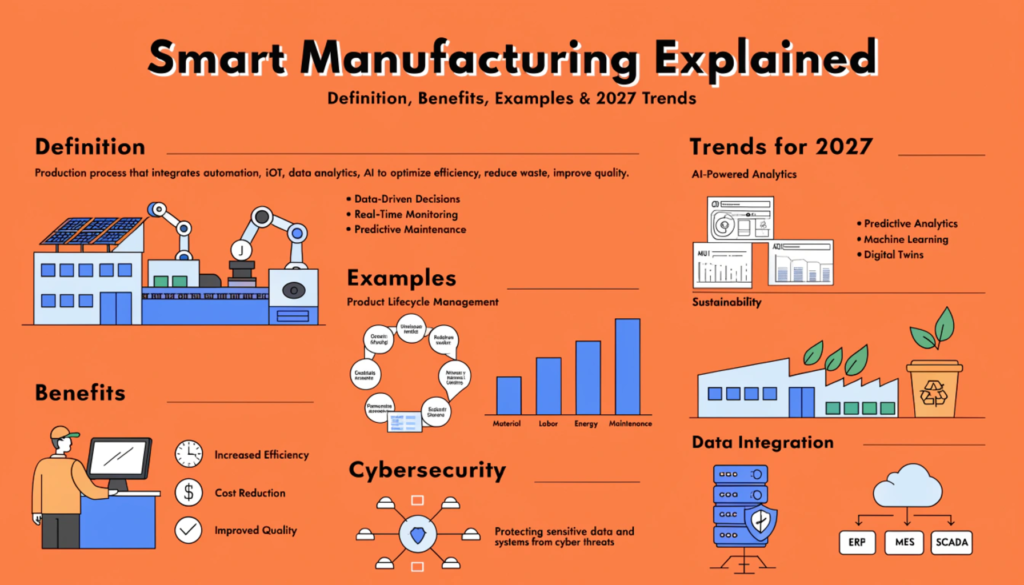
Manufacturing is moving beyond traditional automation. Today, factories are becoming connected, data-driven and increasingly intelligent, allowing manufacturers to monitor operations in real time, predict problems, improve quality and respond faster to changing customer demands. This transformation is commonly referred to as smart manufacturing.
But what is smart manufacturing, and why is it becoming such an important part of the future of industrial production?
Smart manufacturing combines technologies such as Industrial Internet of Things (IIoT), artificial intelligence (AI), machine learning, robotics, cloud computing, edge computing, advanced analytics and digital twins to create more connected and responsive manufacturing operations. IBM describes smart manufacturing as an integrated approach that uses advanced technologies to optimize manufacturing processes and improve agility and adaptability. (IBM)
As manufacturers prepare for 2027, the focus is shifting from simply automating individual machines to creating intelligent systems that can understand operational data, identify opportunities and support faster decision-making.
What Is Smart Manufacturing?
So, what is smart manufacturing in simple terms?
Smart manufacturing is a technology-enabled approach to production in which machines, systems, employees and business processes are connected through data and digital technologies. Instead of relying primarily on manual monitoring and historical information, manufacturers can use real-time data to understand what is happening across the factory and make better operational decisions.
A smart manufacturing environment can collect information from machines and sensors, analyze that information using software and AI, and use the resulting insights to improve production.
For example, sensors installed on a production machine can continuously monitor temperature, vibration, speed and energy consumption. If the system identifies an unusual pattern, analytics or AI can alert maintenance teams before the machine experiences a serious failure.
This creates a shift from reactive manufacturing to predictive and proactive manufacturing.
Smart manufacturing is closely associated with Industry 4.0, which represents the digital transformation of manufacturing through connected technologies, automation, data and intelligent systems. (IBM)
Smart Factory Definition: What Does a Smart Factory Mean?
The smart factory definition is closely connected to smart manufacturing.
A smart factory is a highly connected production environment where machines, systems and people communicate and share data to improve manufacturing performance.
In a traditional factory, different machines and departments may operate as relatively separate systems. Information can become trapped in individual machines, spreadsheets or software platforms.
A smart factory attempts to break down these information silos.
For example, production equipment can communicate with manufacturing execution systems (MES), enterprise resource planning (ERP) platforms, warehouse systems and quality-management applications. Combining these data sources can give managers a more complete view of factory operations.
The smart factory definition therefore goes beyond simply having automated machines. Automation is one component of a smart factory, but connectivity, data visibility, analytics and intelligent decision-making are equally important.
A genuinely smart factory should be able to sense what is happening, analyze information and help people or systems respond effectively.
How Does Smart Manufacturing Work?
Smart manufacturing works through several interconnected layers of technology.
At the factory-floor level, sensors and connected equipment collect data about machines, products and processes. Industrial IoT networks then transmit this information to edge devices, industrial platforms or cloud environments.
Analytics and AI can process the information to identify patterns, anomalies and potential improvements.
For instance, a manufacturer could collect vibration data from motors across a production line. Machine-learning algorithms can analyze the data and identify patterns associated with equipment degradation. Maintenance teams can then inspect the equipment before a breakdown occurs.
The process creates a continuous cycle:
Machines generate data → systems collect data → AI and analytics interpret data → employees or automated systems take action → new data measures the result.
This feedback loop is one of the defining characteristics of smart manufacturing.
Key Technologies Behind Smart Manufacturing
Several technologies form the foundation of modern smart manufacturing.
Industrial Internet of Things
IIoT connects industrial machines, sensors and equipment so they can collect and exchange operational information.
Manufacturers can use IIoT to monitor machine health, production rates, inventory levels, energy consumption and environmental conditions. Connected equipment provides the data required for many other smart manufacturing applications. (IBM)
Artificial Intelligence and Machine Learning
AI and machine learning can transform large volumes of factory data into actionable insights.
Manufacturers can use AI for predictive maintenance, quality inspection, demand forecasting, production optimization and anomaly detection.
The role of AI is expected to become even more significant by 2027. NIST’s 2026 roadmap identifies industrial big-data analytics, advanced sensing, autonomous systems, digital twins, robotics, supply-chain optimization, sustainable manufacturing, generative AI and foundation models among important areas for smart manufacturing development. (NIST)
Robotics and Automation
Robots have long been used for repetitive and physically demanding tasks. Smart manufacturing takes automation further by connecting robotic systems with sensors, software and production data.
Collaborative robots, or cobots, can work alongside human employees, while AI-powered robotic systems can increasingly adapt to changing production requirements.
The industry is also exploring physical AI, in which intelligent software systems interact directly with physical machines and environments. Recent developments indicate growing interest in combining AI with robotics and smart factory systems. (Financial Times)
Digital Twins
A digital twin is a virtual representation of a physical asset, production line, factory or process.
Manufacturers can use digital twins to simulate changes before implementing them in the real environment. This can help teams evaluate production schedules, identify bottlenecks, test layouts and optimize processes.
Digital twins can integrate information from sensors, PLCs, IoT devices, MES and ERP systems to create a more comprehensive representation of factory operations. (McKinsey & Company)
Edge Computing
Not every manufacturing decision can wait for data to travel to a remote cloud environment.
Edge computing processes data closer to where it is generated. This can reduce latency and support applications that require near-real-time responses, such as quality monitoring and machine control. (IBM)
Cloud Computing and Advanced Analytics
Cloud platforms can provide scalable infrastructure for storing and analyzing manufacturing information.
When factory data is combined with analytics, manufacturers can identify trends across production sites, compare performance and support centralized decision-making.
What Are the Benefits of Smart Manufacturing?
Understanding what is smart manufacturing also requires understanding why manufacturers are investing in it.
One major benefit is improved operational visibility. Connected equipment can provide real-time information about production performance instead of requiring managers to depend exclusively on periodic reports.
Smart manufacturing can also improve productivity. Analytics can identify bottlenecks, inefficient processes and underutilized equipment, helping manufacturers focus improvement efforts where they can have the greatest impact.
Another important advantage is predictive maintenance. Instead of waiting for equipment to fail, manufacturers can use machine data to identify potential problems earlier.
Quality can also improve. AI-powered inspection systems can analyze products and processes to identify defects and unusual patterns. Early detection can reduce scrap, rework and customer-quality issues.
Smart manufacturing can also support energy and sustainability objectives. Monitoring energy consumption at machine and production-line levels can help manufacturers identify inefficient equipment and processes.
Workforce capabilities are another important consideration. Smart manufacturing does not simply replace people with machines. It changes the type of work employees perform. Workers increasingly need skills related to data analysis, automation, robotics, cybersecurity and digital systems.
Deloitte’s 2025 smart manufacturing survey found that manufacturers were prioritizing investments in areas including advanced production scheduling, manufacturing execution systems, quality management and data analytics, while many also reported challenges in hiring technology and engineering talent. (Deloitte)
Smart Manufacturing Examples
There are many practical examples of smart manufacturing across modern production environments.
Predictive Maintenance
A factory can use sensors to monitor equipment vibration, temperature and operating conditions. AI models analyze the information and identify unusual patterns.
Maintenance teams receive an alert when equipment shows signs of potential failure. Instead of experiencing unexpected downtime, the manufacturer can schedule maintenance at a more suitable time.
AI-Powered Quality Inspection
Cameras and computer-vision systems can inspect products as they move through production.
AI can identify scratches, dimensional problems, incorrect assembly or other quality issues faster and more consistently than manual inspection alone.
Smart Production Scheduling
Manufacturers can combine customer orders, machine availability, workforce capacity, inventory and production constraints to create optimized schedules.
Advanced analytics and AI can help identify scheduling decisions that reduce idle time, bottlenecks and unnecessary changeovers.
Digital Twin-Based Optimization
Manufacturers can create a digital version of a production line and test different configurations virtually.
Before physically moving equipment, engineers can simulate potential layouts or production scenarios. This can reduce the risks associated with making major changes on the factory floor. (McKinsey & Company)
Connected Supply Chains
Smart manufacturing can extend beyond the factory.
Manufacturers can connect production information with inventory, suppliers, logistics and demand data. This creates greater visibility across the supply chain and can help companies respond more quickly to disruptions.
Smart Manufacturing Trends to Watch in 2027
The next phase of smart manufacturing is likely to focus on making factories not just connected, but increasingly intelligent and adaptive.
1. Generative AI in Manufacturing
Generative AI is expected to become increasingly useful for manufacturing knowledge, engineering support and operational decision-making.
Potential applications include helping employees interpret machine data, generate reports, identify potential causes of equipment problems and interact with complex manufacturing information using natural language.
The NIST 2026 roadmap specifically highlights generative AI, large language models and foundation models as emerging areas for smart manufacturing. (NIST)
2. Physical AI and Intelligent Robotics
By 2027, manufacturers are likely to experiment further with AI systems that interact directly with physical environments.
Rather than programming robots for every possible situation, physical AI aims to make machines more capable of interpreting environments and adapting to tasks.
However, adoption will depend on reliability, safety, cost and the ability of these systems to perform consistently in real industrial environments.
3. Digital Twins Become More Connected
Digital twins are moving from isolated simulations toward more connected operational systems.
By linking digital twins with real-time factory data, AI and optimization technologies, manufacturers can potentially simulate scenarios and make better production decisions continuously.
This could make digital twins an increasingly important component of the smart factory.
4. Edge AI for Real-Time Decisions
As factories generate increasing amounts of data, processing everything centrally may not always be practical.
Edge AI can bring intelligent analytics closer to machines and production processes, supporting faster decisions and reducing dependence on constant cloud connectivity.
5. Greater Focus on Industrial Cybersecurity
More connected factories also create more potential cybersecurity risks.
As IT and operational technology become increasingly integrated, manufacturers will need stronger approaches to identity management, network security, device protection and monitoring.
Cybersecurity is therefore becoming a core part of the smart factory definition, rather than an optional technology layer.
6. Sustainable Smart Manufacturing
Manufacturers are increasingly using digital technologies to understand resource consumption.
Smart sensors and analytics can monitor electricity, water, materials and emissions across production processes. This information can help companies identify waste and improve resource efficiency.
The combination of AI, automation and sustainability is expected to remain an important area of smart manufacturing development in 2027. (NIST)
7. Human-Machine Collaboration
The future of smart manufacturing will not be exclusively about autonomous factories.
Human expertise will remain essential for engineering, maintenance, quality, leadership and complex decision-making. The World Economic Forum’s 2026 outlook describes a movement toward intelligent and increasingly autonomous industrial systems in which humans and intelligent technologies work together in real time. (World Economic Forum)
The most successful manufacturers are therefore likely to focus on human-machine collaboration, combining automation with workforce development.
Challenges of Smart Manufacturing Adoption
Despite its benefits, implementing smart manufacturing is not as simple as purchasing new technology.
Legacy equipment can be difficult to connect with modern systems. Data may exist in different formats across different platforms, creating integration challenges.
Cybersecurity is another concern because connecting operational equipment increases the importance of protecting industrial networks.
Data quality is equally important. AI systems depend on reliable information. Poor-quality, incomplete or inaccurate sensor data can reduce the effectiveness of analytics and AI applications.
Workforce skills can also become a barrier. Employees may need training in automation, data analytics, cybersecurity and digital manufacturing systems.
For this reason, manufacturers should approach smart manufacturing as a long-term transformation rather than a single technology project.
How Manufacturers Can Prepare for 2027
Companies planning their smart manufacturing strategy should begin with business problems rather than technology trends.
Instead of asking, “Which new technology should we buy?” manufacturers should ask, “Which operational problem are we trying to solve?”
A company struggling with unplanned downtime might begin with machine monitoring and predictive maintenance. A company facing quality issues might prioritize computer vision and real-time analytics. Another manufacturer may benefit more from digital production scheduling or energy monitoring.
Starting with a focused use case can make it easier to demonstrate measurable value before scaling across the factory.
Manufacturers should also develop a strong data foundation, integrate IT and OT environments carefully, establish cybersecurity controls and invest in employee training.
Deloitte’s research shows that manufacturers are increasingly creating dedicated teams and structured programs to support smart manufacturing implementation, demonstrating that successful transformation involves people and processes as well as technology. (Deloitte)
The Future of Smart Manufacturing
So, what is smart manufacturing ultimately becoming?
It is evolving from connected machines and automated production toward intelligent industrial ecosystems.
The factory of the future will increasingly combine IIoT, AI, robotics, digital twins, edge computing, advanced analytics and human expertise. These technologies will allow manufacturers to move closer to real-time decision-making, predictive operations and increasingly autonomous production.
However, technology alone will not determine success. Manufacturers will need reliable data, secure infrastructure, skilled employees and clear business objectives.
As 2027 approaches, the organizations that successfully combine these elements will be better positioned to build factories that are more productive, flexible, resilient and sustainable.
The smart factory definition is therefore expanding. A smart factory is no longer simply a facility filled with automated equipment. It is a connected and intelligent production environment where data continuously supports better decisions and where people and technology work together to improve performance.
Conclusion
The answer to what is smart manufacturing can be summarized simply: it is the integration of connected technologies, data, automation and intelligence to create more efficient, flexible and responsive manufacturing operations.
From predictive maintenance and AI-powered quality inspection to digital twins, intelligent robotics and edge AI, smart manufacturing is changing how factories operate.
As manufacturers look toward 2027, the biggest opportunity will be moving beyond isolated technology pilots and building connected systems that deliver measurable business value.
Explore convention topics to discover the technologies, strategies and industry discussions shaping the future of smart manufacturing and automation.