
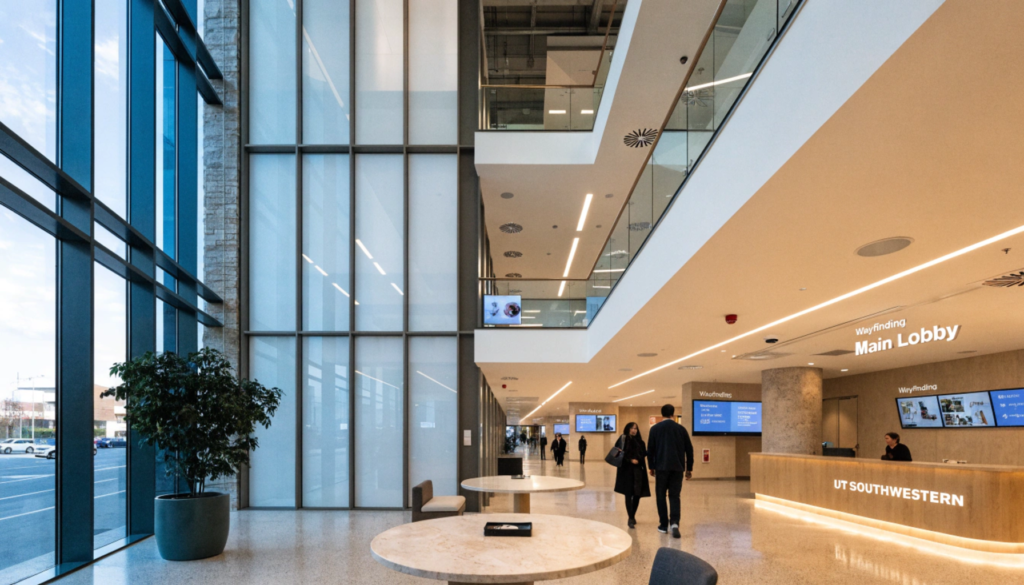
Modern hospitals are no longer defined only by advanced medical equipment or the number of beds they provide. Increasingly, the physical environment itself has become an important part of healthcare delivery. From patient room layouts and natural lighting to digital connectivity, clinical workflows, sustainability, and emergency response, facility design can directly influence how efficiently healthcare teams work and how comfortably patients experience care.
Few examples demonstrate this shift as clearly as UT Southwestern Medical Center in Dallas. Its approach to hospital planning shows how thoughtful architecture, technology, operational efficiency, and patient-centered thinking can work together. The William P. Clements Jr. University Hospital, in particular, was planned around the idea that the building should support better care rather than simply house it. UT Southwestern describes the hospital as a facility designed around patient-centered care, innovation, and the integration of research, education, and clinical missions. (UT Southwestern)
This approach has helped make the UT Southwestern smart hospital concept an interesting model for healthcare organizations looking to rethink facility design for the future.
From Hospital Building to Healthcare Ecosystem
When UT Southwestern began planning Clements University Hospital, the goal was not simply to replace an aging facility. The institution wanted to rethink what a modern academic hospital could accomplish.
The 12-story, 460-bed hospital replaced St. Paul University Hospital, which had opened in 1963. Planning involved input from physicians, nurses, clinicians, patients, and members of the Dallas community. Three broad priorities guided the process: putting patients first, promoting innovation, and integrating patient care with education and research. (UT Southwestern)
That distinction is important because smart facility design starts before construction begins. It begins with understanding how people move through a building, where clinical teams need to collaborate, how patients and visitors navigate the environment, and which technologies can make everyday operations more effective.
Instead of treating architecture, technology, and clinical operations as separate areas, UT Southwestern’s model brings them together.
The result is a facility where design decisions are closely connected to healthcare outcomes and operational requirements.
Designing Around the Patient
One of the clearest characteristics of the UT Southwestern smart hospital approach is its emphasis on the patient experience.
Clements University Hospital incorporates large windows that provide substantial natural light. Patient rooms were designed to offer space for family members and caregivers, recognizing that healthcare is not experienced by patients alone. Rooms also provide patients with greater control over their environment, including lighting, temperature, and window shades. (UT Southwestern)
These features may appear simple, but they represent an important change in healthcare facility thinking.
A hospital can be technologically advanced while still feeling stressful, confusing, or uncomfortable. Smart design attempts to solve both problems simultaneously. Technology should not dominate the environment; instead, it should operate in the background while making the patient’s experience easier.
For example, bedside technology at Clements allows patients to control aspects of their room environment and access services. Flat-screen systems with videoconferencing capabilities can also support communication between physicians and patients, display medical images, and connect patients with family members. (UT Southwestern)
This is a useful lesson for healthcare developers: smart facilities should be designed around human needs first, with technology serving those needs.
Improving Clinical Workflow Through Architecture
A major strength of UT Southwestern’s approach is that smart design is not limited to visible technology.
The physical layout of a hospital can have a major effect on clinical efficiency. If nurses and physicians must constantly travel long distances between patient rooms, supply areas, support spaces, and clinical departments, valuable time can be lost.
Clements University Hospital was designed to reduce unnecessary travel for caregivers and improve communication between team members. Its layout supports better visibility and closer proximity between clinical functions. (UT Southwestern)
The hospital’s distinctive W-shaped design is an example of architecture being used as an operational tool. According to UT Southwestern materials, the configuration improves sightlines into patient rooms while also making navigation easier for patients, visitors, and staff. (UT Southwestern)
This principle extends beyond one hospital.
As healthcare organizations face staffing pressures and rising patient volumes, facility design can help teams work more efficiently. A smart building is therefore not simply one filled with sensors and connected devices. It is a building in which the physical environment supports the way people actually deliver care.
Designing for Faster Emergency Response
Healthcare facility design becomes even more important when minutes can affect patient outcomes.
UT Southwestern’s expansion of Clements University Hospital demonstrates how planners considered the movement of patients and clinicians during time-sensitive care. During the expansion, clinical and support functions were intentionally positioned close to one another. For example, the helipad was placed near the entrance to the angio suite, while the neurointensive care unit was located on the same floor as the angio suite. (UT Southwestern)
These decisions illustrate an important component of smart hospital design: reducing friction.
Every unnecessary transfer, corridor, elevator journey, or communication delay can create operational challenges. By considering these movements during the design phase, hospitals can create workflows that are more responsive.
This is where architecture becomes part of healthcare strategy.
Technology That Supports Smarter Operations
The digital layer is another important element of modern facility design.
UT Southwestern has explored technologies that can connect patients, staff, equipment, and physical spaces. Its work on location tracking and artificial intelligence has included concepts in which sensors can monitor patient movement and identify delays in clinical workflows. UT Southwestern researchers have described a future hospital environment in which sensors across buildings, equipment, and patients could generate data that AI systems analyze to improve workflow and monitoring. (UT Southwestern)
The broader lesson is that healthcare facilities are increasingly becoming data-generating environments.
Connected systems can potentially help organizations understand how rooms are being used, where bottlenecks occur, how equipment moves through a facility, and where staff time is being consumed. When these insights are combined with clinical and operational data, facility leaders can make more informed decisions.
However, technology alone does not create a smart hospital.
The infrastructure must be planned to support connectivity, cybersecurity, interoperability, maintenance, and future upgrades. UT Southwestern’s current design guidelines, for example, address Wi-Fi access and coordination of data requirements for equipment, demonstrating how digital infrastructure is incorporated into facility planning. (UT Southwestern)
Sustainability as Part of Smart Facility Design
Energy efficiency and environmental responsibility are also increasingly connected to healthcare facility strategy.
Hospitals operate continuously and require significant amounts of energy, water, ventilation, cooling, and specialized infrastructure. Therefore, sustainability cannot be treated as an optional architectural feature.
UT Southwestern applies LEED standards when designing and constructing new facilities. Its sustainability initiatives have also included improvements to energy systems, recycling, landscaping, transportation, and hospital waste reduction. (UT Southwestern)
This demonstrates how sustainability can become part of a broader smart facility strategy.
Efficient buildings can reduce operating costs while supporting institutional environmental goals. More efficient thermal systems, responsible landscaping, waste reduction, and better resource management can contribute to long-term facility performance.
For healthcare executives, the important takeaway is that sustainability and smart technology should not be developed as isolated initiatives. They can work together as part of a comprehensive facilities strategy.
Flexibility: Preparing Hospitals for the Future
Healthcare changes quickly. A facility designed around today’s technology and clinical requirements may become difficult to adapt within a decade.
UT Southwestern’s continued campus development demonstrates the importance of planning for growth and changing healthcare needs. Its campus now encompasses major new towers and extensive facilities, while projects such as the new pediatric campus are being designed around future clinical, research, and family needs. (UT Southwestern)
The new Dallas pediatric campus, developed by UT Southwestern and Children’s Health, is planned as a major hub for pediatric care, research, training, and innovation. Its design includes family-centered spaces and connections between clinical, research, and support functions. (UT Southwestern)
This points toward another defining feature of smart healthcare facilities: adaptability.
Flexible rooms, scalable infrastructure, modular technology, and thoughtful circulation can help hospitals respond to new treatments, changing patient demographics, and emerging technologies without requiring constant major reconstruction.
Extending the Model Beyond Traditional Hospitals
UT Southwestern’s facility philosophy is also visible in newer healthcare projects.
In 2026, the Texas Behavioral Health Center in Dallas opened with a patient-centered design developed through a partnership between UT Southwestern and the Texas Health and Human Services Commission. The 292-bed facility includes flexible spaces, patient “neighborhoods,” exercise areas, sensory rooms, a café, a chapel, outdoor courtyards, and other environments designed to support treatment and recovery. (UT Southwestern)
This is significant because smart facility design does not have one universal appearance.
A smart behavioral health facility may need different environmental characteristics from a surgical hospital. A pediatric hospital requires different considerations from an oncology center. The underlying principle, however, remains consistent: design the physical environment around the needs of patients, clinicians, families, and future healthcare delivery.
What Dallas Healthcare Innovation Can Teach Other Healthcare Leaders
The story of UT Southwestern offers valuable lessons for organizations investing in new construction, renovation, or digital transformation.
First, smart facility planning should begin with people rather than technology. Understanding patient and staff workflows can reveal opportunities that a technology-first approach may overlook.
Second, architecture should support clinical operations. Patient room visibility, departmental adjacency, emergency routes, and staff circulation can all influence efficiency.
Third, digital infrastructure should be planned as part of the building rather than added after construction. Connectivity, data requirements, sensors, automation, and equipment integration increasingly depend on the physical infrastructure of the facility.
Fourth, sustainability should be incorporated from the beginning. Energy efficiency, resource management, waste reduction, and resilient infrastructure can create long-term operational benefits.
Finally, healthcare facilities should be designed for change.
These principles help explain why Dallas healthcare innovation has become increasingly relevant to conversations about the future of hospital infrastructure. UT Southwestern demonstrates that innovation does not necessarily mean adding the newest technology to an existing building. Sometimes, the most important innovation is rethinking the building itself.
The Future of Smart Healthcare Facilities
The next generation of hospitals will likely become even more connected.
Artificial intelligence, real-time location systems, digital twins, predictive maintenance, automated building management, robotics, remote monitoring, and advanced analytics could increasingly influence how healthcare facilities operate.
But the foundation for these technologies is thoughtful facility design.
UT Southwestern’s experience demonstrates that a smart hospital is ultimately a combination of architecture, technology, operations, sustainability, and human-centered planning. Clements University Hospital shows how these principles can be incorporated into the physical environment, while newer projects demonstrate how the approach continues to evolve.
The UT Southwestern smart hospital model is therefore valuable not because every healthcare organization should copy its exact building design, but because it provides a framework for thinking differently about healthcare infrastructure.
The future of healthcare will depend not only on medical breakthroughs but also on the environments in which those breakthroughs are delivered.
Learn From the Future of Healthcare Facility Design
Healthcare leaders, facility executives, architects, technology specialists, and infrastructure professionals need opportunities to exchange ideas about the next generation of intelligent healthcare environments.
If your organization is exploring smart hospitals, sustainable infrastructure, digital facility management, automation, patient-centered design, and emerging healthcare technologies, Attend Healthcare Convention 2027 Houston to connect with industry professionals and explore the future of smart healthcare facilities.