
Introduction
Hospitals are no longer planned simply around the number of beds they need today. Changing patient expectations, advances in medical technology, workforce pressures, sustainability targets, digital transformation and shifting models of care are forcing health systems to think much further ahead.
A hospital master plan provides a structured framework for making those long-term decisions. It connects clinical priorities with facilities, infrastructure, technology, finances and operational requirements so that investments made today continue to support the organisation tomorrow.
However, there is no single planning model that works for every health system. A growing regional hospital may need a very different approach from an established urban medical centre operating on a constrained site. A health system focused on ambulatory care may require a different strategy from one expanding specialist and acute-care services.
Understanding different hospital master planning approaches is therefore essential before committing to a long-term development strategy.
The right approach should reflect the health system’s clinical mission, financial position, physical constraints, growth expectations and vision for future care delivery.
What Is Hospital Master Planning?
Hospital master planning is the process of creating a long-term framework for how a healthcare campus, facility or health system should develop over time.
Rather than focusing only on individual construction projects, master planning considers the bigger picture. It can address land use, clinical adjacencies, patient flows, infrastructure capacity, building condition, future expansion, technology requirements, parking, logistics, energy performance and the relationship between different healthcare facilities.
Effective planning also connects physical development with organisational strategy.
This is where healthcare facility strategic planning becomes particularly important. A hospital cannot make sound infrastructure decisions without understanding where healthcare services are heading. For example, increasing outpatient demand may reduce the need for some inpatient expansion while creating greater demand for diagnostic, ambulatory and same-day treatment facilities.
Master planning should therefore begin with strategic questions rather than architectural drawings.
Why Choosing the Right Planning Approach Matters
A poorly selected planning model can create expensive problems later. A hospital may invest in additional capacity that becomes underused, create inefficient departmental relationships or design facilities that cannot adapt to new technologies.
Conversely, a well-selected approach can help organisations phase investments, improve patient experience and use limited capital more effectively.
The most effective hospital master planning approaches provide enough structure to guide investment while maintaining flexibility as healthcare requirements evolve.
Several models can be considered depending on the health system’s priorities.
1. The Traditional Campus Master Planning Approach
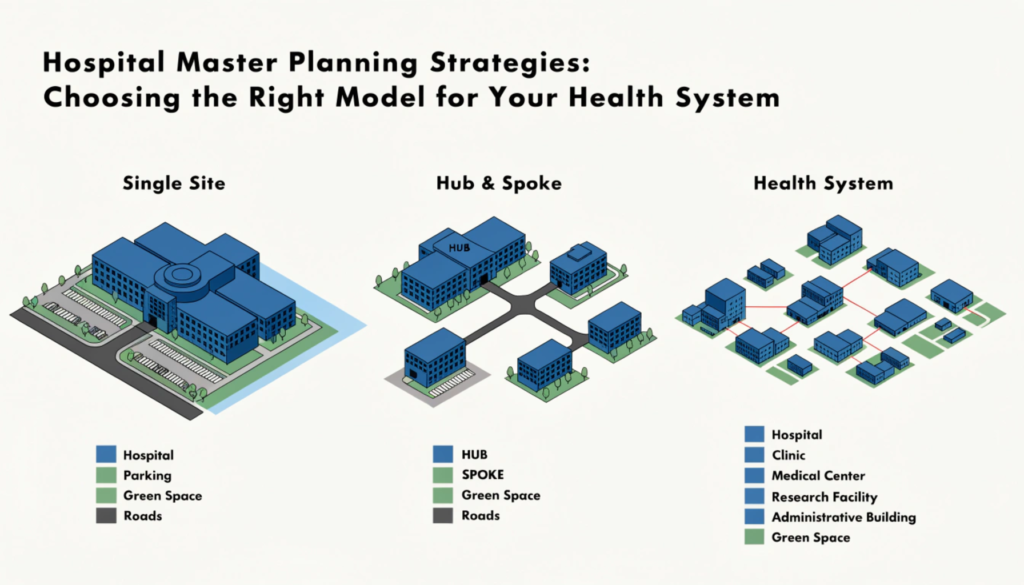
The traditional campus-based model focuses on the physical hospital campus and its future development.
Planners typically assess existing buildings, site conditions, circulation routes, utilities, clinical departments and available expansion areas. A long-term physical framework is then developed to show where new buildings, additions and infrastructure improvements could be located.
This model is particularly useful for hospitals that expect to remain concentrated on a single campus.
For example, an established medical centre may have a strong clinical identity and significant existing infrastructure but need additional operating rooms, diagnostic capacity or inpatient units. Campus master planning allows these requirements to be addressed while considering how new development will interact with existing facilities.
The major advantage is clarity. Decision-makers can see how individual projects fit into a larger physical strategy.
The challenge is that traditional campus planning can become too focused on buildings if it is not connected to broader clinical and operational strategy.
2. Strategic or Vision-Driven Master Planning
A strategic master planning approach begins with the future vision of the health system rather than the existing physical campus.
The planning team starts by examining questions such as: What services will the organisation provide in ten or twenty years? Which patient populations are expected to grow? How will care delivery change? What role will digital health and virtual care play? Which services should remain centralised, and which could move closer to communities?
The answers then influence facility requirements.
This approach works particularly well for health systems undergoing significant transformation. Instead of simply replacing outdated buildings, the organisation can reconsider how care should be delivered before deciding what should be constructed.
This is a core principle of effective healthcare facility strategic planning: facilities should support the business and clinical strategy rather than determine it.
The benefit is long-term alignment. The risk is that strategic assumptions can change, meaning the resulting plan must include flexibility and regular review.
3. Incremental or Phased Master Planning
Not every health system can fund a major redevelopment programme at once. In these situations, an incremental planning model can be highly effective.
Instead of developing a single large capital programme, the hospital identifies a sequence of manageable projects. Each phase addresses an immediate priority while protecting future options.
For example, a health system might first upgrade its emergency department, then expand diagnostic services, followed by an ambulatory care centre and eventually additional inpatient capacity.
The important principle is that each project should fit within a long-term framework.
Incremental planning is particularly valuable when capital availability is uncertain. It allows healthcare organisations to respond to immediate needs without locking themselves into an inflexible development strategy.
However, phasing requires careful coordination. Temporary facilities, construction disruption, utility capacity and future expansion zones must all be considered from the beginning.
4. Scenario-Based Master Planning
Healthcare demand is difficult to predict with complete certainty. Scenario-based planning addresses this uncertainty by developing several possible futures instead of relying on a single forecast.
A health system may develop scenarios based on different levels of population growth, changes in reimbursement, shifts toward outpatient care, technology adoption or changes in service demand.
The physical plan can then be tested against each scenario.
For example, if inpatient demand grows significantly, the plan might allow for additional beds. If care shifts more aggressively toward outpatient settings, the same site could instead accommodate ambulatory facilities.
This makes scenario-based planning one of the more adaptable hospital master planning approaches.
It is especially useful for organisations operating in rapidly changing markets or those making major long-term investments where the consequences of incorrect assumptions could be substantial.
5. Network-Based Health System Planning
Large health systems increasingly need to think beyond individual hospital campuses.
A network-based approach considers hospitals, outpatient centres, diagnostic facilities, specialty centres, urgent care locations and community-based services as parts of a connected system.
Instead of asking, “How much additional capacity does this hospital need?” planners ask, “Where should each service be provided across the network?”
This can prevent unnecessary duplication.
For instance, advanced diagnostic or specialist services may be concentrated at one location while routine services are distributed across community facilities. The resulting master plan focuses on the movement of patients, staff, information and resources throughout the network.
This model is particularly appropriate for multi-hospital systems seeking to improve access and optimise capital investment.
6. Flexible and Adaptable Planning
Healthcare facilities built today may need to serve completely different clinical requirements in the future. Flexible planning therefore focuses on creating buildings that can adapt.
This can influence structural grids, floor-to-floor heights, mechanical systems, circulation, room dimensions and infrastructure distribution.
A facility designed with adaptability in mind may allow clinical spaces to be converted more easily as demand changes.
For example, an area initially designed for one type of clinical service may eventually be converted for another without requiring major structural reconstruction.
Flexible planning can increase initial investment, but it may reduce long-term costs and improve the useful life of the facility.
For health systems facing rapid technological and clinical change, flexibility should be treated as a strategic asset rather than simply an architectural feature.
7. Sustainability-Led Master Planning
Environmental performance has become an increasingly important consideration in healthcare infrastructure.
Hospitals are energy-intensive facilities that operate continuously, making energy efficiency, water management, waste reduction and resilient infrastructure important elements of long-term planning.
A sustainability-led approach integrates environmental objectives into site selection, building orientation, energy systems, materials, transportation and operational planning.
It can also consider resilience against extreme weather, power disruptions, water shortages and other risks.
Rather than treating sustainability as an additional feature added to individual projects, this approach incorporates it into the master plan itself.
The result can be a healthcare campus that is more efficient, resilient and prepared for future environmental requirements.
How Should a Health System Choose?
The right approach depends on the organisation’s circumstances.
An established hospital with limited land may benefit from campus and phased planning. A rapidly growing health system may require scenario-based and network planning. An organisation undergoing a major clinical transformation may benefit from strategic, vision-driven planning.
In many cases, the best solution is not one model but a combination.
For example, a health system could use strategic planning to establish its long-term clinical vision, scenario planning to test uncertainty, network planning to determine where services should be delivered and phased campus planning to translate the strategy into construction projects.
This integrated approach provides greater resilience than relying on a single methodology.
Key Factors to Evaluate Before Master Planning
Before selecting a planning model, health leaders should assess several fundamentals.
First is clinical demand. Population growth, ageing demographics, disease patterns and referral trends can influence future service requirements.
Second is existing infrastructure. Building condition, utility capacity, floor layouts and regulatory requirements can determine whether existing facilities can support future operations.
Third is financial capacity. A technically excellent master plan is of limited value if the organisation cannot realistically fund its implementation.
Technology is another major factor. Digital health, automation, advanced diagnostics and connected building systems can influence both space requirements and infrastructure design.
Patient experience should also be considered. Convenient access, intuitive navigation, comfortable environments and reduced waiting times can all influence planning decisions.
Finally, the organisation should assess resilience. The master plan should consider how facilities will respond to emergencies, supply disruptions, changing demand and unexpected events.
Common Mistakes in Hospital Master Planning
One of the most common mistakes is planning around buildings instead of healthcare strategy.
Another is assuming that today’s demand will remain unchanged. Healthcare delivery can evolve quickly, so plans based entirely on historical utilisation may become outdated.
Ignoring operational workflows is another problem. A visually impressive facility can still perform poorly if patient, staff, material and waste flows are inefficient.
Hospitals can also underestimate the importance of infrastructure. Electrical systems, medical gases, cooling, water, data networks and vertical transportation can become constraints when expansion is planned without adequate capacity analysis.
Finally, master plans should not be treated as documents that are completed once and then placed on a shelf. They should be reviewed periodically as market conditions, technology, clinical models and organisational priorities change.
Building a Master Plan That Can Evolve
The strongest hospital master planning approaches are not necessarily those that predict the future perfectly. They are the ones that allow healthcare organisations to respond when the future differs from expectations.
A successful master plan should provide a clear direction while preserving options.
That means identifying strategic priorities, protecting expansion opportunities, designing adaptable infrastructure, establishing realistic development phases and creating measurable criteria for reviewing progress.
The planning process should also involve clinicians, facilities teams, executives, finance leaders, IT specialists and other stakeholders. Their combined perspectives can reveal operational requirements that may not be visible from a purely architectural or financial viewpoint.
Conclusion
Hospital master planning has evolved from a predominantly physical exercise into a strategic process connecting clinical care, infrastructure, technology, finance and long-term organisational objectives.
There is no universally correct model. Traditional campus planning, strategic planning, phased development, scenario planning, network-based planning, flexible design and sustainability-led planning can each provide value depending on the health system’s needs.
The most effective hospital master planning approaches recognise that healthcare environments must continuously adapt. By combining long-term vision with realistic phasing, scenario testing and flexible infrastructure, health systems can make better capital decisions while preparing for changing patterns of care.
Ultimately, the right master plan is not simply the one that creates more space. It is the one that creates the right capacity, in the right locations, with enough flexibility to support better healthcare for years to come.
Register as a Delegate
Explore the latest ideas, strategies and innovations shaping healthcare facilities and connect with industry professionals at the upcoming event.