
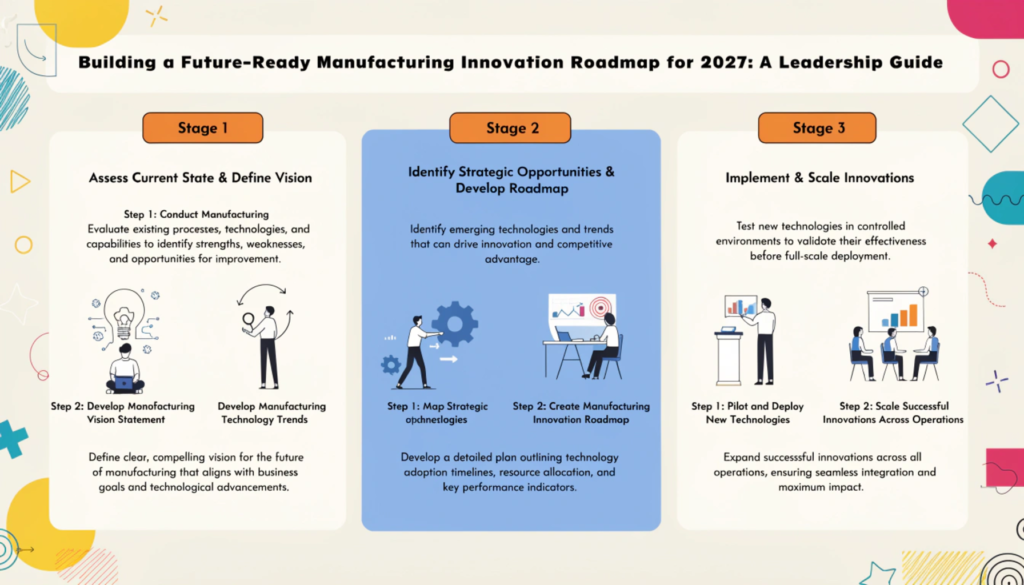
Manufacturing is entering a new phase where competitiveness depends on how effectively organisations combine technology, people, data, sustainability, and operational excellence. As customer expectations rise and supply chains become more complex, manufacturers can no longer treat innovation as a collection of isolated technology projects. They need a clear direction that connects business priorities with measurable transformation.
A well-designed manufacturing innovation roadmap 2027 can help leadership teams identify where to invest, which technologies to prioritise, how to prepare their workforce, and how to turn innovation into measurable business value. Rather than adopting every emerging technology, organisations need a structured approach that focuses investment on the areas with the greatest strategic impact.
Why Manufacturers Need an Innovation Roadmap for 2027
The manufacturing environment is changing rapidly. Artificial intelligence, industrial automation, robotics, digital twins, advanced analytics, connected machinery, edge computing, and smart factory platforms are moving from experimental concepts into practical business applications.
However, implementing technology without a long-term strategy can create disconnected systems, unnecessary costs, and limited returns. A roadmap gives leadership a framework for deciding what should happen first, what can wait, and how individual projects contribute to broader organisational objectives.
The purpose of a manufacturing innovation roadmap 2027 is therefore not simply to list emerging technologies. It should establish a sequence of initiatives that supports business growth, operational resilience, cost efficiency, quality improvement, workforce development, and sustainability.
For leadership teams, the roadmap becomes a decision-making tool. It provides a common vision across operations, IT, engineering, finance, supply chain, and human resources.
Start With Business Objectives, Not Technology
One of the biggest mistakes manufacturers make is beginning their transformation journey by asking, “Which technology should we implement?” A better question is, “Which business problem are we trying to solve?”
Before selecting technologies, leadership should identify the organisation’s most important objectives for 2027. These could include increasing production capacity, reducing downtime, improving product quality, lowering energy consumption, reducing waste, strengthening supply chain resilience, or improving customer responsiveness.
For example, if unplanned equipment downtime is reducing productivity, predictive maintenance and industrial analytics may provide greater value than investing immediately in a large-scale digital twin programme. If labour shortages are limiting production capacity, robotics and intelligent automation could become higher priorities.
This business-first approach ensures that innovation investments are connected to measurable outcomes.
Assess Your Current Manufacturing Maturity
The next stage is to understand where the organisation stands today. A successful manufacturing innovation roadmap 2027 should be based on an honest assessment of existing capabilities rather than assumptions about digital maturity.
Leadership should examine areas such as production systems, automation levels, machine connectivity, data availability, cybersecurity, workforce skills, maintenance processes, quality management, supply chain visibility, and energy management.
The assessment should identify both strengths and gaps. Some facilities may already have connected equipment and advanced automation, while others may still rely heavily on manual processes and disconnected systems.
A maturity assessment can help classify initiatives into categories such as foundational, developing, advanced, and transformational. This allows leadership to understand whether the organisation is ready for advanced technologies or whether foundational infrastructure needs to be improved first.
Prioritise Technologies That Create Business Value
The manufacturing technology landscape is crowded. Artificial intelligence, machine learning, robotics, computer vision, digital twins, Industrial Internet of Things platforms, autonomous systems, augmented reality, cloud computing, and advanced analytics can all contribute to transformation.
But adopting technology simply because it is popular can create unnecessary complexity.
The manufacturing innovation roadmap 2027 should rank technologies according to factors such as business impact, implementation cost, scalability, workforce readiness, integration requirements, cybersecurity risks, and expected return on investment.
Artificial intelligence, for example, can support predictive maintenance, demand forecasting, quality inspection, process optimisation, and production planning. However, AI initiatives depend on reliable data. If machine data is incomplete or inconsistent, improving data infrastructure may need to come before implementing sophisticated AI applications.
Similarly, robotics can improve productivity and consistency, but manufacturers need to evaluate process suitability, worker training, maintenance requirements, and the economics of automation before making large investments.
Build a Strong Data Foundation
Data will be one of the most important foundations of manufacturing innovation in 2027. Connected equipment can generate enormous amounts of operational information, but data only creates value when organisations can collect, integrate, analyse, and act on it.
Manufacturers should evaluate whether production systems, enterprise resource planning platforms, manufacturing execution systems, sensors, machines, and quality systems can communicate effectively.
A strong data strategy should include data governance, integration standards, cybersecurity, accessibility, and ownership. Leadership should also establish clear rules around who can access operational data and how it will be used.
Without a strong data foundation, advanced analytics and AI applications may produce unreliable results. Therefore, data infrastructure should be treated as a strategic investment rather than a purely technical requirement.
Integrate AI Into Manufacturing Operations
AI is expected to become an increasingly important component of manufacturing transformation. However, leadership should focus on practical applications rather than treating AI as a standalone initiative.
Manufacturers can explore AI for predictive maintenance, automated quality inspection, production scheduling, demand forecasting, inventory optimisation, energy management, and process monitoring.
Computer vision systems, for example, can help identify defects faster and more consistently. AI-powered analytics can identify patterns in equipment performance that may not be visible through traditional monitoring.
A sensible roadmap should begin with high-value, manageable use cases. Once successful applications demonstrate measurable results, organisations can scale them across additional production lines, plants, or business units.
Accelerate Smart Automation and Robotics
Automation will remain a major driver of manufacturing productivity in 2027. The focus, however, is shifting from isolated automation to interconnected and intelligent systems.
Manufacturers can combine robotics, sensors, machine vision, industrial software, and real-time analytics to create more adaptive production environments.
Collaborative robots can support workers with repetitive or physically demanding tasks, while automated guided vehicles and autonomous mobile robots can improve material movement. Automated inspection systems can also support quality control.
The roadmap should consider where automation will have the greatest impact rather than attempting to automate every process. Leadership should evaluate cycle time, labour requirements, safety, quality, flexibility, and expected payback before prioritising automation projects.
Make Workforce Transformation a Leadership Priority
Technology transformation cannot succeed without people. New equipment and software change the skills employees need, making workforce development an essential part of manufacturing strategic planning.
Employees may need training in robotics operation, data analysis, digital systems, cybersecurity, AI tools, equipment maintenance, and advanced problem-solving.
Leadership should communicate that automation is not simply about replacing manual work. In many cases, it can allow employees to move toward higher-value responsibilities involving supervision, analysis, maintenance, and process improvement.
A strong roadmap should therefore include training programmes, reskilling initiatives, technical certifications, leadership development, and collaboration between experienced manufacturing professionals and digitally skilled employees.
Include Sustainability in the Innovation Strategy
Sustainability is becoming increasingly connected to manufacturing competitiveness. Energy efficiency, waste reduction, emissions management, resource optimisation, and circular production practices can deliver both environmental and financial benefits.
Manufacturers can use connected sensors and analytics to monitor energy consumption across production processes. AI can identify inefficient operating conditions, while automation can improve material utilisation and reduce defects.
The manufacturing innovation roadmap 2027 should therefore include sustainability objectives alongside productivity and financial targets.
For example, an organisation could establish goals for reducing energy consumption per unit produced, minimising material waste, increasing equipment efficiency, or improving resource utilisation.
This approach makes sustainability part of operational performance rather than treating it as a separate corporate initiative.
Strengthen Cybersecurity and Operational Resilience
As factories become more connected, cybersecurity risks also increase. Industrial control systems, connected machines, cloud platforms, sensors, and enterprise systems create more potential entry points for cyber threats.
Cybersecurity should therefore be integrated into every stage of the innovation roadmap.
Manufacturers should assess network security, access controls, device management, software updates, employee awareness, data protection, and incident response capabilities. New technologies should not be deployed without understanding how they affect the organisation’s overall security posture.
Resilience should also extend beyond cybersecurity. Supply chain disruption, equipment failures, labour shortages, and component availability can significantly affect production.
A future-ready roadmap should therefore combine digital transformation with business continuity and operational resilience.
Create a Phased Implementation Roadmap
Once priorities have been identified, leadership needs to convert them into an actionable timeline.
A practical manufacturing innovation roadmap 2027 can be organised into three broad phases.
The first phase should focus on foundations. This may include improving data quality, connecting critical equipment, strengthening cybersecurity, assessing workforce skills, and identifying high-value pilot projects.
The second phase can focus on scaling proven solutions. Successful AI applications, automation projects, analytics platforms, and digital workflows can be expanded across additional production areas.
The third phase should focus on advanced transformation. This could include digital twins, autonomous operations, advanced AI applications, integrated smart factory platforms, and cross-site optimisation.
The exact timeline will vary by organisation, but the principle remains the same: establish foundations before scaling complexity.
Establish Clear Innovation KPIs
Innovation needs measurable outcomes. Without clear KPIs, leadership may struggle to determine whether technology investments are actually delivering value.
Manufacturers can track metrics such as Overall Equipment Effectiveness, downtime, production cycle time, defect rates, first-pass yield, energy consumption, scrap levels, labour productivity, maintenance costs, inventory turnover, and return on investment.
The manufacturing innovation roadmap 2027 should assign specific KPIs to each major initiative. For example, a predictive maintenance project could target a reduction in unplanned downtime, while an automated inspection system could target lower defect escape rates.
Regular performance reviews should allow leadership to continue successful projects, adjust underperforming initiatives, and stop investments that no longer support strategic objectives.
Align Innovation With Manufacturing Strategic Planning
Technology initiatives should never operate independently from corporate strategy. This is where manufacturing strategic planning becomes critical.
Leadership should connect innovation investments with revenue objectives, operational targets, customer expectations, workforce plans, capital expenditure, and long-term growth strategies.
Cross-functional governance can help maintain alignment. A leadership committee involving operations, technology, finance, engineering, supply chain, and HR can review the roadmap regularly and ensure that different departments are working toward shared objectives.
This also reduces the risk of individual departments adopting systems that cannot integrate with the wider manufacturing environment.
Build a Culture of Continuous Innovation
A roadmap should not be treated as a document that is created once and forgotten. Manufacturing technologies, customer requirements, regulations, and competitive conditions can change throughout the year.
Leadership should therefore review the roadmap regularly and adjust priorities based on performance, market developments, and new opportunities.
A culture of innovation also encourages employees to identify operational problems and propose solutions. Frontline workers often have valuable insights into production challenges that may not be visible at the executive level.
Giving employees opportunities to participate in improvement programmes can increase adoption and create stronger support for transformation initiatives.
Preparing for a More Competitive Manufacturing Future
The manufacturing leaders of 2027 will not necessarily be those that adopt the greatest number of technologies. They will be the organisations that make better strategic decisions about where technology can create measurable value.
A successful manufacturing innovation roadmap 2027 combines business objectives, technology priorities, workforce capabilities, data infrastructure, sustainability, cybersecurity, and measurable performance outcomes.
The most effective approach is to start with business problems, establish strong foundations, test high-value use cases, measure results, and scale proven solutions. At the same time, manufacturing strategic planning should ensure that innovation remains connected to the organisation’s broader financial and operational goals.
As manufacturing becomes increasingly intelligent, connected, and automated, leadership teams have an opportunity to move beyond short-term technology adoption and create long-term competitive advantage. The organisations that begin preparing now will be better positioned to respond to changing customer expectations, workforce challenges, supply chain pressures, and technological disruption.
Conclusion
Building an effective innovation roadmap requires more than selecting the latest manufacturing technologies. It requires leadership, prioritisation, collaboration, investment discipline, and a clear understanding of the organisation’s future objectives.
By assessing current capabilities, strengthening data foundations, prioritising high-value technologies, developing workforce skills, improving cybersecurity, integrating sustainability, and establishing measurable KPIs, manufacturers can create a practical path toward smarter and more resilient operations.
For industry leaders, 2027 should be viewed not simply as another year of technological change, but as an opportunity to build manufacturing systems that are more productive, flexible, sustainable, and intelligent.
Ready to connect with manufacturing leaders and explore the future of smart manufacturing and automation?
Register as a delegate and discover insights, strategies, and opportunities shaping the next generation of manufacturing.