
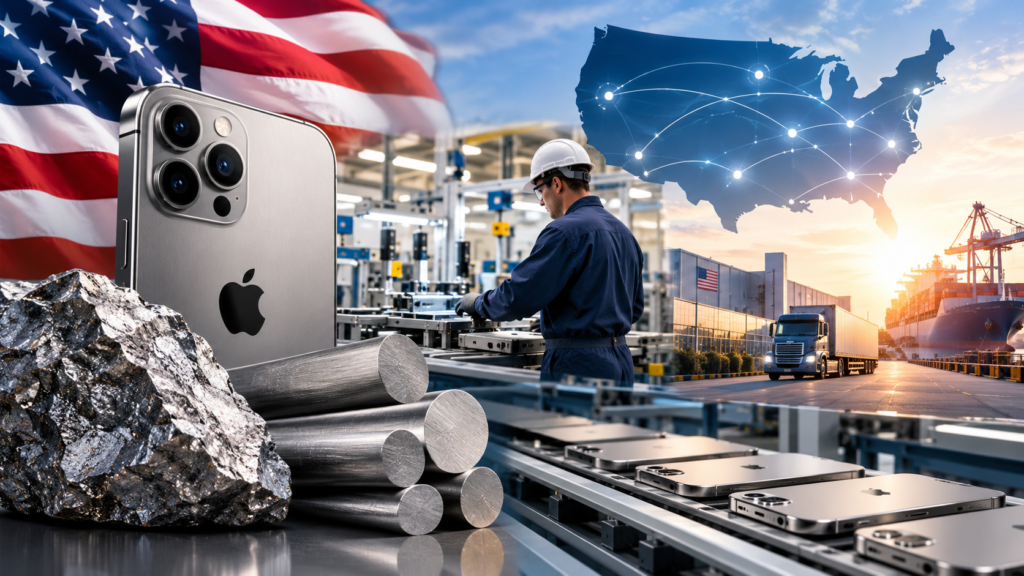
What if a $100 million investment in titanium could tell us something much bigger about the future of American manufacturing?
For decades, the United States has relied on complex global supply chains to produce the technologies people use every day. From smartphones and semiconductors to advanced industrial equipment, many critical manufacturing processes have depended on suppliers spread across the world. Now, one of the world’s most influential technology companies is helping reshape that equation.
Apple’s latest move is a powerful signal: the future of manufacturing may depend not only on designing better products but also on building stronger domestic supply chains.
The company has committed up to $100 million over three years for U.S.-produced titanium, partnering with Pennsylvania-based Perryman Company. The material is expected to support Apple’s product manufacturing, including the enclosure of its first foldable iPhone.
But titanium is only one piece of a much larger story.
Apple is also expanding its network of American component suppliers, strengthening domestic semiconductor production and supporting advanced manufacturing capabilities. With TSMC’s Arizona facility expected to produce more than 100 million chips for Apple in 2026, the company’s strategy extends far beyond a single material or factory.
The bigger question is no longer whether American manufacturing can grow. It is whether the United States can build a smarter, more technologically advanced manufacturing ecosystem capable of competing in the next industrial era.
From advanced materials and semiconductor production to automation and artificial intelligence, Apple’s investments offer a glimpse into what that future could look like and why manufacturers across the country should be paying attention.
The $100 Million Question: Why Titanium?
Titanium is not an ordinary manufacturing material.
It is lightweight, strong and resistant to corrosion, making it valuable in industries such as aerospace, medical technology, defence and advanced electronics.
For Apple, titanium can provide the strength and durability required for sophisticated product designs while maintaining a premium appearance and relatively low weight.
But the more interesting part of Apple’s announcement is not simply the material.
It is where the material will be produced.
Apple’s agreement with Perryman Company will support titanium production at the company’s facility in Houston, Pennsylvania. Perryman melts, forges and rolls titanium and plans to supply Apple with Grade 5 titanium containing at least 80% recycled content.
That creates a direct connection between a major global technology brand and an American advanced-materials manufacturer.
It is also a sign that the future of Apple U.S. manufacturing may increasingly depend on specialised American suppliers rather than only final product assembly.
Apple’s Manufacturing Strategy Is Bigger Than One Factory
Apple’s latest titanium announcement makes more sense when placed inside its broader American investment strategy.
The company previously announced plans to spend $600 billion in the United States over four years on manufacturing, innovation and related activities.
That commitment includes investments across several parts of the technology supply chain.
Instead of attempting to move Apple’s entire global manufacturing operation into America, the company is expanding domestic capabilities in areas where advanced manufacturing can provide strategic value.
That includes:
- Semiconductors.
- Advanced materials.
- Glass production.
- Electronic components.
- AI infrastructure.
- Manufacturing technology.
This is an important distinction.
Modern products are not created inside a single factory. They depend on networks of specialised suppliers.
A smartphone can involve semiconductor manufacturers, glass producers, metal suppliers, camera technology companies, packaging specialists and dozens of other businesses.
Strengthening those individual links can make the overall supply chain more resilient.
TSMC Arizona Could Be One of the Biggest Pieces
If titanium represents the materials side of Apple’s strategy, semiconductors represent the technology side.
TSMC’s Arizona facility is becoming increasingly important to Apple’s domestic manufacturing ambitions.
Apple says the Arizona operation is expected to produce more than 100 million chips for Apple in 2026.
That is significant because advanced semiconductor manufacturing has historically been concentrated heavily in Asia.
Increasing chip production in Arizona gives Apple access to another source of advanced semiconductor capacity within the United States.
But the impact extends beyond Apple.
A semiconductor facility requires an entire supporting ecosystem.
- It needs specialised equipment.
- It needs engineers.
- It needs materials.
- It needs logistics.
- It needs highly controlled facilities.
- It needs packaging and testing.
- It needs maintenance and technical services.
As those capabilities develop around semiconductor facilities, additional businesses can enter the ecosystem.
That is how an individual factory can eventually become part of a much larger American supply chain.
From Chips to Components: The Supplier Network Is Expanding
Apple’s American manufacturing strategy also involves a growing number of suppliers.
The company says nearly 100 components used in the iPhone Duo and iPhone 18 Pro are produced by American companies.
Those suppliers are spread across more than a dozen states.
This geographic distribution is important.
A resilient manufacturing ecosystem does not depend on a single factory or location. It depends on multiple companies with specialised capabilities.
For example, Broadcom is expanding its Fort Collins, Colorado, operations, while Corning continues to manufacture cover glass in Kentucky.
Other suppliers are contributing technologies ranging from wireless components to lasers and semiconductor packaging.
Together, these businesses create something more valuable than individual factories.
They create manufacturing capacity.
Why This Matters for the Rest of American Industry
Apple’s purchasing decisions can have a major influence on suppliers.
When a company with Apple’s scale commits to purchasing large quantities of a specialised material or component, suppliers gain a stronger reason to expand production.
That can mean new equipment.
New facilities.
Additional workers.
More automation.
More research and development.
And eventually, new suppliers entering the market.
This is one reason Apple’s investment could matter beyond the technology sector.
The same infrastructure supporting Apple’s products can potentially benefit other industries.
A company that develops advanced titanium-processing capabilities for consumer electronics could also serve aerospace or defence customers.
A semiconductor manufacturing ecosystem can support automotive, industrial and artificial intelligence applications.
Advanced packaging technologies can serve multiple technology markets.
This creates the possibility of a multiplier effect throughout U.S. manufacturing.
The New Manufacturing Competition Is About Technology
There was a time when manufacturing competitiveness was primarily associated with labour costs.
Today, the equation is changing.
Advanced manufacturers increasingly compete on:
- Production speed
- Automation
- Precision
- Energy efficiency
- Product quality
- Data analytics
- Artificial intelligence
- Supply-chain resilience
That is why smart manufacturing is becoming increasingly important.
A factory filled with advanced machines is not necessarily a smart factory.
A smart factory connects machines, people, software and data.
Sensors can monitor production equipment.
Artificial intelligence can identify patterns in manufacturing data.
Automation can reduce repetitive tasks.
Digital systems can provide managers with real-time information.
Predictive maintenance can identify potential equipment failures before they interrupt production.
For high-value manufacturing, these capabilities can make a major difference.
Apple’s Manufacturing Push Is Also a Technology Story
Apple’s U.S. manufacturing strategy should therefore not be viewed simply as a relocation of factories.
It is better understood as a combination of manufacturing, technology and supply-chain strategy.
The company is working with suppliers that operate in highly specialised areas.
It is investing in semiconductor production.
It is expanding advanced materials manufacturing.
It is supporting manufacturing education and workforce development.
And it is increasingly connecting American suppliers to some of the world’s most advanced consumer technology products.
This is what makes the latest titanium agreement particularly interesting.
The material itself is only one part of the story.
The real story is the infrastructure behind it.
The Workforce Will Decide How Far This Can Go
There is another challenge that cannot be solved simply by investing billions of dollars.
America needs skilled manufacturing workers.
Modern factories require people who understand robotics, automation, artificial intelligence, engineering, industrial software and advanced production processes.
The manufacturing worker of the future may spend less time performing repetitive manual tasks and more time operating, monitoring and improving automated systems.
Apple has already invested in manufacturing workforce development.
Its manufacturing education initiatives include training programmes designed to help workers and suppliers develop capabilities in areas such as AI, automation and advanced manufacturing.
That investment could become increasingly important as American factories become more technologically sophisticated.
Sustainability Is Becoming Part of the Equation
Apple’s titanium partnership also highlights another major manufacturing trend: sustainability.
The company says the titanium supplied through Perryman’s production will contain at least 80% recycled content.
That is significant because manufacturers are facing increasing pressure to reduce waste, energy consumption and dependence on newly extracted resources.
Recycling advanced materials can help manufacturers move toward more circular production models.
At the same time, renewable energy is becoming an increasingly important part of industrial strategy.
For large technology companies, sustainability is no longer only a corporate responsibility issue.
It can also become part of supply-chain planning.
Could Other Companies Follow Apple?
Apple is not the only company interested in strengthening domestic manufacturing.
The United States is experiencing growing investment in semiconductors, batteries, electric vehicles, aerospace, defence, data centres and other technology-intensive industries.
As these sectors expand, demand for advanced manufacturing capabilities is likely to increase.
Apple’s strategy could provide a useful example of how large companies can strengthen domestic supply chains without completely abandoning global manufacturing.
The likely future is not a world where every component is manufactured in one country.
Instead, companies may build more resilient global supply chains with stronger regional manufacturing hubs.
For the United States, that could mean greater capacity in strategically important technologies and materials.
What Does Apple’s Titanium Deal Really Tell Us?
The $100 million investment is important.
But it should not be viewed in isolation.
Put together with Apple’s semiconductor production, American component suppliers, advanced materials investments and workforce programmes, it represents something much larger.
It shows how one of the world’s most valuable technology companies is helping build demand for American manufacturing capabilities.
The implications could extend across industries.
More demand can encourage suppliers to invest.
More investment can create new facilities.
New facilities can create jobs.
New facilities also create demand for automation, engineering, software, energy infrastructure and logistics.
And those industries can create their own supply chains.
That is how a manufacturing ecosystem grows.
The Next Chapter of American Manufacturing
The biggest takeaway from Apple’s latest move may be that the future of American manufacturing will not be defined simply by the number of factories built.
It will be defined by what those factories can produce and how intelligently they can operate.
Titanium production, semiconductor fabrication, advanced glass, AI infrastructure and precision components represent the higher-value side of industrial production.
When these capabilities are combined with automation, artificial intelligence and connected production systems, the result is a very different manufacturing landscape.
Apple’s $100 million titanium commitment is therefore more than a supplier agreement.
It is a small but meaningful piece of a much larger transformation.
The United States is working to strengthen its ability to produce strategically important technologies and materials at home.
Apple is helping accelerate that movement through its enormous purchasing power and supplier network.
And if this trend continues, the next era of American manufacturing may be less about bringing the past back and more about building something entirely new.
The Opportunity for Smart Manufacturing Leaders
The transformation already underway across the American industrial sector is creating opportunities for manufacturers, technology providers, automation specialists and facility leaders.
As companies invest in domestic production, they will need smarter factories, more efficient processes, advanced automation and better-connected facilities.
That makes the growth of smart manufacturing more than a technology trend. It could become one of the foundations of the next generation of U.S. industrial competitiveness.
Connect With the Future of Manufacturing
Want to understand the technologies, strategies and opportunities shaping the next generation of American industry?
Explore the Smart Manufacturing & Automation Convention 2027 and connect with industry professionals focused on automation, advanced manufacturing and the future of smart factories.
Explore the Smart Manufacturing & Automation Convention 2027 →