
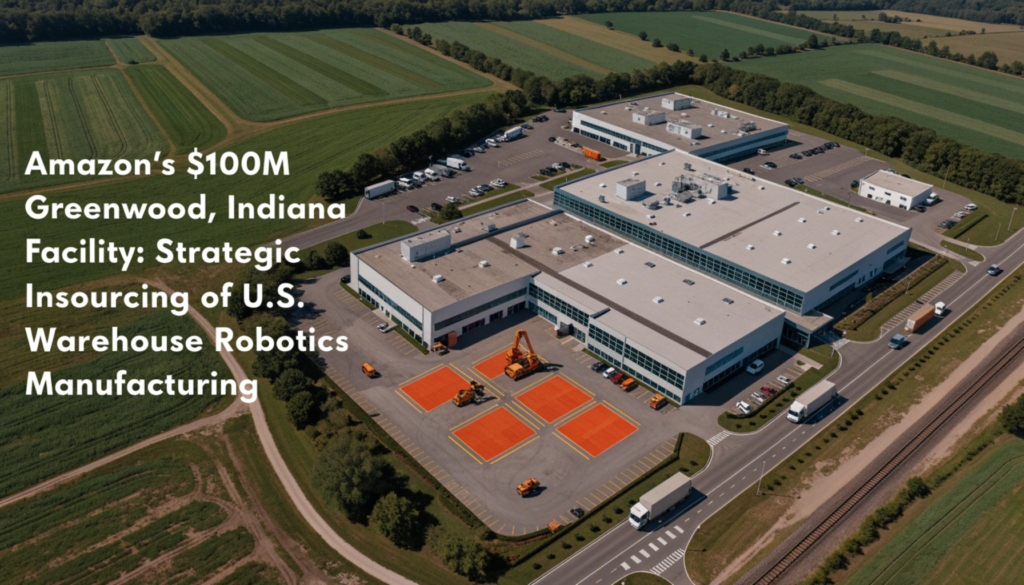
On September 24, 2026, e-commerce and cloud computing giant Amazon formally announced a monumental capital commitment exceeding $100 million to establish a state-of-the-art advanced manufacturing complex in Greenwood, Indiana. Spanning 585,000 square feet within Johnson County, this flagship industrial campus is dedicated exclusively to fabricating, assembling, and testing high-precision components and complex sub-assemblies for the company’s rapidly expanding proprietary warehouse robotics network. By creating approximately 300 highly skilled manufacturing engineering, advanced fabrication, mechatronics, and optical quality-assurance positions, the plant represents a major structural pivot in how tech conglomerates approach mission-critical automation hardware. Rather than relying entirely on third-party offshore original design manufacturers (ODMs), Amazon is aggressively establishing dedicated domestic production capacity, marking a watershed moment for robotics manufacturing facility USA initiatives.
For corporate executives, operations directors, and supply chain strategists across North American manufacturing, this announcement carries profound implications. It signals that warehouse robotics has transitioned from specialized, low-volume automation equipment into a high-throughput, mission-critical industrial commodity. Amazon’s multi-million-dollar commitment illustrates a broader paradigm shift away from fragile globalized supply lines, standing as a premier case study in the current wave of U.S. manufacturing investment 2026.
Deconstructing Amazon’s $100 Million Greenwood Investment
The Greenwood manufacturing complex is engineered specifically to manufacture heavy-duty structural frames, high-torque drive units, precision mechanical drive-trains, and integrated electrical assemblies for Amazon’s growing fleet of autonomous mobile robots (AMRs). Key systems produced will include drive units like Proteus and Hercules, automated item-handling robotic arms like Robin and Cardinal, and newly introduced container management devices. The massive 585,000-square-foot footprint will house high-precision multi-axis CNC machining centers, automated robotic welding cells, electrostatic powder coating lines, and state-of-the-art electrical quality-assurance testing bays.
Amazon’s decision to locate the campus in central Indiana reflects the region’s robust industrial infrastructure, central geographic location, and deep technical talent pool. With average annual compensation for engineering and skilled technical roles approaching $100,000, the investment has received strong support from state and local economic development authorities. The Greenwood site joins existing specialized robotics facilities in Massachusetts and Texas, solidifying a dedicated domestic industrial network designed to supply hardware for more than 1,000 fulfillment centers across North America.
Beyond raw square footage, the facility is designed around Industry 4.0 standards. Real-time telemetry, automated inline inspection tools, and digital twin technology will monitor component quality throughout the manufacturing workflow. By embedding intelligent automation into the factory floor itself, Amazon aims to minimize production defects and significantly boost component throughput.
Strategic Drivers Behind Vertical Hardware Insourcing
Amazon’s strategic move toward internalizing hardware production highlights crucial operational calculations that are reshaping manufacturing strategy across sectors:
1. Supply Chain Resilience and Lead-Time Compression
Over recent years, global logistics networks suffered severe bottlenecks due to ocean freight disruptions, port congestion, geopolitical friction, and component shortages. For a fulfillment ecosystem engineered around same-day and next-day delivery commitments, extended delays for critical replacement hardware are unacceptable. Establishing a dedicated domestic robotics manufacturing facility USA eliminates reliance on international shipping corridors, ensuring full control over production scheduling, lead times, and hardware availability.
2. Protecting Proprietary Mechatronic Intellectual Property
Proprietary mechatronics and custom robotic designs form a significant competitive advantage in modern e-commerce fulfillment. Outsourcing hardware fabrication to offshore contract manufacturers introduces operational risks, including intellectual property leakage, unauthorized design replication, and grey-market supply contamination. By keeping advanced welding, component fabrication, and firmware installation under direct supervision within the United States, enterprises protect their strategic technological assets.
3. Tight Mechanical and Software Feedback Loops
Close geographical proximity between R&D engineering teams in Boston and Seattle and production personnel in Indiana accelerates design-for-manufacturing (DFM) feedback loops. When operational issues or mechanical improvements are identified in active fulfillment centers, design changes can be tested, validated, and rolled out on the Greenwood production floor in days rather than months. This rapid prototyping cycle drives continuous hardware refinement and operational performance.
4. Total Cost of Ownership and Quality Assurance
While offshore unit production costs may appear lower initially, total cost of ownership (TCO) calculations favor insourced production when factoring in freight fees, import tariffs, defect rates, and inventory holding costs. In-house manufacturing allows for rigid quality control standards at every stage of assembly, preventing costly field failures across fulfillment sites.
The Technology Behind Amazon’s Autonomous Fleet
To appreciate the scale of the Greenwood investment, it is essential to examine the sophisticated autonomous mobile robots and mechatronic systems that will be manufactured at the facility:
- Proteus and Autonomous Mobile Drive Units: Amazon’s fully autonomous mobile robot, Proteus, navigates safely around human employees using advanced perception, safety technology, and real-time obstacle avoidance. Manufacturing these drive units requires ultra-precise motor calibration, heavy-duty chassis alignment, and custom sensor integrations.
- Robin and Cardinal Robotic Manipulation Arms: Designed for package sorting, picking, and container loading, these multi-axis robotic arms rely on complex mechanical grippers, artificial intelligence vision software, and high-precision gearboxes produced to exact engineering tolerances.
Next-Generation Container Handling Systems: Automated tote-handling equipment and transport machinery optimize storage density and accelerate item retrieval within multi-level fulfillment structures.
Macroeconomic Impact: The Resurgence of Advanced American Tooling
Amazon’s Greenwood investment demonstrates that modern domestic manufacturing is not about returning to labor-intensive manual assembly lines. Instead, it illustrates how digital automation, industrial robotics, precision machining, and software integration are revitalizing the American industrial sector:
- High-Value Industrial Employment: The 300 positions created in Greenwood focus on specialized technical disciplines such as multi-axis CNC machinists, robotic welding specialists, industrial systems engineers, mechatronics technicians, and optical metrology experts offering competitive wages and long-term career growth.
- Regional Supply Chain Multipliers: A 585,000-square-foot robotics plant generates significant secondary demand across Midwestern suppliers, driving orders for raw aluminum, structural steel extrusions, precision bearings, industrial wiring harnesses, and electronic components.
- Accelerating Regional Automation Ecosystems: Concentrating advanced robotics manufacturing in Indiana strengthens the Midwest’s position as a national center for industrial automation, attracting technology vendors, specialized contractors, and academic research partnerships.
Overcoming Domestic Manufacturing Challenges
While the transition toward insourced domestic production offers clear operational advantages, scaling advanced manufacturing plants within the United States involves key challenges that demand careful planning:
- Talent Pipeline Development: Recruiting 300 highly specialized engineers and skilled technicians requires close collaboration with local universities, vocational trade institutes, and apprenticeship initiatives to build a sustainable talent pipeline.
- Capital Investment and Setup Costs: Establishing a modern 585,000-square-foot facility equipped with automated tooling and quality control infrastructure demands substantial upfront capital, requiring clear long-term payback models.
- Upstream Sub-Component Sourcing: Insourcing final assembly and major sub-assemblies still relies on resilient supply chains for raw metals, microcontrollers, and specialized sensors, necessitating strong supplier relationships.
Strategic Takeaways for Manufacturing and Supply Chain Leaders
As corporate leaders and operations managers refine their industrial strategies for 2027 and beyond, Amazon’s manufacturing initiative provides actionable insights:
- Evaluate Strategic Hardware Insourcing: Audit key operational machinery and automation components to identify critical dependencies. Where external supply risks threaten primary operations, analyze the long-term feasibility of nearshoring or insourcing fabrication.
- Automate the Production Ecosystem: Operational efficiency multiplies when automated machinery, robotic cells, and smart quality checks are deployed to build next-generation hardware systems, creating self-sustaining productivity gains.
- Leverage Established Industrial Corridors: Select site locations offering strong freight networks, robust utility infrastructure, and proximity to engineering institutions to maintain a reliable workforce and efficient distribution channels.
- Integrate Design and Production Teams: Establish direct communication links between R&D engineers and shop-floor manufacturing teams to accelerate product development cycles and reduce manufacturing friction.
Conclusion: The Architecture of Autonomous Logistics
Amazon’s $100 million advanced manufacturing facility in Greenwood, Indiana, demonstrates that the future of logistics and industrial automation rests on strong domestic production capability. By building a premier robotics manufacturing facility USA, the enterprise secures its operational hardware pipeline, creates high-skill manufacturing positions, and sets a powerful precedent for U.S. manufacturing investment 2026 across the industrial tech sector.
Optimize Your Advanced Manufacturing Facility Infrastructure
Interested in smart factory leadership and industry events? Learn more about the Smart Manufacturing & Automation Convention 2027.