
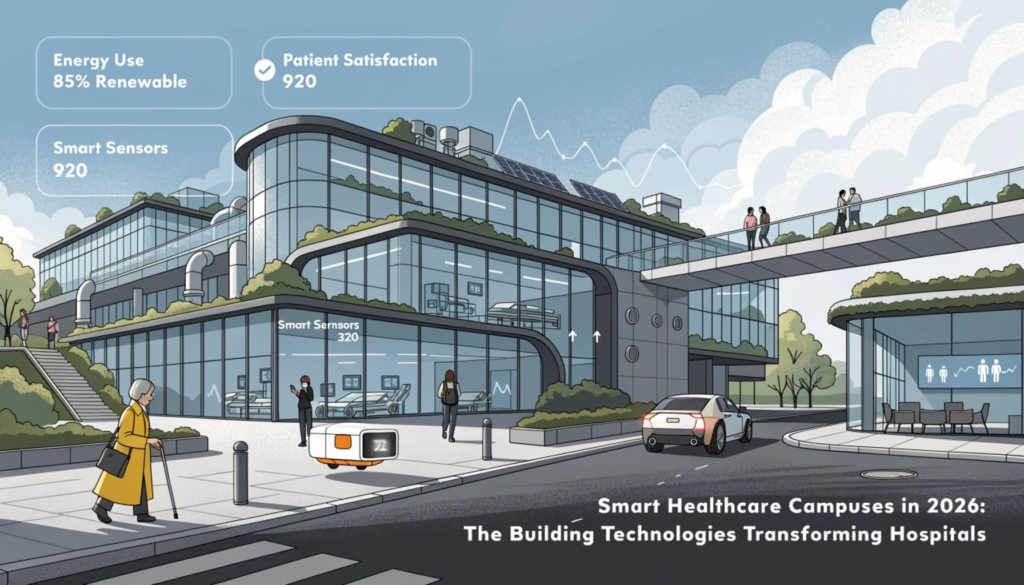
Healthcare campuses are becoming more complex every year. Hospitals now need to manage rising energy costs, stricter sustainability expectations, increasing patient demands, advanced medical equipment, cybersecurity risks, and the need for safer, more comfortable environments. Traditional building systems are often unable to handle this level of complexity efficiently. This is where smart building technology healthcare solutions are becoming increasingly important.
In 2026, smart hospitals are moving beyond basic automation. Modern healthcare campuses are integrating connected sensors, artificial intelligence, digital twins, advanced building management platforms, predictive maintenance systems, intelligent lighting, smart HVAC controls, and real-time occupancy monitoring. These technologies allow facility teams to understand how buildings are performing and make faster, data-driven decisions.
For healthcare organizations, the objective is not simply to create a technologically advanced building. The real goal is to create a safer, more efficient, resilient, sustainable, and patient-focused environment. As healthcare infrastructure continues to evolve, understanding the most important smart building technologies can help hospital leaders make better investment decisions.
Why Smart Building Technology Matters for Healthcare Campuses
Hospitals operate differently from conventional commercial buildings. They run 24/7, contain highly sensitive equipment, accommodate patients and visitors continuously, and require carefully controlled environmental conditions. Operating rooms, intensive care units, laboratories, pharmacies, imaging departments, and patient rooms can all have different requirements.
A failure in a hospital’s building infrastructure can have consequences far beyond inconvenience. HVAC problems can affect temperature-sensitive areas, electrical failures can disrupt critical equipment, and poor indoor air quality can create additional risks. Consequently, smart building technology healthcare systems are increasingly being used to monitor and optimize critical infrastructure continuously.
Connected building systems can collect information from thousands of sensors and devices. Facility managers can then use this information to identify unusual patterns, respond to faults, reduce energy consumption, and improve building performance.
The shift also changes the role of hospital facility teams. Instead of relying primarily on manual inspections and reactive maintenance, teams can use real-time information to anticipate problems before they become major operational disruptions.
1. AI-Powered Building Management Systems
One of the most significant developments in smart building technology healthcare is the integration of artificial intelligence into building management systems.
Traditional building management platforms primarily monitor equipment and allow facility managers to adjust settings. AI-powered systems take this further by analyzing historical and real-time data to identify patterns and recommend or automatically implement improvements.
For example, an AI-enabled system can analyze temperature, humidity, occupancy, equipment performance, weather conditions, and energy consumption. It may recognize that a particular building zone regularly consumes excessive energy during periods of low occupancy and recommend adjustments.
AI can also help identify abnormal equipment behavior. If a chiller, pump, air-handling unit, or ventilation system begins operating differently from its normal pattern, the system can flag the issue for investigation.
This capability can make hospital building management more proactive. Instead of waiting for equipment to fail, facility teams can prioritize maintenance based on actual equipment conditions.
2. Smart HVAC and Indoor Air Quality Monitoring
Heating, ventilation, and air conditioning represent some of the most important building systems in healthcare facilities. Hospitals require precise environmental control, but HVAC systems can also consume substantial amounts of energy.
Smart HVAC technology combines sensors, automation, analytics, and connected controls to optimize environmental conditions according to the requirements of different areas.
Modern systems can monitor temperature, humidity, carbon dioxide levels, particulate matter, pressure relationships, and other indoor environmental conditions. Facility managers can view this information through centralized dashboards and respond when conditions move outside acceptable parameters.
For example, occupancy sensors can help determine whether certain non-critical spaces require full HVAC operation. Similarly, smart controls can adjust airflow and temperature based on real-time conditions while maintaining the requirements of critical healthcare areas.
This makes intelligent HVAC an important part of hospital building management, particularly as healthcare organizations attempt to balance patient comfort, operational requirements, energy efficiency, and sustainability.
3. Predictive Maintenance Using IoT Sensors
The Internet of Things is transforming how healthcare campuses monitor physical infrastructure. IoT sensors can be installed on equipment and building systems to continuously collect operational data.
Instead of relying entirely on scheduled maintenance, hospitals can use sensor data to understand equipment health. Vibration, temperature, pressure, electrical consumption, and other measurements can indicate whether equipment is operating normally.
Predictive maintenance platforms analyze these signals and identify potential problems before equipment failure occurs.
Consider a hospital’s critical air-handling equipment. If sensors detect unusual vibration or temperature behavior, the maintenance team can investigate the issue before it develops into a major breakdown.
This approach can reduce unplanned downtime, improve maintenance planning, extend equipment life, and make better use of engineering resources.
For large healthcare campuses, predictive maintenance can become a core component of smart building technology healthcare, particularly when hundreds or thousands of assets need to be monitored simultaneously.
4. Digital Twins for Healthcare Facilities
Digital twin technology is becoming another important component of intelligent healthcare infrastructure.
A digital twin creates a digital representation of a physical building, including information about its systems, equipment, spaces, and operational performance. When connected to live building data, the digital twin can provide facility teams with a dynamic view of what is happening across the campus.
Healthcare organizations can use digital twins during planning, construction, renovation, and ongoing operations.
Facility managers may use a digital twin to locate equipment, understand system relationships, visualize maintenance requirements, and analyze how proposed changes could affect building performance.
For example, before modifying an HVAC system, facility teams could use a digital model to evaluate potential effects on energy consumption and environmental conditions.
Digital twins can therefore support more informed decision-making while improving coordination between engineering, facilities, construction, and management teams.
5. Smart Lighting and Occupancy Controls
Lighting may appear relatively simple compared with medical infrastructure, but intelligent lighting can contribute significantly to healthcare campus efficiency and patient experience.
Smart lighting systems can combine LED technology with occupancy sensors, daylight harvesting, scheduling, and automated controls. Lights can be adjusted according to occupancy and natural daylight levels rather than remaining at full output continuously.
Healthcare facilities can also create different lighting environments for different areas. Patient rooms, corridors, waiting areas, administrative offices, laboratories, and clinical spaces may require different lighting characteristics.
In addition to energy savings, intelligent lighting can support a more comfortable environment for patients, visitors, and healthcare workers.
When connected to broader building systems, lighting data can also contribute to occupancy analytics and energy management.
6. Occupancy and Space Utilization Technology
Healthcare campuses often contain a mixture of highly utilized clinical spaces and areas that may remain underused for significant periods. Understanding how spaces are actually used can help hospitals improve operational planning.
Smart occupancy sensors can provide real-time information about how rooms, corridors, waiting areas, conference rooms, and other spaces are being utilized.
This information can help facility teams identify underutilized areas and optimize space allocation.
For example, if a particular administrative area consistently has low occupancy, hospital leadership may consider alternative uses for the space. Similarly, occupancy information can help adjust HVAC and lighting systems according to actual demand.
The result is a closer connection between physical infrastructure and operational decision-making.
7. Smart Energy Management Systems
Energy efficiency is becoming a strategic priority for healthcare organizations. Hospitals require continuous electricity, heating, cooling, ventilation, lighting, and specialized equipment, making energy management particularly challenging.
Smart energy management platforms collect information from meters, HVAC systems, lighting systems, equipment, and other building assets. Advanced analytics can then identify consumption patterns and opportunities for improvement.
Hospitals can monitor energy use across individual buildings, departments, floors, or equipment categories. This level of visibility makes it easier to identify unusual consumption and measure the impact of efficiency initiatives.
AI can also help forecast energy demand and optimize building operations according to expected occupancy, weather conditions, and other factors.
For healthcare organizations pursuing sustainability goals, smart energy management is therefore becoming a critical part of smart building technology healthcare investments.
8. Connected Water Management
Water systems are another area where smart technologies can deliver operational benefits.
IoT-enabled water monitoring systems can track consumption, pressure, temperature, and potential leaks. Advanced systems can identify unusual consumption patterns that could indicate a hidden leak or equipment problem.
Early detection can prevent water damage and reduce unnecessary consumption.
For large healthcare campuses, water monitoring can also provide valuable information for sustainability reporting and resource management.
Integrating water data with broader building platforms can give hospital facility teams a more complete understanding of campus resource consumption.
9. Smart Security and Access Control
Healthcare facilities must balance accessibility with security. Patients, visitors, healthcare professionals, contractors, and vendors may all need access to different parts of a campus.
Modern access control systems can use connected credentials, mobile technologies, biometrics, visitor management platforms, and centralized monitoring to improve security.
Smart systems can create different access permissions according to roles and locations. They can also provide facility teams with better visibility into building access.
Integration with other building systems can make these technologies even more useful. For example, security events can be connected with lighting, elevators, surveillance systems, and building management platforms to improve situational awareness.
Cybersecurity is particularly important because connected building systems can create additional digital entry points. Healthcare organizations therefore need to treat cybersecurity as an integral part of smart building deployment rather than an afterthought.
10. Integrated Command Centers
As healthcare campuses become more connected, centralized command centers are becoming increasingly valuable.
A modern facility operations center can bring information from HVAC, electrical systems, security, energy management, fire and life safety systems, elevators, water infrastructure, and other building technologies into a unified operational environment.
Instead of switching between multiple disconnected platforms, facility teams can use integrated dashboards to monitor campus performance.
During an emergency, centralized visibility can become especially valuable. Facility personnel can quickly understand which systems are affected and coordinate their response.
This represents an important evolution in hospital building management. The facility team becomes not only a maintenance function but also a data-driven operational command center supporting the wider healthcare organization.
11. Smart Elevators and Vertical Transportation
Elevators are essential to large healthcare campuses, particularly hospitals where patients, staff, equipment, medicines, and supplies constantly move between floors.
Smart elevator technologies can monitor usage patterns, equipment performance, and maintenance conditions.
Destination-control systems can improve traffic management by grouping passengers traveling to similar floors. Predictive maintenance technologies can also identify potential equipment issues before they cause significant disruption.
For hospitals with multiple buildings, intelligent transportation systems can contribute to smoother movement throughout the campus.
12. Digital Wayfinding and Patient Experience
Smart buildings are not only about engineering efficiency. They can also improve the experience of patients and visitors.
Digital wayfinding platforms can help people navigate complex hospital campuses using interactive displays, mobile applications, indoor positioning, and real-time directions.
This can be particularly useful in large hospitals where visitors may struggle to locate departments, diagnostic facilities, parking areas, or waiting rooms.
When combined with occupancy information, digital wayfinding can potentially help users identify less crowded routes or waiting areas.
This demonstrates how smart building technology healthcare can extend beyond infrastructure into patient experience.
13. Integration Through Open Platforms
One of the biggest challenges for healthcare organizations is technology fragmentation. A hospital may have separate systems for HVAC, lighting, security, energy, elevators, fire safety, and equipment monitoring.
If these platforms cannot communicate effectively, facility teams may struggle to obtain a complete picture of building performance.
Open and interoperable platforms can help connect different systems. Rather than replacing every existing technology, healthcare organizations can gradually integrate systems into a broader digital infrastructure.
This approach can make smart building investments more scalable and reduce the risk of creating isolated technology platforms.
The Future of Hospital Building Management
The future of hospital building management will increasingly depend on the ability to connect data, systems, people, and decision-making.
The most successful healthcare campuses will not necessarily be those with the largest number of sensors or the most sophisticated technology. Instead, they will be organizations that deploy technology around clearly defined operational objectives.
A hospital may prioritize energy reduction, predictive maintenance, patient comfort, resilience, cybersecurity, or space utilization. The technology strategy should support those priorities.
Data quality will also become increasingly important. Smart systems are only as effective as the information they receive. Healthcare organizations need appropriate sensor placement, reliable connectivity, standardized data, cybersecurity controls, and trained personnel.
Staff adoption is another critical factor. Facility teams need training to interpret dashboards, understand analytics, respond to alerts, and use data in daily decision-making.
How Healthcare Leaders Can Prepare for 2026 and Beyond
Healthcare organizations planning smart building investments should begin with an assessment of their existing infrastructure. Understanding what systems are already installed, how they communicate, and where the biggest operational gaps exist can help organizations prioritize investments.
Rather than attempting to digitize an entire campus at once, hospitals can begin with high-value applications such as HVAC optimization, predictive maintenance, energy monitoring, or indoor air quality.
The next step is integration. As individual systems become connected, healthcare organizations can gradually build a unified operational environment.
Finally, organizations should establish measurable performance indicators. Energy consumption, equipment downtime, maintenance costs, indoor environmental quality, space utilization, and operational response times can all help determine whether smart building investments are producing meaningful results.
Conclusion
The healthcare campus of 2026 is becoming a connected ecosystem where physical infrastructure and digital intelligence work together. AI-powered building management, IoT sensors, predictive maintenance, smart HVAC, digital twins, intelligent lighting, occupancy analytics, energy management, connected security, and integrated command centers are reshaping how hospitals operate their facilities.
The strongest smart building technology healthcare strategies will focus not only on installing new technologies but also on integrating them into a coherent operational framework. When data from different systems can be transformed into actionable insights, healthcare organizations can improve efficiency, resilience, sustainability, and the overall experience of patients and staff.
As healthcare infrastructure continues to evolve, hospital leaders, facility managers, technology providers, engineers, and solution developers will need to collaborate closely. The organizations that make strategic investments today will be better positioned to create intelligent, efficient, and future-ready healthcare campuses.
Ready to connect with healthcare facility decision-makers and showcase your solutions? Enquire about sponsorship for upcoming BMA healthcare events and explore opportunities to put your technology in front of industry leaders.