
Healthcare organizations across the United States are under constant pressure to control operating expenses while maintaining safe, reliable, and patient-centered environments. For hospital facility managers, this challenge is particularly complex. Hospitals operate around the clock, depend on critical infrastructure, and cannot simply reduce services in the same way as a conventional commercial building.
This makes hospital facility cost reduction in Texas an important priority for healthcare leaders looking to improve financial performance without creating risks for patients, clinicians, or staff.
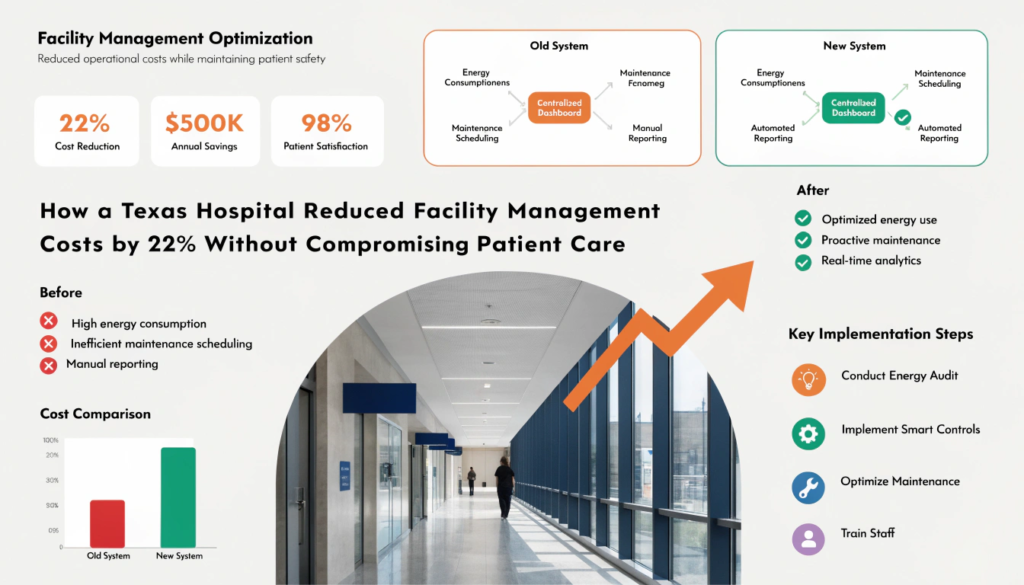
Consider the example of a 500-bed Texas hospital that achieved a 22% reduction in facility management costs over one year. The result did not come from one dramatic budget cut. Instead, the hospital took a structured approach that combined preventive maintenance, energy optimization, workforce planning, vendor management, and better use of facility data.
This healthcare operational efficiency case study demonstrates how relatively practical changes can produce significant savings when they are implemented as part of one coordinated strategy.
The Challenge: Rising Facility Costs in a Complex Hospital Environment
Before the cost-reduction initiative began, the hospital was dealing with several familiar facility management challenges.
Its buildings operated continuously, with HVAC systems, medical gas infrastructure, elevators, lighting, electrical systems, water systems, emergency power equipment, and other assets requiring regular attention. Maintenance requests were also being handled reactively in many areas, meaning teams often responded after equipment had already developed a problem.
Energy represented another major expense. Large healthcare facilities require substantial heating, cooling, ventilation, and lighting, particularly in Texas where extreme temperatures can place considerable pressure on HVAC systems.
The hospital also had multiple external vendors providing maintenance, cleaning, landscaping, equipment servicing, and other facility-related services. Over time, contracts had evolved independently, creating opportunities for duplicated services, inconsistent pricing, and inefficient purchasing.
The leadership team therefore established a clear objective: reduce facility management expenditure without reducing reliability, safety, cleanliness, or the quality of the patient environment.
Moving From Reactive to Preventive Maintenance
One of the first priorities was maintenance.
A reactive maintenance model can become expensive because minor equipment issues can develop into major failures. Emergency repairs may require overtime labor, expedited parts, specialist contractors, and unexpected equipment replacement.
The hospital reviewed maintenance records and identified assets that generated disproportionately high repair costs. Critical equipment was then placed under more structured preventive maintenance schedules.
Instead of waiting for an air-handling unit, pump, generator, or other asset to fail, maintenance teams scheduled inspections and servicing based on manufacturer recommendations, equipment condition, operating hours, and historical performance.
The facility team also began tracking recurring failures more closely. If the same asset required repeated repairs, the hospital evaluated whether continued maintenance was financially sensible or whether replacement would provide a better long-term return.
This shift reduced emergency callouts and helped maintenance teams plan labor and spare-parts requirements more effectively.
Using Energy Management to Lower Operating Expenses
Energy optimization became another major component of the cost-reduction strategy.
In a large hospital, HVAC systems can account for a substantial portion of facility energy consumption. However, reducing energy use cannot mean compromising ventilation, temperature control, infection prevention, or clinical requirements.
The hospital therefore focused on smarter operation rather than simple reduction.
Facility teams reviewed HVAC schedules, temperature settings, equipment performance, lighting usage, and building occupancy patterns. Areas with different operational requirements were assessed separately instead of applying identical settings throughout the facility.
Lighting controls and more efficient lighting technologies were introduced where practical. Equipment that remained operational during low-occupancy periods was also reviewed to determine whether schedules could be optimized without affecting patient care or safety.
The hospital simultaneously monitored utility consumption to identify unusual patterns. Rather than treating the monthly energy bill as a fixed expense, management began viewing energy data as an operational performance indicator.
This approach helped the facility team identify opportunities that might otherwise have remained hidden.
Improving Workforce Productivity
Cost reduction was not simply about cutting headcount.
Instead, hospital leaders examined how facility employees spent their working hours. Maintenance teams were frequently interrupted by urgent requests, while some tasks were distributed unevenly across shifts.
The hospital introduced better work-order prioritization and scheduling. Critical issues were separated from routine requests, allowing maintenance personnel to focus on high-value activities first.
Digital work-order tracking also provided greater visibility into response times, repeat requests, backlog levels, and technician workloads.
This information helped supervisors identify where staffing levels were appropriate and where schedules could be adjusted.
The goal was to ensure that skilled employees spent more time on planned maintenance and less time dealing with avoidable emergencies or administrative inefficiencies.
For hospital facility managers, this is an important lesson: labor cost reduction does not necessarily require reducing the workforce. Improving how existing teams are deployed can create substantial savings while protecting service quality.
Rethinking Vendor and Contract Management
External suppliers represented another opportunity for savings.
The hospital reviewed facility-related contracts and compared pricing, service levels, renewal terms, and actual utilization. Several services were renegotiated, while others were consolidated where appropriate.
Rather than automatically renewing contracts, the facility team evaluated whether each service was still delivering measurable value.
Performance expectations were also clarified. Vendors were assessed against defined service requirements rather than simply being evaluated on whether work had been completed.
This created a more accountable relationship between the hospital and its service providers.
For example, instead of focusing only on the cost of a maintenance contract, the hospital considered factors such as equipment reliability, response time, repeat failures, preventive maintenance completion, and overall asset performance.
This broader approach helped management distinguish between a low-cost vendor and a genuinely cost-effective vendor.
Making Facility Data Part of Everyday Decision-Making
One of the most important changes was the hospital’s approach to facility data.
Previously, information about maintenance, energy use, work orders, equipment failures, and vendor performance existed across different systems and reports. Management could see individual numbers but had limited visibility into how they connected.
The hospital began bringing key indicators together.
Facility leaders monitored metrics such as maintenance costs per asset, preventive maintenance completion rates, emergency work orders, energy consumption, equipment downtime, vendor performance, and outstanding work orders.
This transformed facility management from a largely reactive function into a more measurable operational discipline.
For example, if one building repeatedly generated higher HVAC costs than another, the team could investigate whether the difference was caused by equipment age, occupancy, operating schedules, maintenance issues, or another factor.
The data did not replace professional judgment. Instead, it helped managers make decisions based on evidence rather than assumptions.
The Result: A 22% Reduction in Facility Management Costs
After one year, the hospital achieved an overall 22% reduction in facility management costs compared with its previous operating baseline.
Importantly, the savings were not achieved through a single large-scale measure.
They came from the combined effect of multiple improvements:
- Better preventive maintenance reduced avoidable emergency repairs.
- Energy optimization lowered unnecessary utility consumption.
- Improved workforce scheduling increased productivity.
- Vendor negotiations and contract reviews reduced external service costs.
- Facility data improved decision-making and accountability.
- Greater visibility into recurring problems helped management address root causes instead of repeatedly paying for short-term fixes.
The hospital also maintained its focus on patient care, safety, cleanliness, and infrastructure reliability.
That distinction matters. Effective facility cost reduction is not simply about spending less money. It is about eliminating waste while protecting the functions that matter most.
What This Healthcare Operational Efficiency Case Study Teaches Facility Leaders
The example offers several lessons for other hospitals considering similar initiatives.
First, cost reduction should begin with visibility. Organizations cannot effectively control costs they do not measure. Understanding where money is being spent provides the foundation for identifying opportunities.
Second, preventive maintenance should be treated as a financial strategy as well as a technical requirement. Keeping critical assets reliable can help reduce expensive emergency interventions and extend useful equipment life.
Third, energy management deserves attention because healthcare buildings have significant and continuous energy requirements. Small operational improvements can become meaningful when applied across a large facility.
Fourth, workforce productivity should be evaluated before staffing reductions are considered. Better planning, scheduling, prioritization, and technology can often help teams accomplish more with existing resources.
Finally, hospitals should regularly review vendor contracts. Long-term supplier relationships can be valuable, but they should still be evaluated against current operational requirements and measurable performance.
Why Hospital Facility Cost Reduction Matters Across Texas
The Texas healthcare environment presents unique facility management pressures. Large hospitals must operate through changing weather conditions, increasing infrastructure demands, evolving technology requirements, and growing expectations for efficiency.
At the same time, facility managers are expected to support clinical teams without disrupting patient care.
That makes strategic facility management increasingly important.
A hospital does not need to wait for a financial crisis to begin looking for efficiencies. Regular reviews of maintenance practices, energy consumption, staffing workflows, procurement, and vendor performance can uncover savings opportunities before costs become difficult to control.
The 22% reduction achieved in this illustrative case demonstrates an important principle: meaningful savings can come from improving the way a facility operates rather than simply reducing the resources available to it.
Building the Next Generation of Efficient Healthcare Facilities
The future of hospital facility management will increasingly depend on technology, data, sustainability, predictive maintenance, and cross-functional collaboration.
Facility managers will need to work closely with finance teams, clinical leaders, IT departments, procurement specialists, and senior executives. Decisions about infrastructure will increasingly be evaluated not only on technical performance but also on financial impact, resilience, sustainability, and patient experience.
Hospitals that invest in better systems and processes today can be better positioned to manage tomorrow’s operational pressures.
The key is to think beyond individual cost-cutting projects. A successful strategy creates a culture in which every maintenance decision, energy initiative, contract, and facility investment is evaluated through the lens of long-term value.
Conclusion
The 500-bed Texas hospital’s 22% facility management cost reduction illustrates what can happen when healthcare organizations approach efficiency systematically.
The hospital did not rely on one aggressive budget cut. It improved preventive maintenance, optimized energy use, strengthened workforce planning, reviewed vendor contracts, and used facility data to make better decisions.
For healthcare organizations exploring hospital facility cost reduction in Texas, the biggest lesson is clear: sustainable savings come from smarter operations.
Facility management is not merely a support function. It directly influences financial performance, infrastructure reliability, staff productivity, patient experience, and operational resilience.
As healthcare organizations continue facing pressure to deliver more value with limited resources, facility leaders who combine operational discipline with technology and data-driven decision-making will be better positioned to deliver both efficiency and quality.
Sponsor BMA Conventions
Are you looking to connect with healthcare facility leaders, technology providers, and industry professionals shaping the future of smarter healthcare infrastructure? Sponsor BMA Conventions and position your organization in front of decision-makers focused on healthcare facilities, operational efficiency, innovation, and the future of hospital infrastructure.
Sponsor BMA Conventions – Smart Healthcare Facilities Convention 2026