
Data centers are entering a new phase of energy demand. Artificial intelligence, cloud computing, high-performance workloads and digital services are driving facilities to consume more electricity than ever. At the same time, operators face increasing pressure from customers, investors, regulators and communities to reduce emissions and improve environmental performance.
The International Energy Agency estimates that electricity generation associated with data centers could rise from about 460 TWh in 2024 to more than 1,000 TWh by 2030. Renewables are expected to meet nearly half of the additional electricity demand from data centers during this period. (IEA)
For operators, this makes the transition to clean power more than a sustainability initiative. It is becoming an energy-security, cost-management and infrastructure-planning priority.
Achieving 100% clean power, however, is more complicated than simply purchasing renewable energy certificates. Solar and wind generation fluctuate, while data centers require reliable electricity around the clock. A stronger approach combines renewable generation, long-term procurement, storage, efficiency, flexible workloads and smarter grid strategies.
Here are nine renewable energy strategies that can help data center operators move toward a more resilient and genuinely low-carbon power model.
1. Sign Long-Term Renewable Power Purchase Agreements
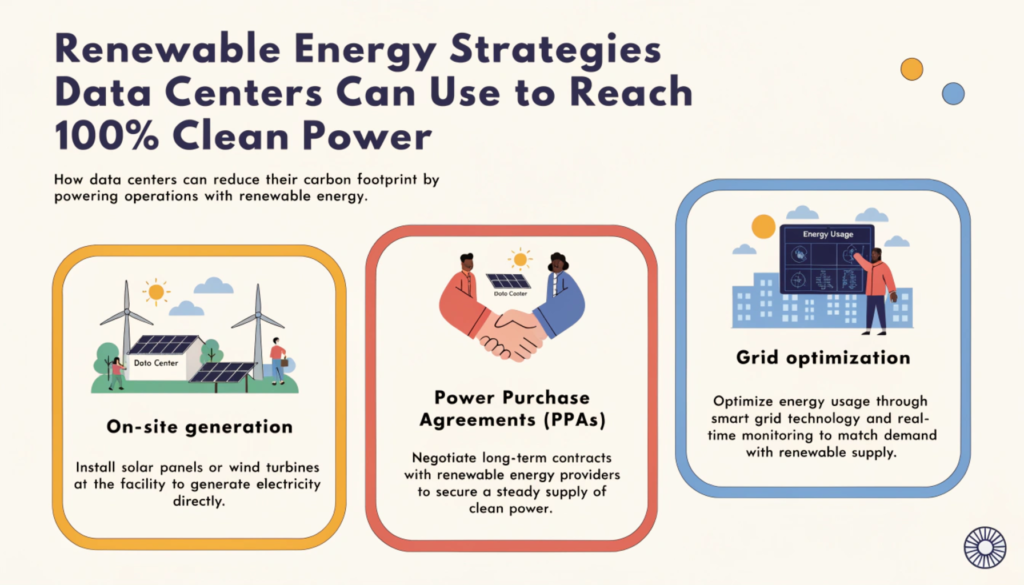
Power Purchase Agreements, or PPAs, remain one of the most important tools for building a renewable energy data center strategy.
Through a PPA, an operator agrees to purchase electricity or renewable energy attributes from a renewable project, often for many years. These agreements can help developers secure financing for new solar and wind projects while giving data center operators greater visibility over energy costs and renewable supply.
Large technology companies have already demonstrated the scale possible through this approach. The IEA notes that major technology companies have become significant corporate renewable-energy buyers, with Amazon, Microsoft, Meta and Google among the largest corporate PPA purchasers. (IEA)
For operators planning new facilities, PPAs can also be structured around the geography of the data center. Procuring renewable electricity from projects connected to the same grid can provide a stronger relationship between the facility’s demand and the clean power being supported.
The goal should not simply be to buy enough renewable energy annually. Operators should increasingly consider whether their contracts contribute to new clean generation and whether the electricity is available when and where the data center needs it.
2. Develop Onsite Solar Where Practical
Onsite solar can provide a direct source of renewable electricity and reduce dependence on grid power during suitable hours.
Large data center campuses may have significant rooftop, parking-area or adjacent-land opportunities for solar photovoltaic systems. Even when onsite generation cannot satisfy the entire facility load, it can reduce daytime grid demand and complement other renewable procurement strategies.
The limitation is obvious: solar generation changes throughout the day and disappears at night. Data centers operate continuously, so onsite solar should generally be treated as one component of a broader energy portfolio rather than the only solution.
Operators should evaluate solar potential during the initial site-selection and facility-design stages. Structural capacity, available land, local regulations, grid interconnection and expected electricity demand should all be considered before investing.
3. Combine Renewable Energy With Battery Storage
Battery energy storage can help solve one of the biggest challenges facing renewable-powered data centers: timing.
Solar production may peak around midday while electricity demand continues after sunset. Batteries can store surplus renewable electricity and discharge it when renewable generation declines.
A renewable energy data center equipped with storage can therefore improve the match between clean generation and facility demand.
Battery systems can also provide additional operational benefits, including peak-demand management, backup support and grid services where regulations permit. Hybrid renewable projects combining solar, wind and batteries are becoming increasingly relevant as large electricity consumers seek more reliable clean-power portfolios. Research published in 2026 also highlights battery storage and demand flexibility as important tools for improving the feasibility of renewable PPAs designed around 24/7 energy delivery. (ScienceDirect)
The correct storage size depends on the facility’s load profile, renewable resources, grid conditions and reliability requirements. Operators should therefore model different scenarios instead of treating batteries as a standard-size add-on.
4. Move From Annual Matching to 24/7 Clean Energy
One of the most important changes in data center sustainability 2026 planning is the shift from annual renewable matching toward hourly or 24/7 matching.
A facility can theoretically consume 100% renewable electricity on an annual basis while still relying on fossil-fuel-heavy grid electricity at night or during periods of low renewable generation.
This distinction matters.
A 24/7 clean-energy strategy attempts to match electricity consumption with carbon-free electricity during each hour, taking both location and timing into account. Google has described this model as a progression beyond simply matching annual electricity consumption with renewable purchases. (Sustainability)
Operators pursuing this approach need better energy data, forecasting and procurement. They may combine solar, wind, hydro, storage and other low-carbon resources to create a more balanced supply profile.
For companies serious about reaching 100% clean power, hourly matching provides a much more meaningful target than simply purchasing enough certificates to equal annual consumption.
5. Use Renewable Energy Certificates Strategically
Renewable Energy Certificates, or RECs, can still play a role in a clean-energy strategy, particularly when direct renewable procurement is difficult.
However, operators should understand what RECs can and cannot achieve.
A certificate represents the environmental attributes associated with renewable electricity generation. Purchasing and retiring appropriate certificates can support renewable-energy claims, but it does not necessarily mean the physical electricity entering a data center is renewable at that particular moment.
The IEA has highlighted this limitation, noting that annual renewable purchases or certificates do not necessarily mean data centers are physically powered by renewable electricity at all times. (IEA)
Therefore, RECs are best used as part of a broader strategy that prioritizes additional renewable generation, PPAs, onsite projects and hourly matching.
Operators should also maintain clear documentation around certificate ownership, retirement, geographic eligibility and accounting treatment.
6. Select Data Center Locations With Clean Power in Mind
Energy strategy begins before construction.
Choosing a data center location with access to abundant renewable electricity can make the transition to clean power significantly easier. Operators should assess renewable-resource availability, grid carbon intensity, transmission capacity, electricity pricing, water stress and the potential for future clean-energy development.
Some regions are particularly attractive because they combine strong renewable resources with expanding grid infrastructure.
Location flexibility can also allow operators to place workloads where lower-carbon electricity is more available. The IEA expects renewables and nuclear power to supply most of Europe’s additional data center electricity demand through 2030, while renewable energy is also expected to become increasingly important in markets such as India and Southeast Asia. (IEA)
This means sustainability should become a core component of site-selection models rather than an issue considered after a location has already been chosen.
7. Improve Energy Efficiency Before Adding More Clean Power
The cleanest electricity is still electricity that does not need to be consumed.
Improving energy efficiency reduces the amount of renewable generation, storage and grid capacity required to support a facility.
Operators should optimize cooling systems, server utilization, power distribution, airflow management, lighting, networking equipment and storage infrastructure. Advanced monitoring can identify inefficient equipment and help teams understand where electricity is being consumed.
Cooling deserves particular attention because it can represent a significant portion of facility energy demand. Higher-efficiency cooling architectures, liquid cooling for appropriate high-density workloads and intelligent temperature management can reduce unnecessary energy consumption.
Energy efficiency therefore supports both environmental and financial goals. Every kilowatt-hour eliminated through efficiency reduces the amount of clean electricity that must subsequently be generated or purchased.
8. Use Flexible Computing and Demand Management
Not every computing workload has to occur at exactly the same time or in exactly the same location.
Some batch processing, AI training, data analysis and other non-latency-sensitive workloads can potentially be shifted toward periods when renewable electricity is abundant.
This creates an opportunity to make the data center load more flexible.
For example, if solar generation is particularly high during certain hours, operators could prioritize suitable workloads during that period. Similarly, workloads may be moved between facilities when another location has better access to low-carbon electricity.
The IEA specifically identifies workload shifting and digital technologies as potential tools for aligning data center electricity demand with periods and locations where low-carbon electricity is more plentiful. (IEA)
Demand flexibility does not replace renewable procurement, but it can make renewable energy portfolios more effective and reduce pressure on batteries and the grid.
9. Build an Integrated Clean-Energy Portfolio
The final strategy is to stop treating renewable energy as a single procurement decision.
A successful renewable energy data center strategy will usually require multiple resources working together.
An operator might combine long-term solar and wind PPAs with onsite solar, battery storage, renewable certificates, grid electricity, demand response and flexible workloads. The exact combination will depend on location, facility size, reliability requirements and available energy markets.
This portfolio approach is becoming increasingly important as AI-driven demand accelerates. Recent industry analysis indicates that corporate renewable procurement is moving toward larger, more integrated energy systems capable of supporting reliable power requirements around the clock. (ENGIE North America)
It also creates greater resilience. If solar production falls, wind or storage may compensate. If grid conditions change, flexible workloads can potentially reduce demand. If a renewable project underperforms, additional procurement can help close the gap.
Why 100% Clean Power Is Becoming a Strategic Priority
The pressure to decarbonize data centers is increasing at the same time that electricity demand is growing rapidly.
That creates a difficult balancing act. Operators need reliable power for critical digital infrastructure while reducing their dependence on fossil-fuel generation.
Simply declaring an annual 100% renewable target may not be enough. Organizations increasingly need to examine where renewable electricity comes from, when it is generated, whether it supports new capacity and how closely it matches actual facility demand.
The distinction is particularly important as data center construction accelerates. Recent reporting has highlighted concerns that new data center demand could encourage additional fossil-fuel generation in some markets where clean-energy projects and grid connections cannot expand quickly enough. (Financial Times)
This makes energy planning a core infrastructure issue.
A Practical Roadmap for Data Center Operators
Operators do not have to implement every strategy simultaneously.
The first step is to establish a detailed baseline of electricity consumption by facility, workload and time period. The next step is to identify the current grid electricity mix and renewable-energy exposure.
From there, operators can develop a staged plan.
In the short term, efficiency improvements, renewable certificates and utility green-power programs can help reduce emissions. Medium-term strategies can include PPAs, onsite solar and battery storage. Long-term planning can move toward 24/7 clean-energy matching, flexible workloads and deeper grid partnerships.
The key is to measure progress using more than a single annual renewable percentage. Operators should track renewable generation supported, hourly clean-energy matching, grid emissions, energy intensity, storage performance and the additional renewable capacity enabled by procurement.
The Future of Renewable Energy Data Centers
The future data center will need to be both digitally powerful and energy intelligent.
AI workloads and cloud infrastructure are unlikely to reduce electricity demand. Instead, the industry will need to find better ways to meet that demand without creating proportional increases in emissions.
Renewable generation will be central to that transition, but renewable energy alone is not enough. PPAs, onsite generation, batteries, efficient cooling, workload flexibility, strategic site selection and 24/7 energy matching must increasingly operate as one integrated system.
The strongest operators will view clean power not simply as an ESG target but as part of their long-term infrastructure strategy.
As the industry moves through 2026 and beyond, the organizations that combine sustainability with reliability, efficiency and smart energy procurement will be better positioned to manage rising power demand while reducing environmental impact.
Nominate for BMA Awards
Is your organization leading the way in sustainable data center design, renewable energy procurement, energy efficiency or innovative infrastructure?
Nominate for BMA Awards and showcase the teams and projects helping shape the future of data center sustainability.