
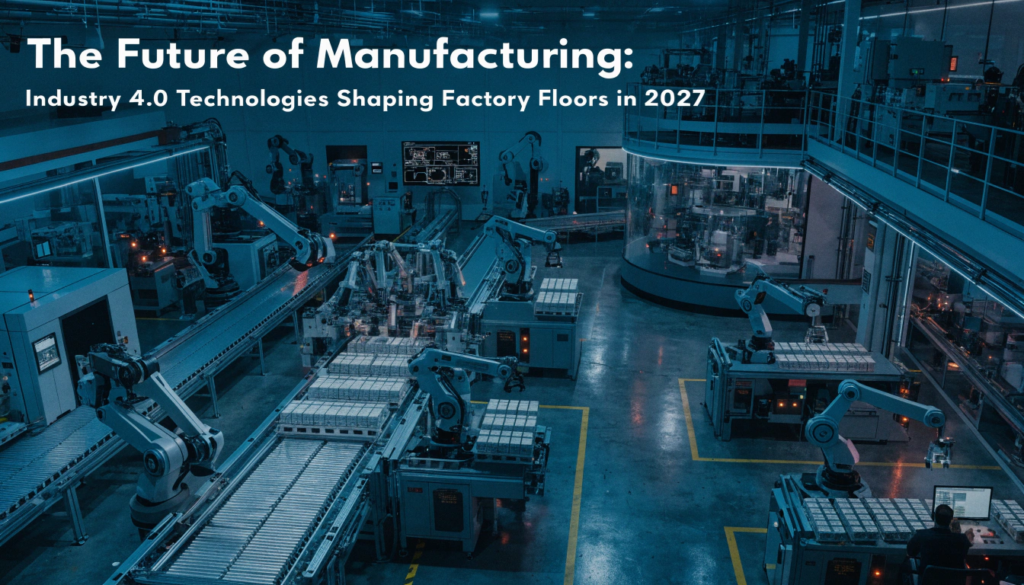
Manufacturing is entering a new phase of industrial transformation. As factories become more connected, intelligent, automated, and data-driven, Industry 4.0 technologies 2027 are expected to play a central role in reshaping how products are designed, produced, monitored, and delivered. From artificial intelligence and industrial IoT to digital twins, robotics, edge computing, and advanced analytics, modern technologies are changing the traditional factory floor into a highly responsive digital ecosystem.
The shift is no longer simply about automating individual machines. Manufacturers are increasingly focused on connecting equipment, people, software, supply chains, and production processes so that decisions can be made faster and with greater accuracy. This transformation is particularly important as manufacturers face pressure to improve productivity, reduce costs, address labor shortages, increase flexibility, strengthen resilience, and meet sustainability targets.
In 2027, the most successful manufacturers will likely be those that move beyond isolated technology investments and develop integrated smart manufacturing environments. Understanding the emerging smart manufacturing trends can help factory leaders identify where technology can create measurable operational value.
What Are Industry 4.0 Technologies?
Industry 4.0 refers to the fourth industrial revolution, characterized by the integration of digital technologies into manufacturing and industrial operations. Unlike traditional automation, where machines may perform predefined tasks independently, Industry 4.0 focuses on connectivity, real-time data, intelligence, and collaboration.
Connected sensors can continuously monitor machines. Cloud and edge computing can process production data. Artificial intelligence can identify patterns and predict potential problems. Digital twins can simulate production environments, while robotics and autonomous systems can perform increasingly sophisticated tasks.
The result is a factory environment where physical operations and digital intelligence work together.
In 2027, this concept is becoming increasingly important because manufacturers are moving toward more adaptive production models. Instead of simply asking whether a machine is operating, factory managers can use connected technologies to understand why a machine is performing differently, predict when maintenance may be needed, and determine how changes could affect overall production.
1. Industrial IoT Will Connect More Factory Assets
One of the most important Industry 4.0 technologies 2027 will be the Industrial Internet of Things, or IIoT. Sensors and connected devices allow manufacturers to collect real-time information from machines, production lines, utilities, warehouses, and other assets.
A modern factory can generate enormous amounts of operational data. Temperature, vibration, energy consumption, machine speed, pressure, cycle time, quality measurements, and equipment status can all provide valuable insights.
The real opportunity lies in converting this information into actionable intelligence.
For example, instead of waiting for a machine to fail, an IIoT-enabled system can identify unusual vibration patterns and alert maintenance teams to investigate. Production managers can monitor equipment utilization, identify bottlenecks, and compare performance across production lines.
As connectivity expands, factories will increasingly operate as interconnected systems rather than collections of independent machines.
2. Artificial Intelligence Will Move Deeper Into Manufacturing
Artificial intelligence is expected to become one of the defining technologies on factory floors in 2027. AI can analyze large volumes of production data much faster than humans and identify relationships that may otherwise remain difficult to detect.
One of the most valuable applications is predictive maintenance. AI models can analyze historical equipment data and identify patterns associated with failures. This allows maintenance teams to intervene before an unexpected breakdown disrupts production.
AI can also support quality control. Computer vision systems can inspect products for defects, inconsistencies, incorrect assembly, or surface abnormalities. Instead of relying entirely on manual inspection, manufacturers can use AI-powered visual systems to monitor products continuously.
Another emerging application is AI-assisted production planning. AI systems can analyze demand, inventory levels, machine availability, labor requirements, and production constraints to recommend more efficient schedules.
These applications demonstrate why AI is becoming an important part of smart manufacturing trends. The goal is not simply to introduce AI into the factory but to use it to improve decision-making and operational performance.
3. Digital Twins Will Help Manufacturers Simulate Reality
Digital twins are becoming increasingly important for manufacturers seeking to understand and optimize complex operations.
A digital twin is a virtual representation of a physical asset, machine, production line, facility, or process. Data from the physical environment can be used to update the digital model, allowing manufacturers to analyze real-world performance in a virtual environment.
In 2027, manufacturers can use digital twins for several purposes. Before making changes to a production line, engineers can simulate potential configurations and identify possible bottlenecks. Before purchasing new equipment, organizations can evaluate how it might interact with existing systems.
Digital twins can also support maintenance and energy optimization. By monitoring the behavior of physical assets and comparing it with digital models, manufacturers can identify deviations and investigate potential problems.
For complex factories, this capability can reduce the risks associated with experimentation. Instead of testing every change directly on the factory floor, teams can evaluate multiple scenarios digitally before implementing the most promising solution.
4. Robotics Will Become More Collaborative and Flexible
Robotics has been part of manufacturing for decades, but the next generation of robotic systems is becoming more flexible, intelligent, and collaborative.
Traditional industrial robots are often designed to perform highly repetitive tasks in controlled environments. Collaborative robots, or cobots, are designed to work more closely alongside human employees in appropriate applications.
In 2027, robotics will continue expanding beyond repetitive assembly and material handling. Advances in computer vision, AI, sensors, and machine learning can help robots adapt to changing production conditions and perform more complex tasks.
Autonomous mobile robots can also support intralogistics by moving materials, components, and finished goods around manufacturing facilities. This can reduce unnecessary movement by employees and improve material flow.
Rather than replacing humans entirely, many manufacturers are likely to focus on human-robot collaboration. Employees can concentrate on problem-solving, supervision, quality decisions, and other tasks requiring human judgment while robots handle repetitive or physically demanding activities.
5. Edge Computing Will Enable Faster Factory Decisions
Cloud computing has played a major role in digital transformation, but industrial environments often require rapid responses. Sending every piece of data to a remote cloud platform can introduce latency and may not always be practical.
This is where edge computing becomes valuable.
Edge computing processes information closer to where it is generated. In a factory, data can be processed directly near machines, production lines, sensors, or local industrial networks.
For applications requiring immediate responses, this can be critical. If a vision system detects a manufacturing defect, for instance, the system may need to trigger an action immediately rather than waiting for data to travel to a remote server and return.
Edge computing can also reduce the amount of data that needs to be transferred to centralized platforms, improving efficiency and potentially lowering costs.
As manufacturers adopt more connected equipment and AI-driven applications, edge computing will become an important component of the industrial technology architecture.
6. Smart Quality Control Will Reduce Manufacturing Defects
Quality management is another area experiencing significant transformation.
Traditional quality control can involve sampling products at different stages of production. While effective, sampling may allow certain defects to remain undetected until later in the process.
Smart manufacturing technologies are enabling continuous and automated quality monitoring.
AI-powered computer vision can inspect products at high speeds and detect subtle variations. Sensors can monitor production conditions in real time, while analytics platforms can identify correlations between process variables and quality outcomes.
This allows manufacturers to move from reactive quality control toward predictive quality management.
For example, if a manufacturer identifies that certain combinations of temperature, pressure, and machine speed are associated with defects, analytics systems can alert operators before defective products accumulate.
This approach can reduce waste, rework, material costs, and production downtime while improving consistency.
7. 5G and Advanced Connectivity Will Strengthen Industrial Communication
Reliable connectivity is the foundation of a smart factory. As more machines, sensors, robots, and software platforms become connected, manufacturers require networks capable of supporting large volumes of data and industrial applications.
5G and other advanced connectivity solutions can support faster communication between devices and systems. In suitable industrial environments, this can enable applications such as connected robotics, remote monitoring, mobile equipment, machine vision, and real-time analytics.
Connectivity also supports more flexible factory layouts. Wireless technologies can make it easier to deploy or relocate connected equipment without relying entirely on fixed network infrastructure.
As factories become more digitally integrated, connectivity will increasingly be treated as a strategic part of manufacturing infrastructure rather than simply an IT function.
8. Cybersecurity Will Become a Core Manufacturing Priority
Greater connectivity also creates greater cybersecurity responsibilities.
As industrial control systems, sensors, machines, cloud platforms, and enterprise applications become interconnected, the potential attack surface expands. A cybersecurity incident can affect not only data but also production continuity, equipment availability, product quality, and employee safety.
For this reason, cybersecurity will be an essential component of Industry 4.0 technologies 2027.
Manufacturers will need to consider network segmentation, access controls, authentication, device monitoring, software updates, employee awareness, and incident response. Security should be incorporated into technology planning from the beginning rather than added after a system has already been deployed.
A smart factory must also be a secure factory. Digital transformation without appropriate cybersecurity measures can create new operational vulnerabilities.
9. Sustainable Manufacturing Will Become More Data-Driven
Sustainability is becoming another important driver of industrial technology adoption.
Manufacturers are increasingly looking for ways to reduce energy consumption, minimize material waste, optimize resource use, and improve environmental performance. Smart technologies can help organizations measure these factors more accurately.
Connected sensors can monitor energy consumption across equipment and facilities. Analytics platforms can identify unusual usage patterns and areas of inefficiency. AI can help optimize production schedules and equipment operation to reduce unnecessary energy consumption.
Digital systems can also support more efficient resource management by identifying where materials are being wasted or where processes can be optimized.
This combination of technology and sustainability is one of the significant smart manufacturing trends shaping the future of industrial operations. Instead of treating sustainability as a separate initiative, manufacturers can increasingly integrate it into everyday operational decision-making.
10. Human Skills Will Remain Critical in the Smart Factory
Technology may be transforming the factory floor, but people remain essential to successful Industry 4.0 adoption.
As machines become more automated, employees will increasingly need digital, analytical, technical, and problem-solving skills. Operators may need to understand connected systems and dashboards, while maintenance teams may work with predictive analytics and sensor data.
Engineers may need expertise in robotics, digital twins, AI, industrial networks, and automation systems. Managers will need to understand how technology investments translate into operational improvements.
This means workforce development will be a critical part of digital transformation in 2027.
Manufacturers that invest in employee training can make technology adoption more effective. Employees who understand why a new system is being introduced and how to use it are more likely to embrace transformation than employees who experience technology as a disruption imposed on them.
Building an Integrated Smart Factory in 2027
The biggest mistake manufacturers can make is treating Industry 4.0 as a collection of disconnected technology projects.
Installing sensors without analyzing the resulting data may generate little value. Purchasing robots without redesigning workflows may not improve productivity. Implementing AI without clean and reliable data can create inaccurate insights.
Successful transformation requires an integrated approach.
Manufacturers should begin by identifying operational challenges and measurable business objectives. The question should not simply be, “Which technology should we buy?” Instead, organizations should ask, “Which manufacturing problem are we trying to solve?”
A factory struggling with unexpected downtime may prioritize IIoT sensors and predictive maintenance. A facility experiencing high defect rates may focus on computer vision and AI-powered quality control. A manufacturer facing complex production planning challenges may benefit from advanced analytics and digital twins.
This problem-first approach can help organizations avoid unnecessary investments and focus on technologies that deliver measurable value.
What These Trends Mean for Manufacturers
The development of Industry 4.0 technologies 2027 signals a broader shift in manufacturing strategy. Factories are becoming increasingly intelligent, connected, flexible, and data-driven.
The future factory will not necessarily be defined by one revolutionary technology. Instead, its competitive advantage will come from how different technologies work together.
IIoT can collect data. Edge computing can process information quickly. AI can generate insights. Digital twins can simulate scenarios. Robotics can execute physical tasks. Advanced connectivity can link the entire ecosystem.
When integrated effectively, these technologies can create a continuous cycle of monitoring, analysis, decision-making, and improvement.
Manufacturers should also recognize that digital transformation is not a one-time project. Technology, customer expectations, production requirements, and competitive pressures will continue to evolve. Companies will need an ongoing strategy for evaluating new technologies and determining how they can improve operations.
The Future of Factory Floors Is Connected and Intelligent
The factory floor of 2027 will look increasingly different from the traditional manufacturing environment. Machines will communicate with one another, production systems will generate real-time insights, robots will collaborate with employees, and AI will support decisions across maintenance, quality, planning, and operations.
At the same time, cybersecurity, workforce development, sustainability, and data governance will become just as important as automation itself.
The organizations that gain the most from smart manufacturing trends will be those that connect technology investments to clear business outcomes. Rather than adopting technology simply because it is new, successful manufacturers will focus on solving real operational problems and creating measurable improvements.
Industry 4.0 is ultimately about more than machines. It is about creating manufacturing environments that can sense what is happening, understand what the data means, respond quickly, and continuously improve.
For manufacturers preparing for the next stage of industrial transformation, 2027 presents an opportunity to rethink how technology, people, and processes can work together. The smart factory is no longer simply a future concept; it is becoming an increasingly practical model for modern manufacturing.
Explore the Next Generation of Smart Manufacturing
Want to learn more about the technologies, strategies, and innovations shaping the future of industrial operations?
Register for Smart Manufacturing Convention 2027 and connect with industry professionals exploring the next generation of automation, Industry 4.0, smart factories, and manufacturing technologies.