
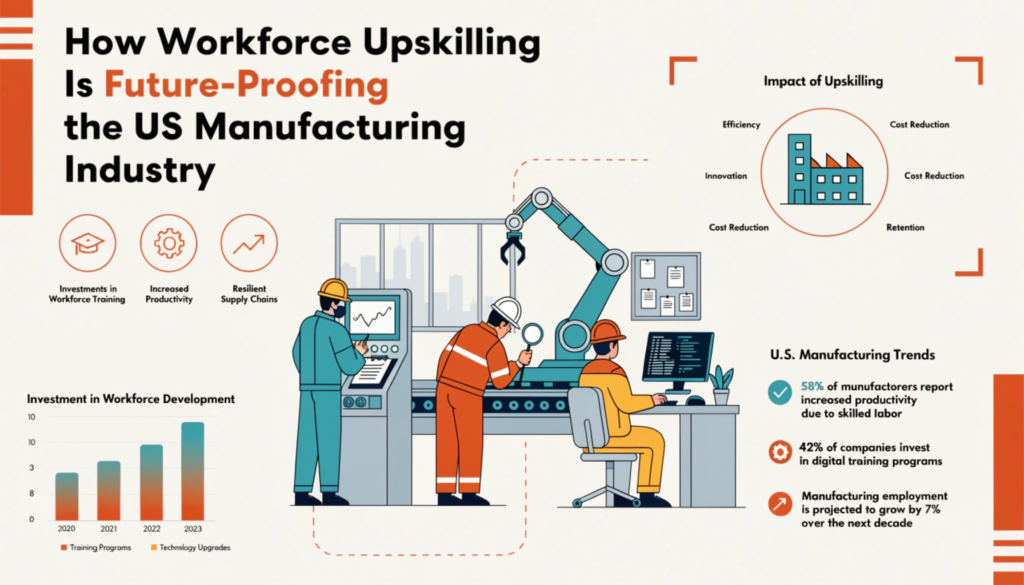
US manufacturing is entering a period of rapid transformation. Automation, artificial intelligence, robotics, connected machinery, advanced analytics, and digital production systems are changing how factories operate and they are also changing the skills workers need to succeed.
For manufacturers, investing in technology is only part of the equation. The real competitive advantage comes from having people who can operate, maintain, analyze, and improve these technologies. This is why manufacturing workforce development 2026 is becoming an increasingly important priority for manufacturers looking to remain productive and competitive.
Instead of relying solely on external hiring to fill emerging technical roles, many manufacturers are focusing on developing the employees they already have. Through structured training, apprenticeships, digital learning, technical certifications, and hands-on technology programs, companies are creating workforces that can adapt to changing production requirements.
The shift toward upskilling manufacturing workers is more than an HR initiative. It is becoming a core component of manufacturing strategy.
Why Manufacturing Skills Are Changing
Traditional manufacturing roles were largely centered on mechanical skills, equipment operation, quality control, and production processes. These skills remain important, but modern factories increasingly require employees to combine traditional expertise with digital capabilities.
A machine operator, for example, may now interact with automated systems, sensors, industrial software, robotics, and real-time production dashboards. Maintenance technicians may need to understand predictive maintenance technologies and analyze equipment data. Production supervisors increasingly need knowledge of automation, analytics, cybersecurity, and digital workflows.
This evolution is creating a significant skills gap.
Manufacturers may have sophisticated equipment, but without trained employees capable of using that equipment effectively, the expected productivity gains can be difficult to achieve.
That is where manufacturing workforce development 2026 becomes critical. Companies are increasingly treating workforce development as a long-term investment that supports technology adoption, operational resilience, employee retention, and business growth.
From Hiring for Skills to Building Skills
For years, manufacturers have attempted to address workforce shortages primarily through recruitment. However, finding employees who already possess every technical skill required by an increasingly digital factory can be challenging.
Upskilling provides an alternative.
Rather than searching exclusively for workers with highly specialized experience, manufacturers can identify employees with strong foundational skills and provide targeted training to help them move into more advanced roles.
For example, an experienced maintenance technician can be trained in industrial IoT, sensor technology, data interpretation, and predictive maintenance. A production employee with strong problem-solving skills can receive training in robotics operation or automation systems.
This approach allows companies to preserve valuable institutional knowledge while adding new capabilities.
Effective upskilling manufacturing workers programs therefore focus not only on what employees currently know but also on the capabilities they will need over the next several years.
Digital Skills Are Becoming Essential
One of the defining characteristics of modern manufacturing is the growing connection between physical production and digital systems.
Factories are increasingly using sensors and connected equipment to collect data about production performance, machine health, energy consumption, quality, and downtime. Employees need to understand how to interact with these systems and use the information they generate.
Digital literacy is consequently becoming an essential part of manufacturing training.
Employees may need to develop skills in areas such as data interpretation, industrial software, digital work instructions, automation interfaces, cloud-connected systems, and cybersecurity awareness.
The objective isn’t necessarily to turn every manufacturing employee into a data scientist or software engineer. Instead, organizations need to make sure workers understand how digital tools support their specific roles.
This practical approach can make manufacturing workforce development 2026 programs more effective because employees can immediately connect training with their everyday responsibilities.
Robotics and Automation Training
Robotics is another major area where workforce skills are evolving.
Industrial robots, collaborative robots, automated guided vehicles, and other automation technologies are increasingly being integrated into production environments. These technologies can perform repetitive and physically demanding tasks, but they still require skilled people to program, operate, monitor, troubleshoot, and maintain them.
This creates new opportunities for employees.
A worker who previously performed a repetitive production task could potentially transition into a robotics operator or automation technician role after appropriate training. Similarly, maintenance professionals can develop specialized capabilities in robotic systems and automated production equipment.
Rather than viewing automation solely as a replacement for manual labor, manufacturers can use workforce development programs to prepare employees for the new roles created by automation.
This is one of the most important principles behind successful upskilling manufacturing workers initiatives.
Apprenticeships Are Gaining Importance
Apprenticeships can provide another powerful pathway for developing manufacturing talent.
Modern manufacturing apprenticeships can combine classroom education with hands-on experience. Employees learn technical concepts while applying them directly to real production environments.
This model can be especially valuable for manufacturers implementing new technologies because training can be aligned with the company’s actual equipment, processes, and operational requirements.
Apprenticeships can also create clearer career pathways. Employees can see how developing specific skills may help them move from entry-level positions into technical, supervisory, or specialized roles.
For manufacturers, this can strengthen internal talent pipelines while reducing dependence on external recruitment.
Cross-Training Creates More Flexible Teams
Another important trend in manufacturing workforce development 2026 is cross-training.
Modern factories need flexibility. Production volumes can change, equipment can be upgraded, and unexpected disruptions can affect operations. A workforce where employees possess only one narrowly defined skill can make it difficult to respond quickly.
Cross-training allows workers to develop capabilities across multiple processes.
An employee might learn equipment operation, quality inspection, basic troubleshooting, and digital monitoring. Another employee might develop skills across multiple automated production cells.
This creates greater workforce flexibility while also giving employees opportunities to expand their careers.
Cross-training can be particularly valuable when combined with automation because workers can understand how different stages of the production process interact.
AI Is Changing the Skills Conversation
Artificial intelligence is also becoming part of the manufacturing workforce discussion.
AI-powered systems can support predictive maintenance, quality inspection, production planning, demand forecasting, process optimization, and other applications. As these technologies become more common, employees will need to understand how AI-generated insights fit into operational decision-making.
Manufacturers do not necessarily need every employee to understand advanced AI algorithms. Instead, workforce training should focus on practical AI literacy.
Employees should understand what AI tools are designed to accomplish, how to interpret their outputs, when human judgment is required, and how data quality affects results.
This human-technology combination will become increasingly important as factories become more intelligent.
Cybersecurity Training Cannot Be Ignored
Greater connectivity also creates new risks.
Connected manufacturing equipment, industrial networks, cloud platforms, and smart production systems can increase operational efficiency, but they can also create cybersecurity vulnerabilities.
Consequently, workforce development needs to include basic cybersecurity awareness.
Employees should understand secure access practices, suspicious activity, password security, data protection, and appropriate procedures for connected industrial systems.
Specialized IT and operational technology professionals will continue to handle advanced cybersecurity responsibilities, but frontline employees also play an important role in protecting manufacturing environments.
Measuring the Success of Upskilling Programs
Investing in workforce development is important, but manufacturers also need to measure whether their programs are producing meaningful results.
Companies can evaluate training initiatives using operational and workforce metrics such as employee retention, internal promotions, productivity, downtime, quality performance, equipment utilization, training completion, and time required to achieve competency.
For example, if employees trained to maintain automated equipment can reduce machine downtime, the business can connect training investment directly to operational performance.
Similarly, if an organization fills more technical positions internally rather than relying on external recruitment, it can measure the impact of its workforce strategy on hiring costs and employee retention.
The most effective manufacturing workforce development 2026 programs therefore connect learning outcomes with measurable business objectives.
Creating a Culture of Continuous Learning
One-off training sessions are unlikely to be enough for a rapidly changing manufacturing environment.
Technology continues to evolve, which means workforce development must become an ongoing process.
Manufacturers can establish continuous learning through short technical courses, digital learning platforms, mentoring, certification programs, hands-on workshops, internal knowledge-sharing sessions, and structured career pathways.
Leadership also plays an important role. Employees are more likely to embrace training when management communicates that learning is part of career development rather than simply another workplace requirement.
A strong learning culture can also improve employee engagement. Workers who see clear opportunities to develop new skills may be more likely to remain with an organization and pursue internal career advancement.
Preparing the Next Generation of Manufacturing Talent
Workforce development also extends beyond existing employees.
Manufacturers increasingly need relationships with community colleges, technical schools, universities, workforce organizations, and industry partners. These relationships can help create pipelines of talent familiar with modern manufacturing technologies.
Programs focused on robotics, automation, mechatronics, industrial maintenance, data analytics, and advanced manufacturing can help students develop relevant skills before entering the workforce.
Manufacturers that participate in these initiatives can also help shape curricula around real-world industry requirements.
This creates a stronger connection between education and employment while helping companies prepare for future talent needs.
The Business Case for Workforce Upskilling
There is a clear strategic reason for manufacturers to prioritize upskilling manufacturing workers.
Technology investments can deliver greater returns when employees know how to use them effectively. Skilled employees can identify production problems, operate sophisticated equipment, improve processes, and adapt to new technologies.
Workforce development can also support resilience.
When companies have employees capable of performing multiple functions and adapting to new technologies, they are better positioned to respond to market changes, labor shortages, technology upgrades, and supply chain disruptions.
Most importantly, workforce development changes the way companies think about talent. Instead of viewing employees only in terms of their current job descriptions, manufacturers can consider their future potential.
The Future of US Manufacturing Depends on People and Technology
The future of American manufacturing will not be defined by automation alone. It will be shaped by the combination of advanced technology and skilled people who know how to use it effectively.
That makes manufacturing workforce development 2026 a strategic priority for organizations preparing for the next phase of industrial transformation.
From robotics and AI to data analytics, cybersecurity, predictive maintenance, and digital production systems, manufacturers need employees who can continuously adapt.
Companies that invest in upskilling manufacturing workers today can build stronger internal talent pipelines, improve technology adoption, increase workforce flexibility, and prepare employees for tomorrow’s manufacturing environment.
The most future-ready manufacturers will therefore not simply ask, “What technology should we buy next?” They will also ask, “What skills will our workforce need to make that technology successful?”
That shift in thinking can become one of the biggest competitive advantages in the evolving US manufacturing landscape.
Connect With the Future of Smart Manufacturing
Industry leaders, technology providers, workforce strategists, and manufacturing professionals can explore the latest developments shaping automation, workforce transformation, and smart manufacturing.
Register as a delegate and connect with professionals working to build the next generation of manufacturing operations.