
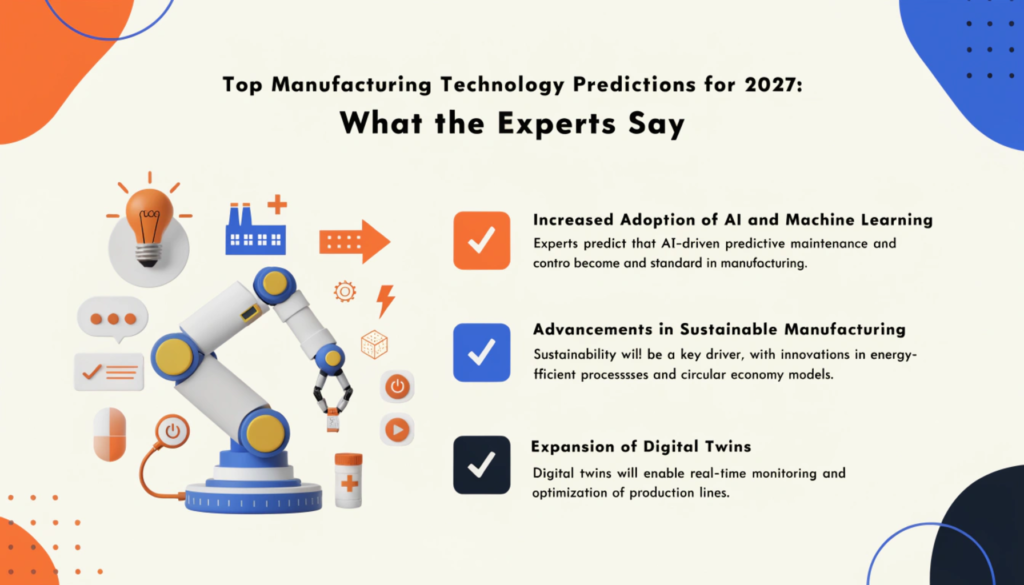
Manufacturing is entering a new phase of technological transformation. Automation, artificial intelligence, connected equipment, robotics, digital twins, advanced analytics and industrial connectivity are moving beyond experimental projects and becoming increasingly important to everyday production.
As manufacturers prepare for 2027, the focus is shifting from simply adopting new technologies to creating connected, intelligent and adaptable operations. Current industry research points toward continued investment in smart manufacturing, AI-enabled operations, automation and data-driven decision-making. Deloitte’s 2025 smart manufacturing survey, for example, found that manufacturers continue to prioritize foundational technologies such as sensors, cloud and edge computing, AI, robotics and simulation. (Deloitte)
This evolving landscape provides an important foundation for the manufacturing technology forecast 2027. While no prediction can be certain, several technology trends are already showing strong momentum and are likely to influence investment and operational strategies throughout the year.
AI Will Move From Manufacturing Experiments to Everyday Operations
Artificial intelligence is expected to become one of the defining technologies of manufacturing in 2027. Rather than being limited to isolated pilot projects, AI is likely to become increasingly integrated into production planning, quality control, maintenance, supply chains and workforce support.
One of the most significant developments is the growth of agentic AI. Unlike conventional AI systems that primarily analyze information or generate recommendations, agentic systems are designed to reason, plan and take actions within defined workflows.
Deloitte identifies agentic AI as an emerging opportunity for manufacturing operations, with potential applications ranging from identifying alternative suppliers to generating shift-handover reports, improving equipment servicing and supporting employees. (Deloitte)
By 2027, manufacturers may increasingly use AI assistants that can monitor production information, identify anomalies, recommend corrective actions and coordinate processes with limited human intervention.
However, successful implementation will depend on more than purchasing an AI platform. Manufacturers will need reliable data, clear governance, cybersecurity controls and employees who understand how to work alongside AI.
Physical AI and Advanced Robotics Will Gain Momentum
Robotics has been a central component of industrial automation for decades, but the next generation of robotics is expected to be more adaptable and intelligent.
Traditional industrial robots are highly effective in structured environments where tasks are repetitive and predictable. Emerging physical AI systems are designed to operate in more dynamic environments by combining sensors, computer vision, AI models and advanced control systems.
Deloitte reported that 22% of surveyed manufacturers planned to use physical AI within two years, compared with 9% at the time of the survey. (Deloitte)
The development of humanoid robots is also attracting significant attention. Recent robotics demonstrations have increasingly focused on practical industrial applications rather than entertainment, including material handling, sorting and assembly. (Reuters)
This does not necessarily mean every factory will introduce humanoid workers in 2027. Cost, safety, reliability and return on investment remain important barriers. However, the technology could become increasingly relevant for manufacturers dealing with labor shortages and difficult-to-automate tasks.
The broader prediction is therefore more important than the specific robot form: manufacturing robots will become increasingly intelligent, flexible and capable of working in less structured environments.
Digital Twins Will Become More Connected to Real Manufacturing Decisions
Digital twins have already become an important part of smart manufacturing, but their value is expected to increase as they become more closely connected to real-time operational data.
A digital twin creates a virtual representation of a physical asset, production line, machine or broader manufacturing system. When connected with sensors, industrial IoT platforms, simulation tools and AI, it can help manufacturers understand current performance and evaluate potential changes before implementing them physically.
Research published in Robotics and Computer-Integrated Manufacturing highlights the convergence of digital twins with AI, industrial IoT, edge and cloud computing, 5G and advanced robotics. (ScienceDirect)
In 2027, manufacturers are likely to use digital twins for applications such as production optimization, predictive maintenance, process simulation, equipment commissioning and workforce training.
The major shift will be from using digital twins simply as visualization tools toward using them as decision-support systems. Instead of asking what happened on a production line, managers will increasingly be able to simulate what could happen if a process, machine setting or production schedule changes.
Predictive Maintenance Will Become More Predictive and Prescriptive
Unexpected equipment failure can create significant costs through downtime, maintenance delays, lost production and missed delivery commitments. Predictive maintenance has therefore become a major smart manufacturing application.
Traditional preventive maintenance relies heavily on schedules—for example, servicing equipment after a specific number of operating hours. Predictive maintenance uses machine data to identify potential failures before they occur.
With better sensors, AI models and edge computing, the next stage will increasingly involve prescriptive maintenance. Systems will not only identify a potential problem but also recommend what should be done, when it should be done and which resources may be required.
This could allow maintenance teams to prioritize high-risk equipment, reduce unnecessary servicing and improve asset availability.
The NIST 2026 roadmap for AI and machine learning in smart manufacturing specifically identifies industrial data analytics, advanced sensing, autonomous systems, digital twins and robotics among the areas shaping the future of intelligent manufacturing. (NIST)
For manufacturers planning their technology strategies, this makes high-quality machine data increasingly valuable.
Edge Computing Will Strengthen Real-Time Manufacturing
Cloud computing has transformed how manufacturers store and analyze data, but factories cannot always depend on sending every piece of information to a remote cloud environment.
Production systems often require extremely fast responses. Edge computing allows data processing to take place closer to machines and production equipment.
This can support real-time monitoring, machine vision, robotics and automated quality control while reducing latency and potentially improving resilience.
The Industry 4.0 outlook 2027 is therefore likely to involve a more balanced technology architecture, where cloud platforms provide broader analytics and coordination while edge systems handle time-sensitive manufacturing processes.
This combination can become particularly valuable as factories generate increasing volumes of sensor and machine data.
Smart Quality Control Will Become More Automated
Quality management is another area where AI and automation are expected to make a significant impact.
Computer vision systems can inspect products at high speed and identify defects that may be difficult to detect consistently through manual inspection. As AI models become more capable, manufacturers can use them to identify patterns across production data and connect quality issues with machine settings, materials or environmental conditions.
The goal is not simply to detect defective products at the end of a production line. Instead, smart quality systems can help manufacturers identify the causes of defects earlier in the process.
Deloitte’s smart manufacturing research shows that quality management remains an important investment priority, alongside manufacturing execution systems and advanced production scheduling. (Deloitte)
By 2027, manufacturers that successfully connect quality data with production data may be better positioned to move from reactive inspection toward continuous quality improvement.
Connected Supply Chains Will Become a Manufacturing Technology Priority
Manufacturing technology is no longer limited to the factory floor. Supply chain visibility is becoming equally important as manufacturers manage changing customer demand, geopolitical uncertainty, supplier risks and transportation disruptions.
AI-powered supply chain platforms can analyze demand signals, inventory levels, supplier performance and logistics information to help organizations make faster decisions.
Manufacturers are likely to increasingly connect procurement, production planning, inventory and logistics systems into a common digital environment.
This means the factory of 2027 may be judged not only by how efficiently it produces goods but also by how quickly it can respond when something changes outside the factory.
Greater supply chain visibility can help manufacturers identify risks earlier and create alternative scenarios before disruptions become production problems.
Industrial Cybersecurity Will Become a Core Investment
As factories become more connected, cybersecurity will become increasingly important.
The traditional separation between information technology and operational technology is becoming less distinct. Machines, sensors, industrial control systems, cloud platforms and enterprise software increasingly exchange information.
This connectivity can improve efficiency, but it also creates additional potential entry points for cyber threats.
Manufacturers therefore need to treat cybersecurity as part of smart manufacturing architecture rather than as an additional layer added after deployment.
In 2027, investments in secure connectivity, identity management, network segmentation, monitoring and employee awareness are likely to become increasingly important as organizations expand their connected production environments.
Sustainable Manufacturing Technology Will Accelerate
Sustainability is also becoming increasingly connected with manufacturing technology.
Energy monitoring systems, smart sensors, AI-based optimization and digital twins can help manufacturers understand how much energy and material their operations consume.
Instead of relying only on monthly or annual sustainability reporting, connected factories can provide more detailed information about energy consumption at machine, line or facility level.
This can help manufacturers identify inefficient processes and evaluate potential improvements.
AI can also support production scheduling and resource optimization, potentially helping manufacturers reduce waste and improve utilization.
The future of sustainable manufacturing is therefore likely to involve a combination of environmental objectives and operational efficiency rather than treating sustainability as a separate business function.
The Workforce Will Become More Technology-Enabled
One of the biggest misconceptions about manufacturing automation is that technology will simply replace workers.
The more likely scenario is a gradual transformation of jobs. Employees will increasingly work with AI assistants, collaborative robots, automated inspection systems and digital work instructions.
Deloitte notes that human capabilities such as creativity, collaboration, critical thinking and adaptability will remain important even as AI changes manufacturing work. (Deloitte)
This makes workforce development a major part of the manufacturing technology forecast 2027.
Manufacturers investing heavily in technology without investing in people may struggle to achieve the expected return. Employees need training to operate, maintain, interpret and manage increasingly sophisticated systems.
The most successful organizations are likely to view technology and workforce development as complementary investments.
Manufacturing Technology Investment Will Become More Selective
Another important prediction is that manufacturers will become more selective about technology investments.
The early Industry 4.0 conversation often focused on adopting as many advanced technologies as possible. By 2027, the emphasis is likely to shift toward measurable business value.
Manufacturers will increasingly ask practical questions: Does this technology reduce downtime? Can it improve quality? Will it increase production capacity? Can it reduce energy consumption? Does it solve a workforce challenge? How quickly can the investment generate value?
This shift toward measurable outcomes is already visible in current manufacturing surveys. Deloitte reports that manufacturers continue to prioritize foundational systems such as production scheduling, manufacturing execution and quality management rather than pursuing emerging technologies simply because they are new. (Deloitte)
This suggests that the leaders of 2027 may not necessarily be the companies with the most technology. They may be the companies that integrate technology most effectively into business strategy.
What the Industry 4.0 Outlook for 2027 Means for Manufacturers
Taken together, these developments suggest that Industry 4.0 is moving toward a more intelligent and interconnected phase.
The Industry 4.0 outlook 2027 is likely to be defined by convergence. AI will work with robotics. Digital twins will connect with real-time factory data. Edge computing will support autonomous systems. Predictive maintenance will connect machine data with maintenance planning. Supply chain platforms will connect external risks with production decisions.
This convergence is more significant than any individual technology.
NIST’s latest smart manufacturing roadmap similarly emphasizes the need to address industrial data, heterogeneous sensing and control systems, trustworthy AI and reliable operation as intelligent manufacturing develops. (NIST)
For manufacturers, the priority should therefore be building a strong technology foundation that can support future capabilities.
Preparing for the Manufacturing Technology Landscape of 2027
Manufacturers preparing for 2027 should begin with their most important operational challenges rather than starting with a technology shopping list.
Organizations can assess where downtime, quality problems, inefficient processes, labor shortages or supply chain uncertainty are creating the greatest business impact. From there, they can identify the technologies capable of addressing those challenges.
Data quality should be treated as a strategic priority. AI, digital twins and predictive analytics are only as effective as the data supporting them.
Manufacturers should also develop an approach to interoperability. New systems need to communicate with existing machines, enterprise software and operational technology environments.
Finally, organizations should build technology roadmaps that combine short-term improvements with longer-term innovation. A practical predictive maintenance project, for example, can provide immediate value while also establishing the data infrastructure needed for more advanced AI applications later.
Conclusion
The manufacturing technology landscape in 2027 is expected to be shaped by AI, advanced robotics, digital twins, edge computing, predictive maintenance, connected supply chains, cybersecurity and sustainable production.
The most important change, however, will not be the arrival of one breakthrough technology. It will be the increasing convergence of technologies into connected manufacturing ecosystems.
The latest research already indicates strong manufacturer interest in smart manufacturing, AI, automation, analytics and connected systems. (Deloitte)
Companies that prepare early can use 2027 as an opportunity to move beyond isolated automation projects and build more intelligent, flexible and resilient operations.
Register Interest for BMA Manufacturing 2027
Want to explore the technologies, strategies and innovations shaping the next generation of manufacturing? Register interest for BMA Manufacturing 2027 and connect with industry professionals discussing smart manufacturing, automation and the future of industrial technology.