
The first half of 2026 has been a defining period for the global data center industry. Artificial intelligence continued to reshape infrastructure requirements, hyperscalers accelerated capacity investments, rack densities climbed, and power availability became an increasingly important factor in deciding where and when new facilities could be built.
At the same time, the industry has encountered several realities that were difficult to ignore. Demand forecasts have moved faster than grid infrastructure, conventional cooling approaches have struggled with AI workloads, and some development plans have been constrained by power, permitting, equipment availability and community concerns.
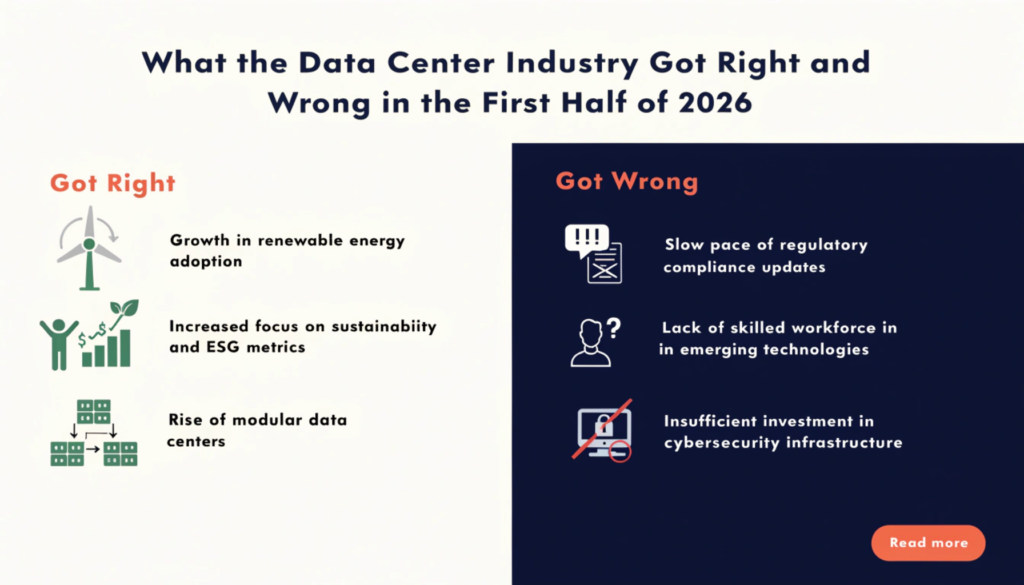
This data center industry review 2026 looks beyond the headlines to assess what the sector got right during the first half of the year and where its assumptions, planning approaches and execution fell short.
AI Demand Was Predicted Correctly but Its Infrastructure Impact Was Underestimated
One of the clearest things the industry got right was recognizing that AI would become a major driver of data center growth.
Hyperscalers, cloud providers and infrastructure developers entered 2026 expecting continued demand for accelerated computing. That expectation proved well founded. The International Energy Agency reports that electricity consumption from AI-focused data centers increased by 50% in 2025, while total data center electricity demand grew by 17%. It also expects global data center electricity consumption to roughly double from 485 TWh in 2025 to around 950 TWh by 2030. (iea.org)
What the industry underestimated was the scale of the infrastructure transformation required to support that demand.
AI is not simply another workload that can be placed inside a traditional facility. High-performance GPU clusters require much greater power density, advanced networking and substantially different thermal-management strategies.
This has changed the definition of a modern data center. Compute capacity alone is no longer enough. Operators must consider power availability, cooling architecture, electrical distribution, network performance and deployment speed as interconnected components.
Power Became the Biggest Reality Check
If there is one area where the first half of 2026 exposed a major planning gap, it is power.
For years, data center discussions often focused on land availability, connectivity and construction costs. In 2026, access to electricity increasingly became the deciding factor.
Dell’Oro Group reported that the global data center physical infrastructure market reached $12 billion in Q1 2026, up 28% year over year, while also identifying access to power as the defining challenge for continued buildout. (prnewswire.com)
This is one of the most important findings in any data center trends analysis today.
A developer can secure land and financing, but without sufficient grid capacity, the project may still face years of delay. That changes how operators evaluate locations. The question is no longer simply, “Where can we build?” It is increasingly, “Where can we obtain reliable power quickly enough to support the workload?”
The industry got this right by increasing attention on energy procurement, onsite generation, renewable power and grid relationships. However, it got one thing wrong: assuming that electricity infrastructure could scale at the same speed as AI investment.
It cannot.
Liquid Cooling Moved From Future Technology to Current Requirement
Another area where the industry made significant progress was cooling.
Traditional air cooling remains appropriate for many workloads, but the rapid increase in AI rack density has changed the equation. High-performance GPUs generate considerably more heat, making conventional cooling approaches increasingly difficult to scale economically.
S&P Global found that 21% of surveyed enterprise data center decision-makers planned to shift to liquid cooling within the following year, compared with 13% in its 2024 survey. Another 25% expected to adopt liquid cooling within two to four years. (spglobal.com)
That represents an important change in mindset.
The industry increasingly understands that cooling should be considered during facility design rather than added as a response to thermal problems later.
Direct-to-chip cooling, liquid distribution systems and hybrid architectures are becoming important tools for supporting higher-density environments.
The mistake was waiting too long to treat cooling as a strategic infrastructure decision. Facilities designed around older assumptions about rack density may require expensive retrofits as AI workloads expand.
The Industry Got Efficiency Right but Efficiency Alone Is Not Enough
Energy efficiency remains a central priority for operators, and this is another area where the sector has made meaningful progress.
Better power distribution, improved cooling systems, more efficient IT equipment and smarter facility controls can all reduce operational overhead.
However, the first half of 2026 has demonstrated an important paradox: greater efficiency does not automatically mean lower total electricity consumption.
AI workloads are becoming more efficient per task, but demand for AI services is growing rapidly. The IEA notes that efficiency improvements have reduced energy use per AI task dramatically, while newer applications such as video generation, reasoning and agentic AI can require substantially more energy than simple text generation. (iea.org)
The lesson is important. Operators should not measure sustainability only through efficiency ratios.
They also need to consider total energy consumption, workload growth, water usage, carbon intensity and the source of electricity.
Sustainability Became Harder to Separate From Capacity Planning
The industry’s sustainability ambitions were strong entering 2026, but the speed of AI infrastructure growth has made execution more complicated.
Large facilities require significant amounts of electricity and, depending on their cooling architecture and local climate, water. As new projects compete for grid capacity and local resources, operators face increasing pressure to demonstrate that growth can occur responsibly.
Research published in 2026 has highlighted how concentrated AI data center load growth can outpace clean-energy deployment in some regions, creating challenges for grid flexibility, reliability and emissions management. (arxiv.org)
The industry got right the idea that sustainability must be integrated into data center planning.
Where it fell short was in treating sustainability and expansion as separate conversations.
The next generation of facilities will need to combine capacity planning with renewable procurement, energy storage, water strategy, heat management and grid coordination from the beginning.
Construction Speed Did Not Match AI Speed
Perhaps the most significant mismatch of the first half of 2026 was the difference between technology development cycles and infrastructure development cycles.
AI models and computing platforms can evolve within months. Data center campuses can take years to plan, permit, connect to utilities and construct.
This creates a fundamental challenge.
A facility designed around today’s AI hardware may need to support very different rack densities and cooling requirements several years later.
The industry therefore needs greater flexibility in facility design. Modular electrical systems, adaptable cooling infrastructure and scalable power distribution can help operators respond to hardware changes without completely redesigning facilities.
The lesson from H1 2026 is straightforward: speed does not simply mean building faster. It means designing infrastructure that can adapt faster.
The Industry Also Got Geographic Strategy Right but for the Wrong Reasons
Data center development is increasingly expanding beyond traditional hubs.
Power constraints, land costs, permitting challenges and infrastructure availability are encouraging developers to consider secondary and emerging markets. Recent European data indicates that hyperscale facilities planned for 2026–2028 are expected to be located much farther from major urban hubs than projects built between 2022 and 2025. (reuters.com)
This geographical shift makes sense.
Emerging markets can offer more land, better power availability and lower development costs. But moving away from established hubs also introduces challenges around network connectivity, workforce availability, latency and local infrastructure.
The industry should therefore avoid treating low-cost land as the primary selection criterion.
The strongest locations will be those that balance power, connectivity, land, permitting, sustainability and long-term scalability.
What the Industry Got Wrong: Planning for Growth Without Enough Flexibility
The biggest mistake of the first half of 2026 may not be a specific technology decision. It is the broader tendency to plan for growth as if the future workload were predictable.
It is not.
AI workloads are changing rapidly. Rack densities are increasing. Cooling requirements are evolving. Power infrastructure is under pressure. Financing conditions can shift. Regulations can change.
Dell’Oro reported that data center physical infrastructure demand remained strong in Q1 2026, but also pointed to project timing and permitting uncertainty. (prnewswire.com)
The better approach is scenario-based planning.
Instead of designing exclusively around one forecast, operators should prepare for multiple scenarios covering different levels of AI adoption, power availability, rack density and workload growth.
What 2026 Should Focus On
The lessons from the first half of the year provide a clear roadmap for the second half.
First, power must become a core component of site strategy. Second, liquid cooling and high-density electrical infrastructure need to be incorporated earlier into facility design. Third, sustainability needs to be measured across the entire lifecycle rather than through PUE alone. Finally, flexibility must become a defining characteristic of new data center infrastructure.
The market is already responding. TrendForce reported in June that AI infrastructure was driving movement from air toward liquid cooling, alongside developments in high-voltage racks and alternative power architectures. (trendforce.com)
The strongest operators will be those that connect these developments rather than treating them as individual technology trends.
Conclusion: The Data Center Industry Is Learning Faster
The first half of 2026 has shown that the data center industry was right about AI, digital infrastructure demand and the need for greater efficiency.
Where it underestimated the future was in the speed and scale of the physical infrastructure transformation.
Power, cooling, networking, land, sustainability and construction timelines are no longer separate data center considerations. They are parts of one interconnected infrastructure challenge.
That is ultimately the biggest takeaway from this data center industry review 2026. The winners in the next phase of growth will not necessarily be the organizations that build the biggest facilities. They will be the ones that can secure power, deploy efficiently, manage heat, control environmental impact and remain flexible as AI requirements continue to evolve.
For infrastructure leaders looking to exchange practical insights on these challenges, industry events can provide an important platform for learning, networking and identifying emerging solutions.
Enquire about BMA conventions to connect with industry professionals and explore the latest developments shaping data center facilities and infrastructure.