
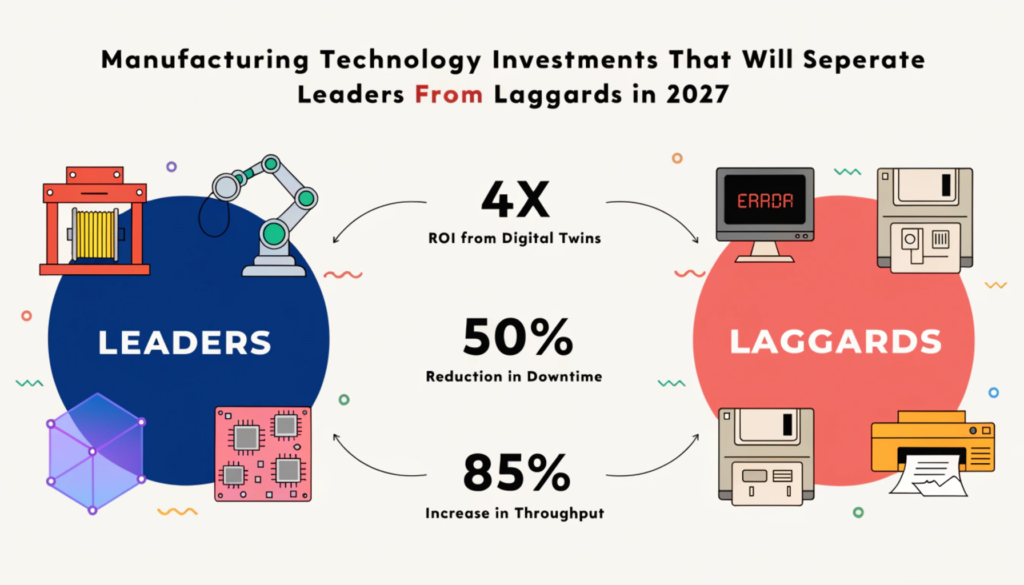
Manufacturing is entering a decisive period where technology investment will increasingly determine which companies can compete on cost, quality, speed, resilience, and sustainability. As manufacturers move deeper into digital transformation, simply purchasing new machines or adding isolated software tools will no longer be enough. The real advantage will come from connecting technologies, data, people, and processes into a coordinated manufacturing ecosystem.
For manufacturers planning their manufacturing technology investment 2027 strategy, the key question is no longer whether to adopt smart technologies. It is where to invest first, how to integrate those investments, and how quickly they can deliver measurable operational value.
The leaders of 2027 are likely to be manufacturers that treat technology spending as a long-term business strategy rather than a collection of disconnected IT or automation projects. Meanwhile, companies that delay modernization or invest without a clear roadmap risk falling behind competitors that can produce faster, operate more efficiently, and respond more effectively to changing customer expectations.
Why Manufacturing Technology Investment Will Matter More in 2027
Manufacturers are dealing with increasingly complex operating environments. Supply chain disruptions, labor shortages, energy costs, changing customer requirements, pressure for faster production, and sustainability expectations are influencing investment decisions.
At the same time, technologies such as artificial intelligence, industrial Internet of Things (IIoT), robotics, digital twins, cloud platforms, advanced analytics, and industrial automation are becoming more practical for everyday manufacturing operations.
This means technology investment is moving beyond experimentation. Manufacturers are increasingly looking for solutions that improve specific business outcomes, including higher productivity, lower downtime, better quality, improved asset utilization, and greater visibility across operations.
A successful manufacturing technology investment 2027 strategy therefore needs to focus on business value. Companies should ask whether a technology can solve an existing operational challenge, integrate with current systems, scale across facilities, and provide measurable returns.
1. AI and Advanced Analytics Will Move Higher on the Investment Agenda
Artificial intelligence is expected to become one of the most important areas of manufacturing technology spending.
Manufacturers generate enormous volumes of information from machines, production lines, quality systems, maintenance platforms, enterprise software, and supply chain processes. The challenge is converting this information into useful decisions.
AI-powered analytics can help identify patterns that may be difficult to detect through traditional reporting. Manufacturers can use these capabilities to support predictive maintenance, quality monitoring, production planning, demand forecasting, and process optimization.
The competitive advantage will not necessarily come from simply implementing an AI platform. It will come from identifying high-value use cases and connecting AI to reliable operational data.
Companies should therefore prioritize data quality, governance, integration, and employee capabilities alongside AI investments.
2. Smart Factory Connectivity Will Become a Core Priority
A smart factory cannot operate effectively when machines, systems, and departments remain isolated.
Connectivity will therefore become one of the most important smart factory spending priorities for manufacturers preparing for 2027. IIoT sensors, industrial networks, edge computing, cloud platforms, and integrated manufacturing systems can help organizations create a more connected production environment.
Instead of relying on manually collected information, connected factories can provide near-real-time visibility into equipment performance, production conditions, energy consumption, and quality indicators.
This visibility enables managers to identify problems earlier and make decisions based on current operational conditions.
However, manufacturers should avoid creating another layer of disconnected technology. Connectivity investments should support interoperability and allow data to move effectively between operational technology and enterprise systems.
3. Robotics and Automation Will Expand Beyond Repetitive Tasks
Industrial robots are no longer limited to traditional repetitive manufacturing applications. Advances in collaborative robotics, machine vision, autonomous systems, and intelligent automation are expanding the range of tasks that can be automated.
In 2027, manufacturers are likely to focus more heavily on flexible automation that can adapt to changing production requirements.
Robotics can support material handling, assembly, inspection, packaging, palletizing, and other repetitive or physically demanding activities. Collaborative robots can also work alongside employees in applications where full automation may not be practical.
The strongest investment strategies will not view automation as a replacement for the workforce. Instead, automation can help employees move toward higher-value activities while improving consistency and productivity.
4. Predictive Maintenance Will Become a Bigger Competitive Advantage
Unplanned downtime can disrupt production schedules, reduce asset utilization, and create additional operating costs.
Predictive maintenance technologies use equipment data, sensors, analytics, and machine-learning models to identify signs of potential equipment problems before failures occur.
For manufacturers, this can change maintenance from a reactive activity into a more proactive process.
Instead of waiting for equipment to fail or relying only on fixed maintenance schedules, organizations can use condition-based insights to determine when intervention may be required.
For companies evaluating their manufacturing technology investment 2027 priorities, predictive maintenance should be considered particularly where equipment downtime has a significant effect on production and revenue.
5. Digital Twins Will Help Manufacturers Test Decisions Before Implementation
Digital twins can provide virtual representations of physical assets, production lines, facilities, or processes. Their value comes from allowing manufacturers to model and evaluate scenarios before making expensive physical changes.
For example, manufacturers can use digital models to examine production layouts, equipment utilization, process changes, or capacity requirements.
This can support better planning while reducing the risks associated with major operational changes.
Digital twins are especially valuable when combined with real-time operational data. The more accurately the virtual model reflects actual factory conditions, the more useful it can become for decision-making.
However, manufacturers should first establish clear use cases rather than creating digital twins simply because the technology is available.
6. Cybersecurity Must Become Part of Every Technology Investment
As factories become more connected, cybersecurity becomes an operational priority rather than solely an IT concern.
Connected machines, industrial control systems, remote monitoring platforms, cloud applications, and supplier connections can expand the potential attack surface of manufacturing organizations.
Manufacturers investing in digital transformation should therefore consider cybersecurity from the beginning of every project.
Security should be integrated into connected equipment, networks, access controls, data platforms, remote-access systems, and third-party technology relationships.
In 2027, manufacturers that prioritize cybersecurity alongside automation and connectivity will be better positioned to protect operational continuity and digital assets.
7. Energy Management and Sustainable Manufacturing Will Influence Spending
Energy efficiency is becoming an increasingly important consideration in manufacturing investment decisions.
Smart meters, connected equipment, energy-monitoring platforms, automation systems, and analytics can provide greater visibility into energy consumption across production environments.
Manufacturers can use this information to identify inefficient processes, monitor consumption patterns, and evaluate opportunities to reduce unnecessary energy use.
Sustainability technology should not be treated as a separate initiative from operational improvement. In many cases, reducing energy waste can also improve cost efficiency.
This makes energy management an increasingly relevant component of smart factory spending priorities.
8. Cloud and Edge Computing Will Support Faster Decision-Making
Manufacturers need technology architectures that can process information where and when it is most useful.
Cloud computing can support centralized data storage, enterprise-wide analytics, collaboration, and scalable applications. Edge computing, meanwhile, enables data processing closer to machines and production processes.
The two approaches can complement each other.
Manufacturers may use edge computing when low-latency processing is important while using cloud environments for broader analytics, data management, and enterprise applications.
The goal should not be choosing between cloud and edge technology. Instead, manufacturers should develop an architecture that supports their operational requirements.
9. Workforce Technology Will Become Just as Important as Machine Technology
Technology transformation cannot succeed without people who understand how to use, manage, and improve new systems.
One of the biggest mistakes manufacturers can make is investing heavily in equipment and software while underinvesting in employee training.
Workers increasingly need skills related to automation, data analysis, digital systems, robotics, cybersecurity, and technology-enabled problem-solving.
Manufacturers should therefore include training and change management in their technology investment plans.
The most successful organizations will build a workforce capable of working alongside advanced technologies rather than treating digital transformation as a purely technical project.
10. Integration Will Separate Leaders From Laggards
Perhaps the most important investment principle for 2027 is integration.
A manufacturer may have robotics, AI, sensors, cloud software, predictive maintenance, and digital dashboards, but these technologies will have limited strategic value if they operate independently.
Leaders will increasingly focus on creating connected technology ecosystems.
For example, machine data could feed into an analytics platform, which identifies a potential equipment issue, triggers a maintenance workflow, updates production planning, and provides management with visibility into the operational impact.
This kind of integration creates significantly more value than isolated technology deployments.
Companies should therefore evaluate every new investment based on how well it fits into their broader technology architecture.
How Manufacturers Should Prioritize Technology Spending in 2027
Not every manufacturer needs to invest in every emerging technology.
The best approach is to begin with business challenges and then identify the technology capable of addressing them.
Manufacturers can evaluate potential investments based on several factors: expected operational impact, implementation complexity, integration requirements, scalability, employee readiness, cybersecurity considerations, and potential return on investment.
A phased approach can also reduce risk. Organizations can begin with a focused pilot, measure results, identify lessons, and then scale successful solutions across additional production lines or facilities.
This approach helps prevent large technology investments from becoming expensive experiments.
Manufacturers should also establish measurable KPIs before implementation. Depending on the project, these could include downtime, throughput, cycle time, scrap rates, energy consumption, quality performance, labor productivity, or overall equipment effectiveness.
The objective should always be measurable improvement rather than technology adoption for its own sake.
The Biggest Mistakes to Avoid in 2027
Manufacturers preparing their technology strategies should be careful about several common mistakes.
The first is investing in technology without a clearly defined business problem. New technology can be impressive, but if it does not solve an important operational challenge, its long-term value may be limited.
The second is ignoring legacy systems. Many factories operate with a combination of modern and older technologies. A successful transformation strategy must account for integration rather than assuming every existing system can simply be replaced.
The third is focusing only on hardware. Software, data infrastructure, cybersecurity, training, and process redesign are equally important.
Finally, manufacturers should avoid measuring success only by whether a project was completed. Technology investments should be evaluated based on the business outcomes they produce.
What Will Separate Manufacturing Leaders From Laggards?
The difference between manufacturing leaders and laggards in 2027 will not simply be the amount of money they spend on technology.
Leaders will invest strategically.
They will connect technology investments to measurable business objectives, prioritize scalable solutions, strengthen their data foundations, train employees, and continuously evaluate performance.
Laggards may continue purchasing isolated technologies without creating an integrated roadmap. They may delay modernization until competitors have already established advantages in productivity, flexibility, quality, and operational resilience.
The most competitive manufacturers will understand that digital transformation is not a one-time project. It is an ongoing process of improving how factories operate, how employees make decisions, and how technology supports business growth.
Conclusion
The manufacturing technology investment 2027 landscape will be defined by smarter, more connected, and more integrated factories. AI, advanced analytics, robotics, IIoT, predictive maintenance, digital twins, cybersecurity, energy management, cloud infrastructure, and workforce technologies will all play important roles.
But technology alone will not create competitive advantage.
Manufacturers that win in 2027 will be those that prioritize investments based on business value and integrate individual technologies into a broader smart manufacturing strategy. They will use data to make faster decisions, automation to improve productivity, connected systems to increase visibility, and digital tools to build more resilient operations.
For manufacturers planning their next stage of transformation, the time to define those priorities is now. Understanding where the industry is heading and which technologies can deliver meaningful operational value can make the difference between simply keeping up and becoming a technology leader.
Enquire About BMA Conventions
Want to explore the technologies, strategies, and investment priorities shaping the future of manufacturing? Enquire about BMA conventions and connect with industry professionals, technology experts, and decision-makers focused on smart manufacturing and automation.